


If you missed last week’s Notadeepdive, catch up here.
TOGETHER WITH CREDIT DIRECT

This term, Credit Direct Checkout is going all the way with you.
Get up to N1,000,000 to purchase iPads, laptops and other school essentials from over 500 merchants.
Fixed and Fibre
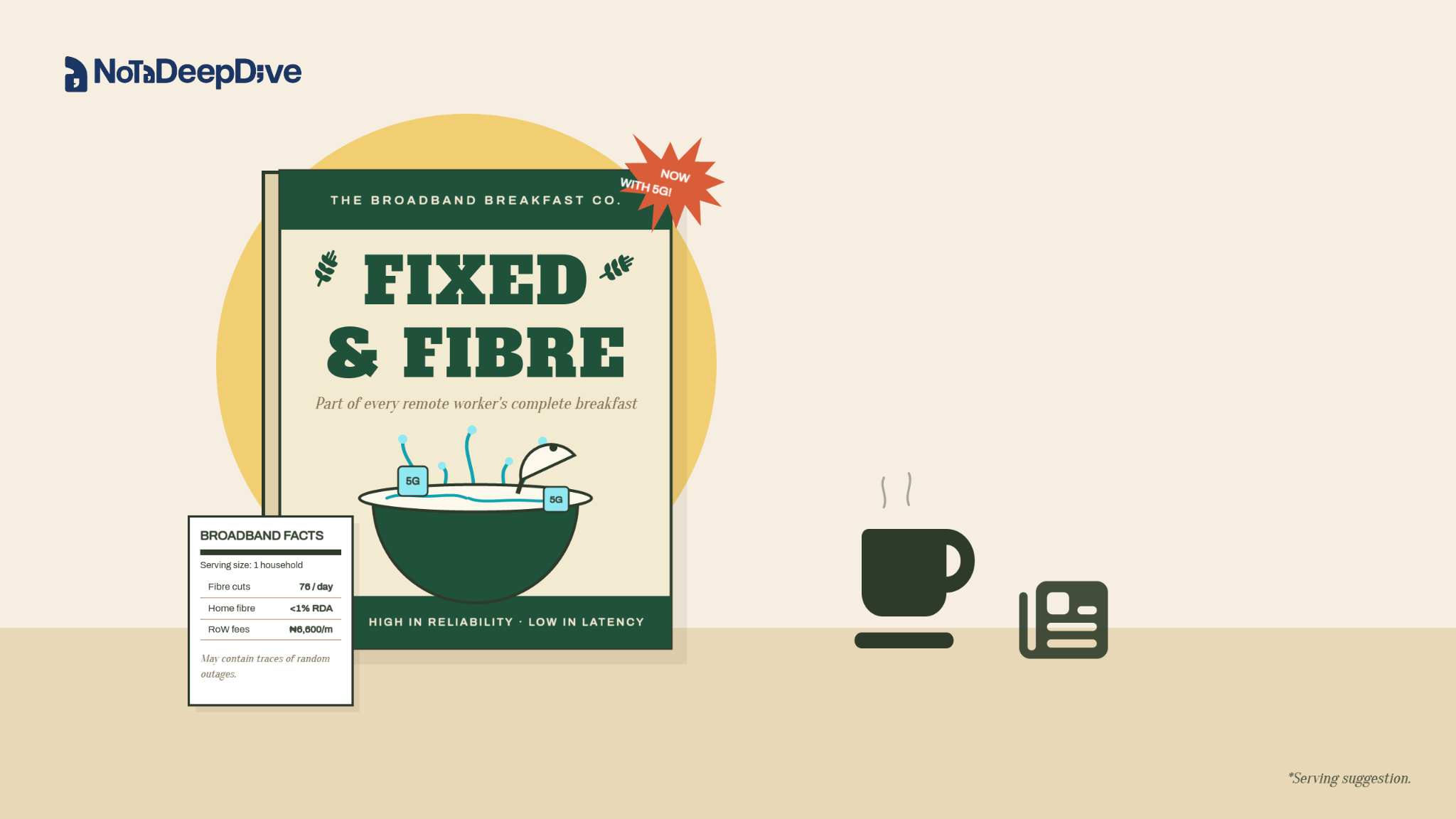
This week, in my quest for truly uninterrupted internet, I added MTN’s FlyX, an outdoor 5G router, to my existing Starlink connection.
This kind of internet stack is common among Nigerians who work remotely. Some people will use FibreOne and MTN, Spectranet and FibreX—you get the drift. No serious person who wants to hold down a remote job for long relies on one connection.
A country where remote workers treat backup internet as basic equipment should be a great market for home broadband. Less than 1% of the country’s estimated 38.7 million households have any fibre connection; almost all of Nigeria’s 124.4 million broadband subscriptions in July were mobile lines.
It sent me down a rabbit hole of trying to understand the market.
Telcos never stopped investing
In 2016, when NCC fined MTN Nigeria ₦1.04 trillion over unregistered SIM cards, the telco invested over ₦196 billion in its network. It even kept spending through a second recession and the 2020 COVID pandemic.
Fast forward to 2024, and MTN spent ₦444 billion ($350m) on its network, up from ₦361 billion ($850m) two years earlier, with naira devaluation reducing the amount spent in dollar terms. Capital expenditure also fell to 13.2% of service revenue as the company posted a ₦400 billion loss.
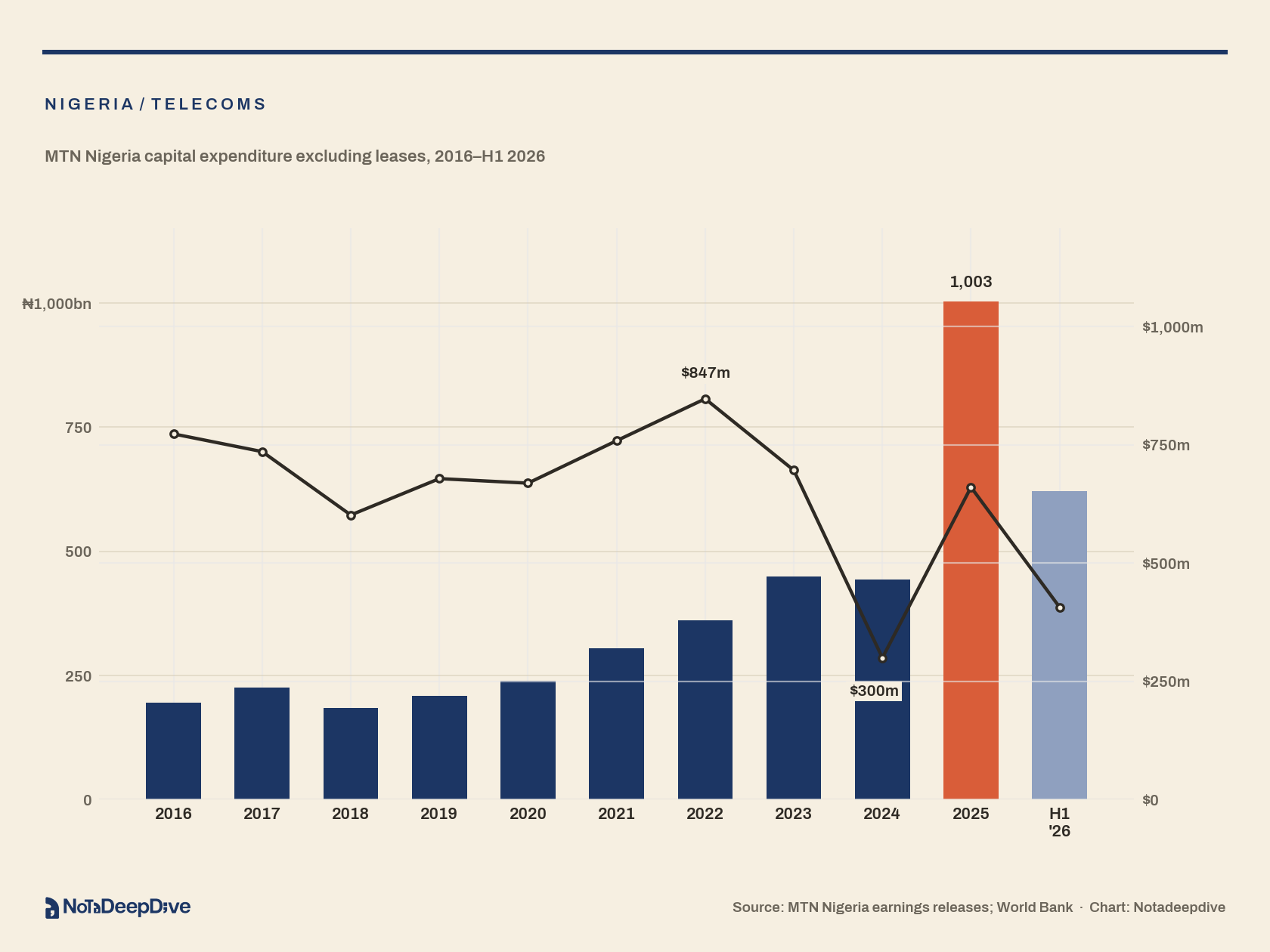
The 50% tariff increase in 2025 gave MTN room to spend ₦1 trillion ($660m) on its network and another ₦620.5 billion ($400m) in the first half of this year. “Now that we’ve got a business case to make those investments, we will continue to make those investments,” Modupe Kadri, MTN Nigeria’s CFO, said in March.
The telcos zero in on homes
MTN has run a fibre-to-the-home business for about a decade, first branded MTN Fibre Broadband, before jazzing it up as FibreX in April 2025. For most of that decade, it had only a few thousand subscribers, even as mobile customers continued to grow annually.
The fibre-to-the-home business has been sluggish because for a long time, it made little commercial sense to telcos. When telcos spend money on mobile capacity, they reach millions of people who are already paying for data (data traffic was growing by more than 40% annually).
Fibre-to-the-home requires digging up a road to reach a few hundred homes, many of which may not pay ₦30,000 a month for the connection. Operators also pay right-of-way fees to lay cables and spend more money to fix cable cuts caused by road contractors and vandals. Next to the mobile business, the addressable market for home broadband is (but not for long!) a rounding error.
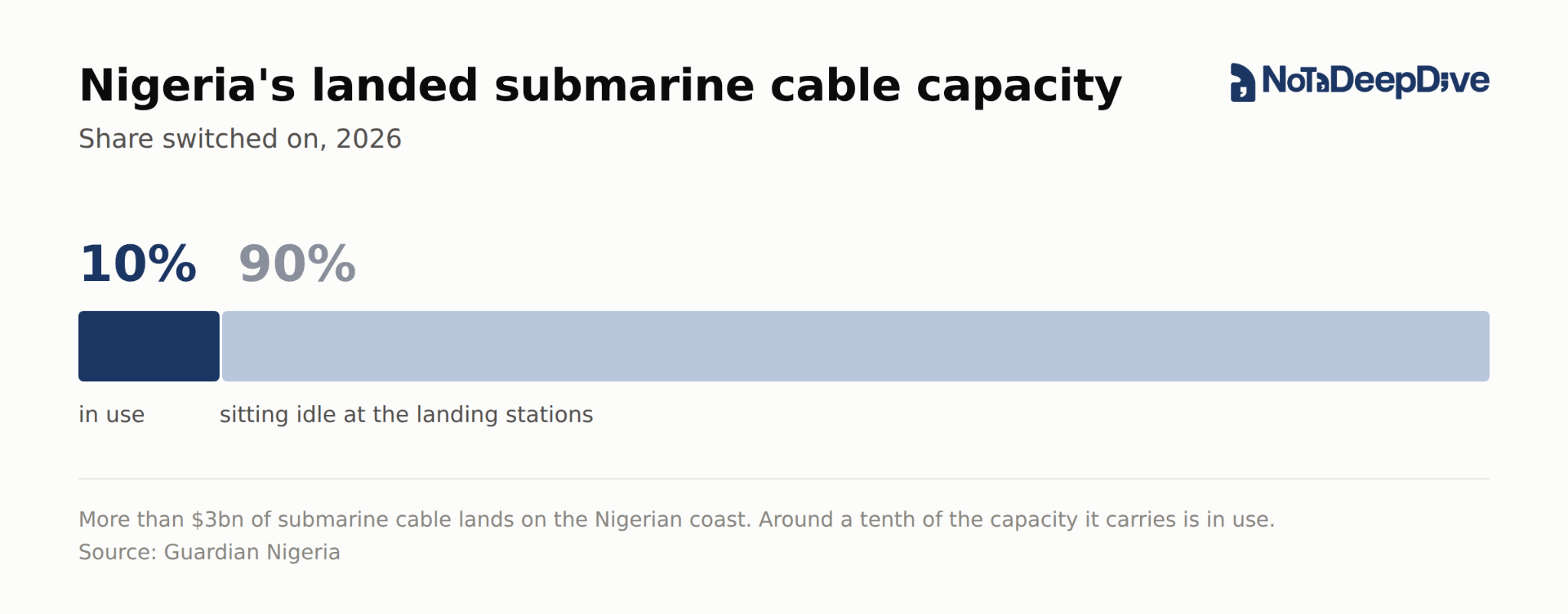
A fibre connection is the last in a chain of four networks. The first is international capacity, i.e., the submarine cables that connect Nigerian networks to the rest of the internet. At least eight submarine cable systems land in Nigeria, including MainOne, Glo-1, Equiano and 2Africa, so this end of it is pretty much solved.
From where those cables land, you need a national backbone to move internet capacity between cities; Nigeria’s existing capacity is roughly 35,000 kilometres, and Minister Bosun Tijani’s ambitious Project BRIDGE plans to add 90,000 kilometres to that.
The last two networks in the chain, metro fibre and fibre-to-home, are where Nigeria struggles. An operator laying fibre across Nigerian cities has to negotiate right-of-way fees with state governments.
Yaba’s emergence as a technology cluster was thanks in part to the Lagos state government’s agreement to waive right-of-way fees for MainOne to lay fibre in 2013.
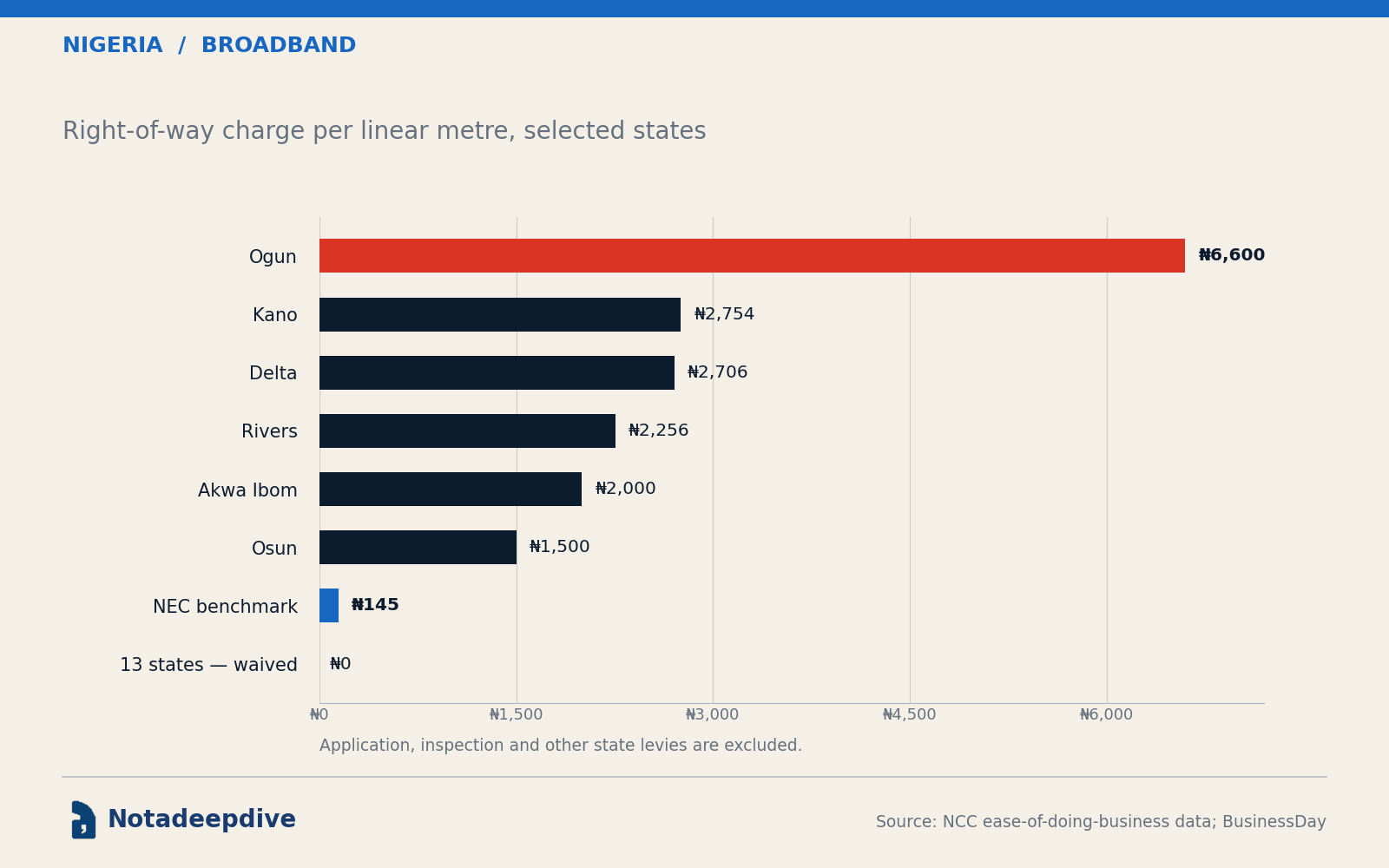
While the National Economic Council recommends that states charge ₦145 per metre for RoW fees, only 19 states comply with that recommendation. Many states are unwilling to give up such a sweet revenue source.
Ogun charges ₦6,600 per metre while Kano charges ₦2,754 before application and inspection fees. Telcos have cited these costs as a deterrent to fibre network expansion in Nigeria, but they’re now rethinking that stance because of demand patterns.
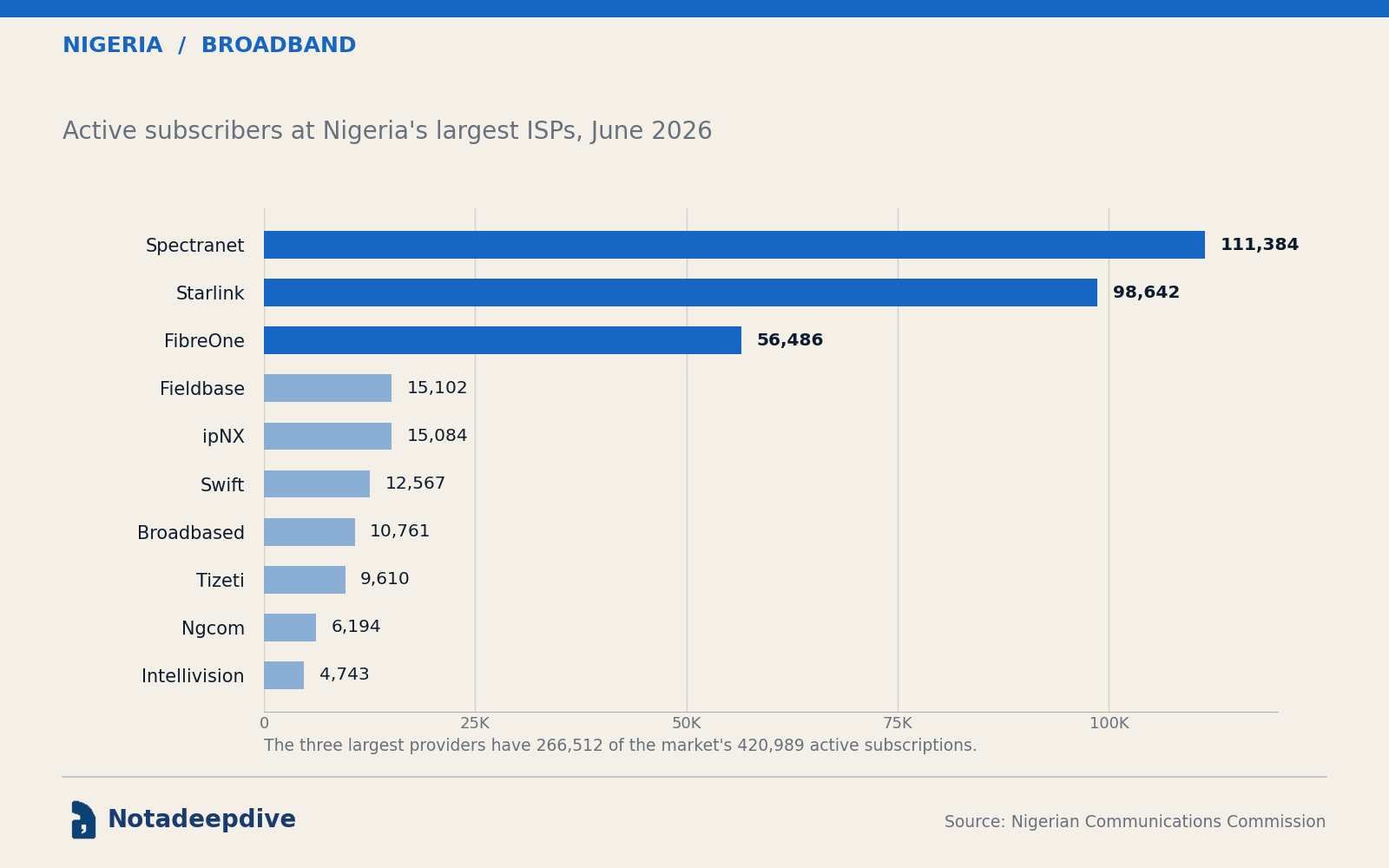
Starlink, the country’s second-largest internet service provider excluding the telcos, went from 11,207 subscribers in 2023 to 98,642 by June 2026. Almost 100k Nigerians are willing to pay ₦57,000 a month for internet that works; imagine the demand at something like half the price.
MTN’s FibreX (30k a month with free installation- not an ad!) grew from 89,441 subscribers in January this year to 176,468 by June, giving it 55% of a national fibre market of 319,735 connections. FiberOne, the next largest, has 56,486.
Cable cuts
The NCC recorded 27,685 fibre cuts in 2025 (roughly 76 a day), alongside 27,000 cases of operators being denied access to their sites and 4,210 thefts. Another 5,934 cuts were recorded in the first half of this year, most of them caused by road construction and excavation. MTN Nigeria CEO, Karl Toriola, claimed Nigeria records more fibre cuts in a day than Saudi Arabia records in a year.
Anyone looking to scale fibre to eight million homes must make their peace with the massive headache that will come with it.
Safaricom, with a large mobile-money business and a much older home-fibre operation, connects about half the homes its network passes. It had passed 807,016 Kenyan homes by March and connected 407,080 of them. At that conversion rate, eight million homes passed would mean four million connections, roughly ten times Nigeria’s entire home-broadband market today.
Consolidating at the top, fragmenting at the bottom
According to data from the NCC, 124 of the 148 licensed internet providers have fewer than 2,000 customers. 97 have fewer than 500 customers.
It’s tempting to conclude that smaller players should prioritise mergers. Merging three 800-subscriber ISPs gives you one 2,400-subscriber ISP that can share fixed costs. Curiously, the business models of the small ISPs suggest they want to remain small.
The typical small ISP is an estate business focusing on finding places where the last mile is short, and permission comes from one person, i.e., the estate developer. Once they have access to a cluster of residents and assurance that private security will protect their equipment, they’re fine. They’re not looking to go national.
That strategy may be working; 125 small providers added 47,400 subscribers between them in six months, and the NCC has licensed six new ISPs this year. The market is consolidating at the top and fragmenting at the bottom.
The government tried to solve this fragmentation problem at the bottom by licensing seven infrastructure companies to build open-access fibre networks across the country, but by the end of three years, none had become fully operational. Operators told BusinessDay that a promised ₦3 billion subsidy was not paid.
According to Aminu Maida, the NCC’s chief executive, “Nigeria has fibre across the states, but what we lack is a fair access market.” Existing routes are often owned by companies that built for themselves, with inconsistent pricing that makes it difficult for smaller providers to lease them.
There are cheaper ways to build the missing links into homes. Safaricom strings much of its feeder fibre on power poles, above the road crews responsible for most Nigerian fibre cuts. There’s no equivalent national framework that allows telecom operators to attach fibre to electricity distribution poles here. Nigeria has spent years agreeing what it should cost to dig but has paid less attention to whether every cable needs to be buried.
Two broadband plans, seven infrastructure licences and eight submarine cables have brought fibre within a few hundred metres of many Nigerian buildings. Getting into homes is an expensive undertaking that telcos have historically avoided; the clear commercial opportunities are now forcing them to make a big play for it.
See you on Sunday!
Nice callout on the fragmentation problem.
They should sha consolidate for knowledge transfer purposes.
97 ISPs with 500 customers or estates is just us reinventing the wheel and not making any technological advancements.
I don't understand why the "fragmentation" of the small providers is a problem when neither the businesses nor their customers are complaining.
I stay in an estate and make use of SmartCiti, probably one of those small providers, and my complaints are very few to non-existent.