


If you missed Friday’s newsletter, catch up here. If this email was forwarded to you, subscribe here for free:
TOGETHER WITH CREDIT DIRECT

That phone. That watch. The gadget you keep removing from your cart.
With Credit Direct Checkout, 25% down is all it takes to go from browsing to owning.
Let’s start a tech publication

Everyone and their daddy believes they should start a tech media publication.
The thinking is that reporters at existing publications don’t have sufficient expertise. Stories miss important context, and most of the analysis is shallow.
So every year or so, people who work in the technology ecosystem toy with the idea of assembling a newsroom of top reporters to produce better work and eventually become the publication.
I have written about the problems with that argument, so I will not rehash them. The more interesting question is what happens after someone assembles that newsroom and has to pay those reporters monthly.
I’ve been thinking about that since reading Techpoint Africa in the last two weeks.
Techpoint was founded in 2015 to explain Nigeria’s nascent technology industry to a wide audience, using office tours, founder profiles and accessible reporting. It has published important stories and built one of the category’s most recognisable brands.
Yet, since at least November 2024, one of its most prolific reporters has been Artificial Intelligence.
PointAI, Techpoint’s AI author, produces news using a mixture of public sources and Techpoint’s data, after which a human reviewer checks the work. At the time of writing, PointAI has 338 articles to its name. That’s almost certainly more stories over the period than any other reporter at the publication.
Techpoint’s masthead lists a five-person editorial team. Chimgozirim Nwokoma, listed as a senior reporter, is now a senior reporter at Condia. Bolu Abiodun, another senior reporter on the masthead, last published on Techpoint in May. Oluwanifemi Kolawole, one of the publication’s longstanding bylines, last published there in December 2024. There are still active human reporters at Techpoint, but it’s likely a tinier team than what an already small masthead suggests.
If the newsroom is small but the story count has not noticeably slipped, then PointAI is worth discussing. AI can write adequate news updates, so that question is settled. But why does a newsroom’s output have to keep the same pace when a smaller newsroom could simply publish less?
In an interview with Communique, Techpoint CEO Muyiwa Mátùlúkò committed to quadrupling Techpoint’s startup coverage over five years. That commitment is a window into how Nigerian tech media works.
An AI byline is an interesting choice for a media publication because credibility is the asset a publication sells or extends to publishers. It builds credibility through the reporters whose names repeatedly appear in bylines and the important stories they produce.
Readers learn which journalists understand a beat and a difficult story carries weight partly because of a reporter’s reputation.
But credibility is expensive, and finding ways to pay for it is work in progress. Big Cabal Media, TechCabal’s parent company, cut 19 per cent of its workforce in 2023.
In a tenth-anniversary account Techpoint published in 2025, a dramatic revenue decline in October 2023 led to salary cuts of up to 70 percent instead of layoffs. The company was still operating at 60 percent capacity well into 2024. In October 2025, its parent company, Businessfront, laid off an undisclosed number of employees, citing long-term sustainability and strategic focus.
The original bargain
Most Nigerian tech publications begin with roughly the same model. Hire a small newsroom, publish every day, build an audience, and then convert the audience into pageviews. They sell those pageviews to advertisers and use the advertising revenue to pay the newsroom, which—stay with me here—produces more stories that attract even more readers.
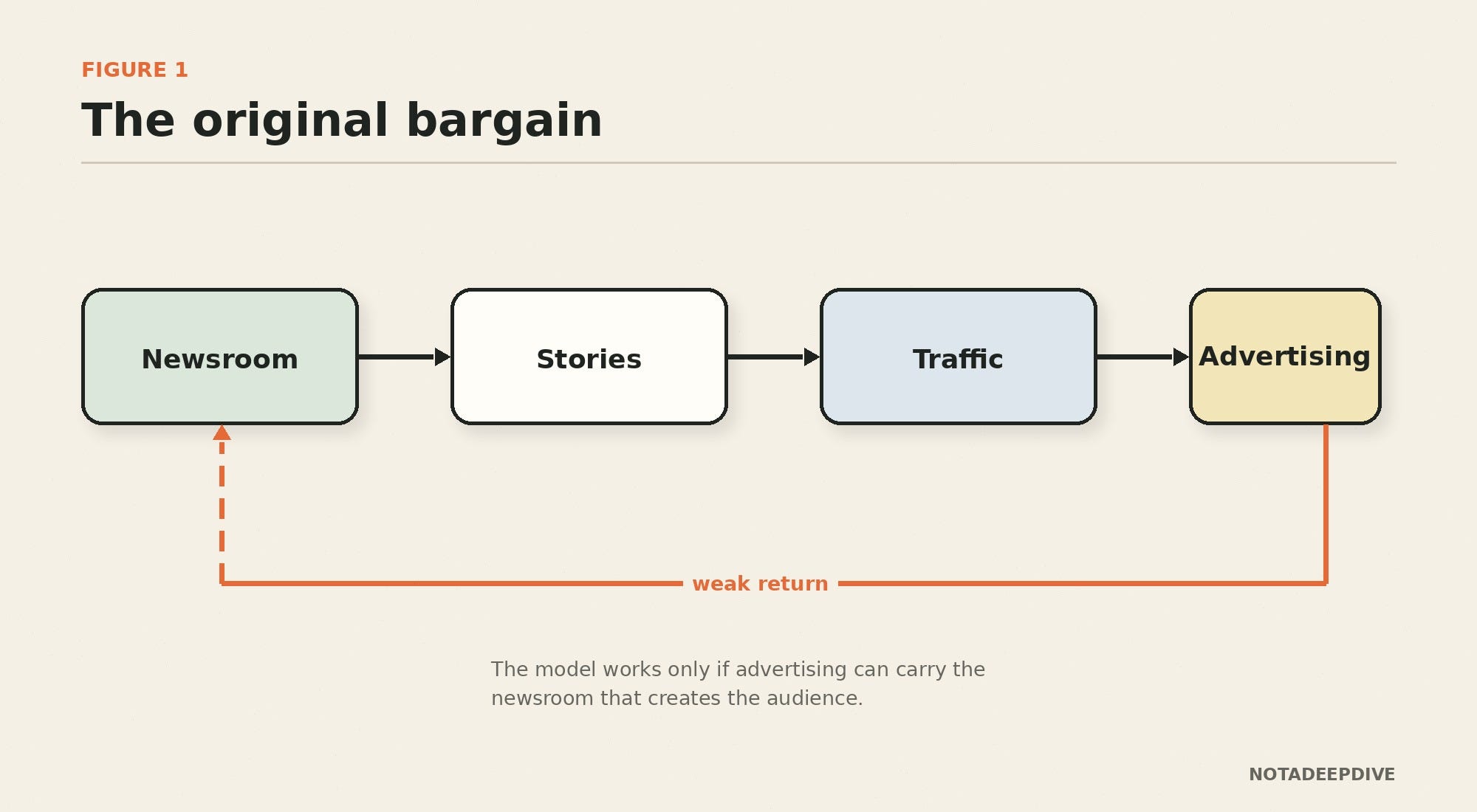
The model always runs into a set of problems, which are amplified when a publication is niche.
The Nigerian technology audience is valuable but not especially large, so the number of companies with a reason and a budget to advertise to that audience is modest. Programmatic advertising rewards enormous scale, which niche business publications do not have.
Direct advertising pays better, but costs more to sell. You’ll hire salespeople and maintain relationships. Crucially, you’ll need to find a steady supply of companies willing to spend money.
The way out of this problem is expanding the surface area of things a publication can sell.
The publication already knows that website advertising cannot support the newsroom it wants. What it does not know is which adjacent product will. So it launches a newsletter, a podcast, native social video, a research arm, and an events business.
TechCabal’s Moonshot has become an important commercial product. At Semafor, events now produce roughly half of revenue. The company reported $40 million in revenue and $2 million in EBITDA in 2025, its first full year of profitability.
Finding a vertical that works
The problem with expanding the surface area of your publication is that there’s no guarantee you will find something that works quickly.
A podcast needs hosts, production, distribution and a sales proposition before it has an advertiser. Video needs equipment, editors and enough consistent output to learn what audiences want. An event is worse, requiring venue deposits, vendors, programming, sponsor sales and months of staff time before anyone knows whether the room will be filled.
Every new surface for revenue is also a new surface for losses.
Techpoint began hosting events in 2017. ‘Techpoint Inspired’ was followed by ‘Techpoint Build’, town halls, a fintech summit and a blockchain conference. Some became meaningful parts of the brand and attracted sponsorship.
In 2023, the company tried to extend the formula into human resources with Modern Workplace Africa. Mátùlúkò told Communiqué it failed to reach the intended audience and was not profitable. It put its events business on hold the following year.
That experience shows that “events” is not really a business model. A recurring conference with a recognised audience, returning sponsors and an operating team that knows how to deliver it is a business model. The first edition of an event in a new vertical is a bet.
Media is also a herd business. Once one publication proves that a conference, research arm or specialised newsletter can make money, others cluster around the same model. They approach the same sponsors, invite many of the same speakers and compete for the same attendees’ limited time.
What looks like a proven revenue line may still be a bad business for the fifth publication that attempts it.
This herd effect is intensified by how concentrated the pool of buyers is. A publication may have six different products while selling all six to much the same group of banks, telcos, fintechs, venture firms and global technology companies. Diversification on the product side can conceal concentration on the customer side.
Success with an experiment or vertical ironically produces more problems. When one experiment finally succeeds, its profits subsidise the newsroom. It also finances the podcast that has not found an audience, the video unit that has not found a sponsor and the second event that management insists needs one more year.
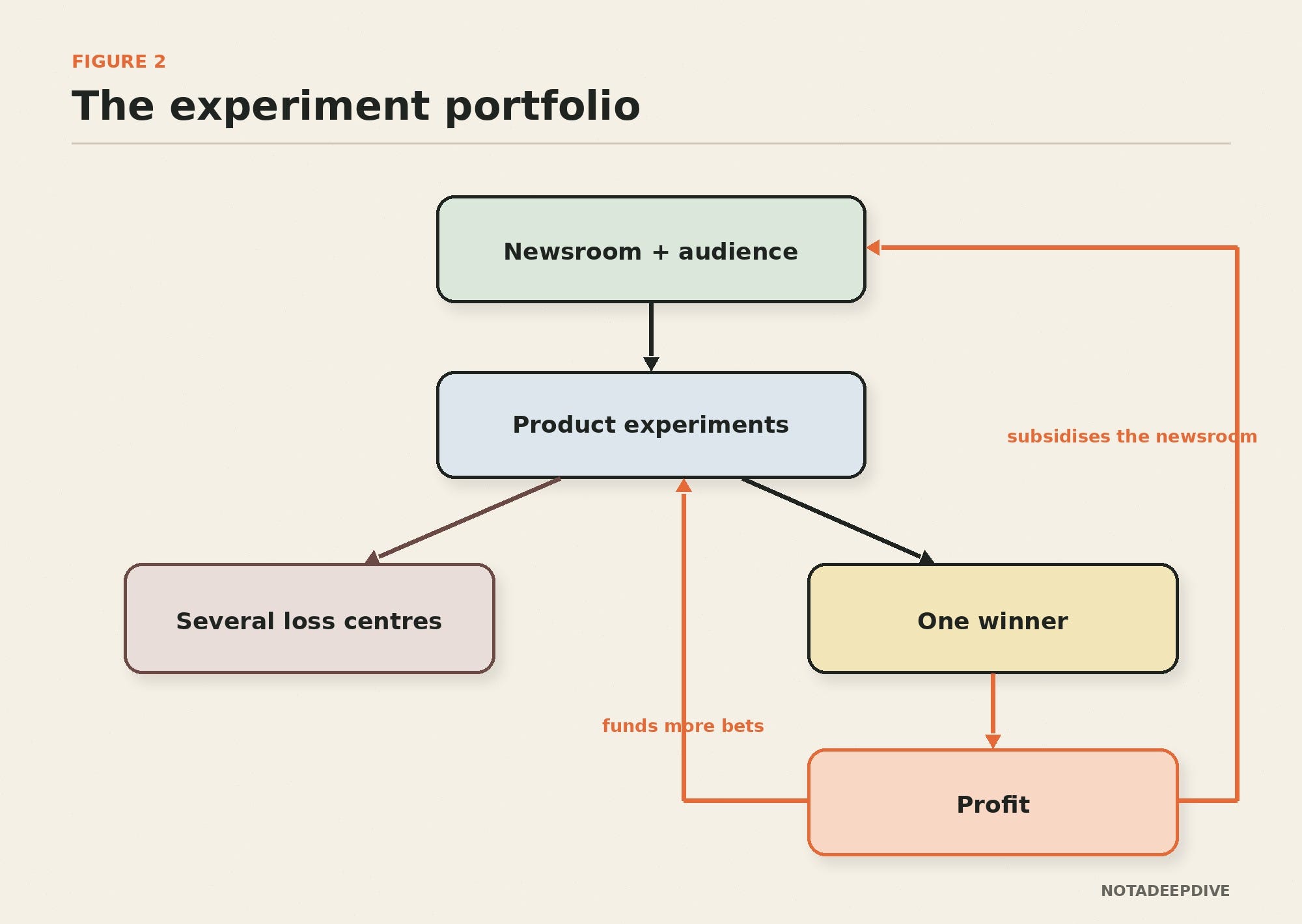
It’s difficult to know if a failed product is fundamentally bad, mistimed, or poorly executed. Abandoning an experiment is great financial discipline, but it may also mean abandoning the next Moonshot just before it clicks.
Once a company has one profitable product, it can afford to postpone that decision to kill a product. The winner extends the runway of every other loser.
The accounting of newsrooms only compounds the complexity. An event may appear profitable because the reporters who developed its programme, recruited its speakers and attracted its audience are already counted as newsroom costs.
A video unit loses money while making a larger sponsorship package possible. The newsroom acts as marketing for the event, and the event pays for the newsroom. Management is not choosing among a collection of self-contained profit-and-loss statements.
Execution complicates the decision further. Editorial credibility may persuade people to attend the first conference or take a meeting about a research project, but it does not automatically give a publication expertise in venue operations, enterprise sales, sponsor fulfilment, video production or product management. A media company can have the correct strategy and still lose money because it has built five businesses it does not yet know how to operate.
These experiments also draw on the same management attention, sales relationships, and institutional reputation. A poorly executed conference can weaken a sponsor relationship that the newsletter depends on. A podcast without an audience can still consume the editor who should be improving the newsletter. The loss centres do not always sit harmlessly beside the winner; they can make the winner worse.
The challenge, then, is not simply to expand the surface area of things that can be sold. It is to find the money-spinner before the search for it consumes the company and then to decide how many other experiments that money-spinner should be required to carry.
Three jobs, one newsroom
A small editorial team must publish frequently enough to maintain a habit, quickly enough to remain relevant and deeply enough to earn respect. Those are three different jobs.
Daily news has become a commodity that supplies search traffic. But since every publication receives the same press release and watches the same regulator, there is a sameness to daily news.
Analysis is slower. It requires a reporter who has covered a beat long enough to know what is unusual, sources who will explain what is missing from the announcement, and an editor willing to let the article take several days. Investigations are slower and more uncertain. They can consume weeks and end with nothing publishable.
A large publication solves this by having enough reporters to do several things at once. Nigerian tech publications typically ask the same small cast of reporters to perform all these roles.
The daily news obligation wins because tomorrow’s homepage cannot be filled with the investigation that might be ready next month. The newsroom produces the work that keeps the machine alive, even though the work that gives the publication its reputation is the work the machine leaves least time to produce.
Two demand curves
Articles face at least two demand curves: the demand for attention and the demand for payment.
A recent working paper by Gregory Martin, Shoshana Vasserman and Cameron Pfiffer examined four years of activity at a large American metropolitan newspaper: 605 million article visits, 1.2 billion user sessions and more than 55 million paywall encounters.
Soft news produced traffic, but Hard news—local politics, public health and the local economy—produced a greater willingness to pay.
The estimated willingness to pay for the average Local News article was roughly twice that of the average Entertainment article. A newsroom optimised for advertising would allocate staff differently from one optimised for subscriptions.
Yet, the paper found that even the strongest subscription-producing sections could not cover their staffing costs with digital subscription revenue alone.
In Nigeria, the advertising market is thinner, and reader revenue is constrained by incomes, payment friction and the abundance of free alternatives. A niche publication can have a deeply influential audience without having enough people willing and able to pay a recurring subscription that supports a large newsroom.
As we’ve seen with a handful of publications, paywalls can capture more money from loyal readers while shrinking the reach that makes sponsorship attractive. Keeping everything free preserves reach while leaving the publication dependent on advertisers.
That is why arguments about whether Nigerian readers “value journalism” are pointless. Readers can value a product, advertisers can value its audience, and neither will add up to the cost of producing the product at the desired quality and frequency.
Even willingness to pay is not the same thing as willingness to pay enough.
This is why the hunt for a money-spinner is existential and why it often changes what the company sells.
The business behind the publication
Consider an event. On paper, an event is another format for editorial content: interviews happen on a stage rather than in an article. Economically, it is a different product because a sponsor is paying for a room full of potential customers, speaking time for an executive, private access to founders, recruitment leads, product demonstrations and the status of appearing at the centre of an industry conversation.
Research and consulting follow a similar path. A publicly available article gives many readers a general understanding of a market. A commissioned report gives a client an answer to a specific question. The client pays far more because the information is tailored, scarce, and useful to a decision.
Branded content sells production and credibility; executive profiles signal status while awards sell recognition. Each of these surfaces sells a seat near the industry or some version of it. A bank that pays for a keynote slot is not buying an article.
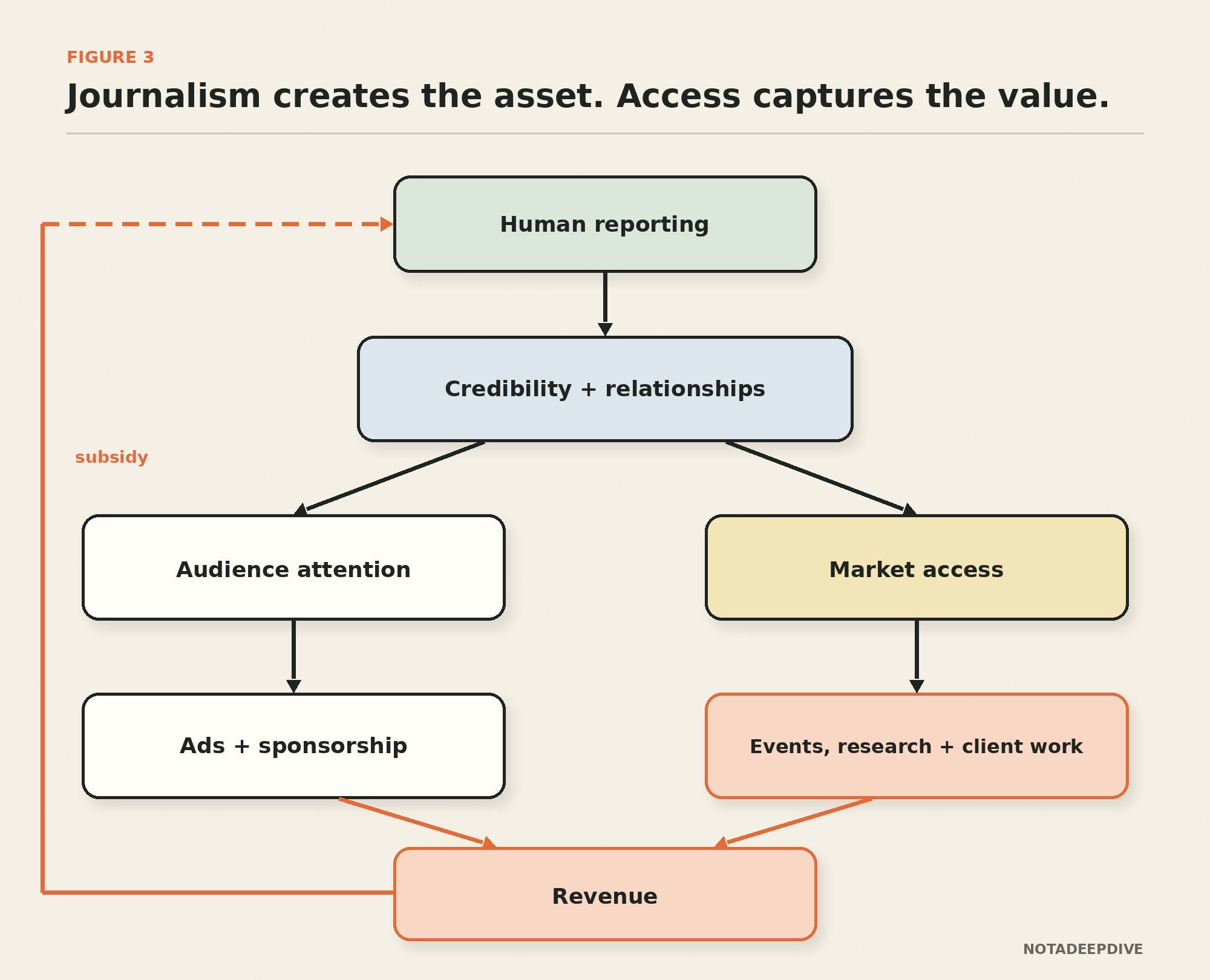
Techpoint’s monthly Pitch Friday meetup began as a community product, but a NAMIP case study says founders who attended later returned as paying sponsors. The event also fed an investor newsletter and the flagship Techpoint Digest. Direct revenue from subscriptions or event tickets was limited; the relationships produced sponsorships and other business opportunities.
TechCabal has built an insights business that offers research and consulting to development institutions, financial institutions, technology companies, startups, governments and investors. Its Moonshot conference sells sponsorship, exhibitions and proximity to the African technology ecosystem. Technext has built conferences around cryptocurrency and financial technology. Across the category, the pattern is that a newsroom creates an audience and a position in the industry; the rest of the company tries to turn that position into something a client can put in a budget.
A good investigation may change how founders behave, help an investor avoid a bad company, give a regulator a clearer picture of an industry, and make thousands of readers better informed. The publication cannot send each beneficiary an invoice but an event can charge a sponsor for a booth.
Journalism creates the asset and access captures the value.
This explains why a profitable Nigerian tech publication often becomes, in economic terms, a market-access company with a newsroom attached.
The website is the public face and underneath it sits a mixture of sponsorship sales, event production, research, data, branded work and corporate relationships. It creates a peculiar internal arrangement where the part of the company with the greatest prestige is not necessarily the part with the highest revenue.
A peculiar tension follows from that arrangement. Editors want reporters to produce work the industry cannot ignore. Commercial teams want products clients will buy this quarter. Management wants the newsroom to publish every day, build the brand, support events, moderate panels, appear in sponsored videos and somehow find time for the investigation that will prove the publication still matters. Even success can feel like losing the argument about what the company was built to do.
The subsidiser has a cycle
I’ve argued before that the industry’s thinness changes editorial relationships. Reporters, founders, investors and communications people know one another, meet in the same rooms and often disagree over whether a story has enough “context.” Context becomes a negotiation over meaning.
The company being covered may be an advertiser, an event sponsor, a research client, a source, and the employer of a future speaker. The publication does not need to promise favourable coverage for the structure to matter. Commercial dependence works through softer channels: which relationship can survive a difficult headline, which sponsor is considered “strategic,” how much senior management time goes into repairing offence, and how quickly an editor learns that a technically defensible story can still create a commercial problem.
In a large market, the loss of one advertiser is painful, but in a thin market, the same loss can remove a meaningful share of an event budget.
It also means technology publications inherit the funding cycle of the industry they cover. When venture money is abundant, startups hire aggressively, launch products, sponsor conferences, buy employer-brand campaigns and pay to be associated with growth. Investors and professional-services firms want access to the same founders. Banks and telcos want to look innovative. The ecosystem’s optimism becomes media revenue.
When funding slows, those budgets are among the easiest to cut. Startups stop buying visibility and start extending runway. Investors need fewer large events to meet founders. Global companies trim local marketing. The publication still has salaries, rent, and the obligation to publish tomorrow morning.
Techpoint’s 2023 experience, a failed vertical and 70 percent salary cuts, shows how these risks converge. Its response was a broader parent company and a new business-media strategy: Finance in Africa, Energy in Africa and Intelpoint alongside Techpoint, modelled in part on the specialist-publication logic of Industry Dive.
A portfolio of publications is only diversified if the customers and revenue cycles are meaningfully different. Otherwise, it is a larger production system resting on adjacent versions of the same corporate budget.
See you next week!
Wish this went further to calculate how much it costs to run an AI newsroom member