


If you missed last week’s Notadeepdive edition, catch up here.
TOGETHER WITH CREDIT DIRECT
Black Friday is discount season and Credit Direct Checkout makes it easier. Get up to ₦1M in shopping credit to shop unbeatable discounts across 500+ merchants with only a 25% downpayment.
Shop for phones, laptops, TVs, fridges, freezers, washing machines, microwaves, blenders and air fryers without emptying your account.
Best of all, you qualify for the raffle draw to win a Solar Power Tank when you use Checkout between now and December 1st.
OPay in orange clothing?
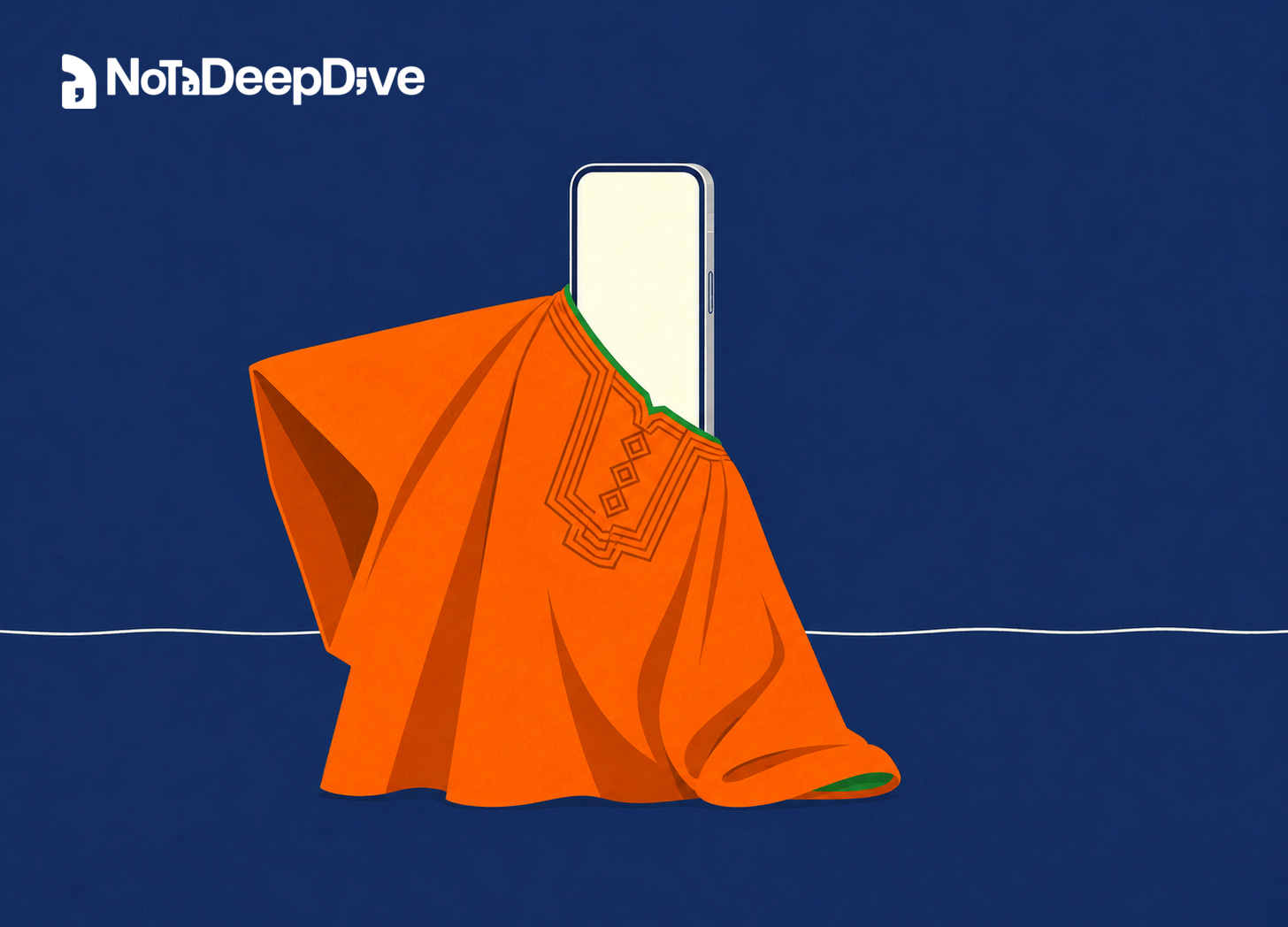
In May, Segun Agbaje, who runs one of Nigeria's most profitable banking groups, said he was no longer afraid of fintechs. It tracked, given that HabariPay, which GTCO set up a few years ago, is now the most profitable fintech owned by a Nigerian bank. This month, the orange bank went looking for a second win with the launch of an app it is calling 737.
Anyone who remembers the catchy *737# jingle from back in the day will get the naming, although USSD codes are on a fast track to the grave. GTBank processed ₦2.15 trillion through USSD in the first half of 2021 and only ₦413 billion in the first half of this year, a fall of 81% in five years. 737 is now being reborn as an app with big hopes that lets you use your phone number as your account number and offers loans and super competitive rates on savings. It even found time to slap on a "fund your betting account" feature.
Why is GTBank, which already has three million long-suffering users on GTWorld, turning to yet another app, and one that is pretty much OPay in orange clothing?
The cheap naira is leaving
Around here, I often say the trick to being a profitable Nigerian bank is to find people who will keep their deposits with you and ask for very little in return. GTBank has made this an art form; it pays an average interest rate of 1.8% a year to depositors, most of whom hold savings and current accounts.
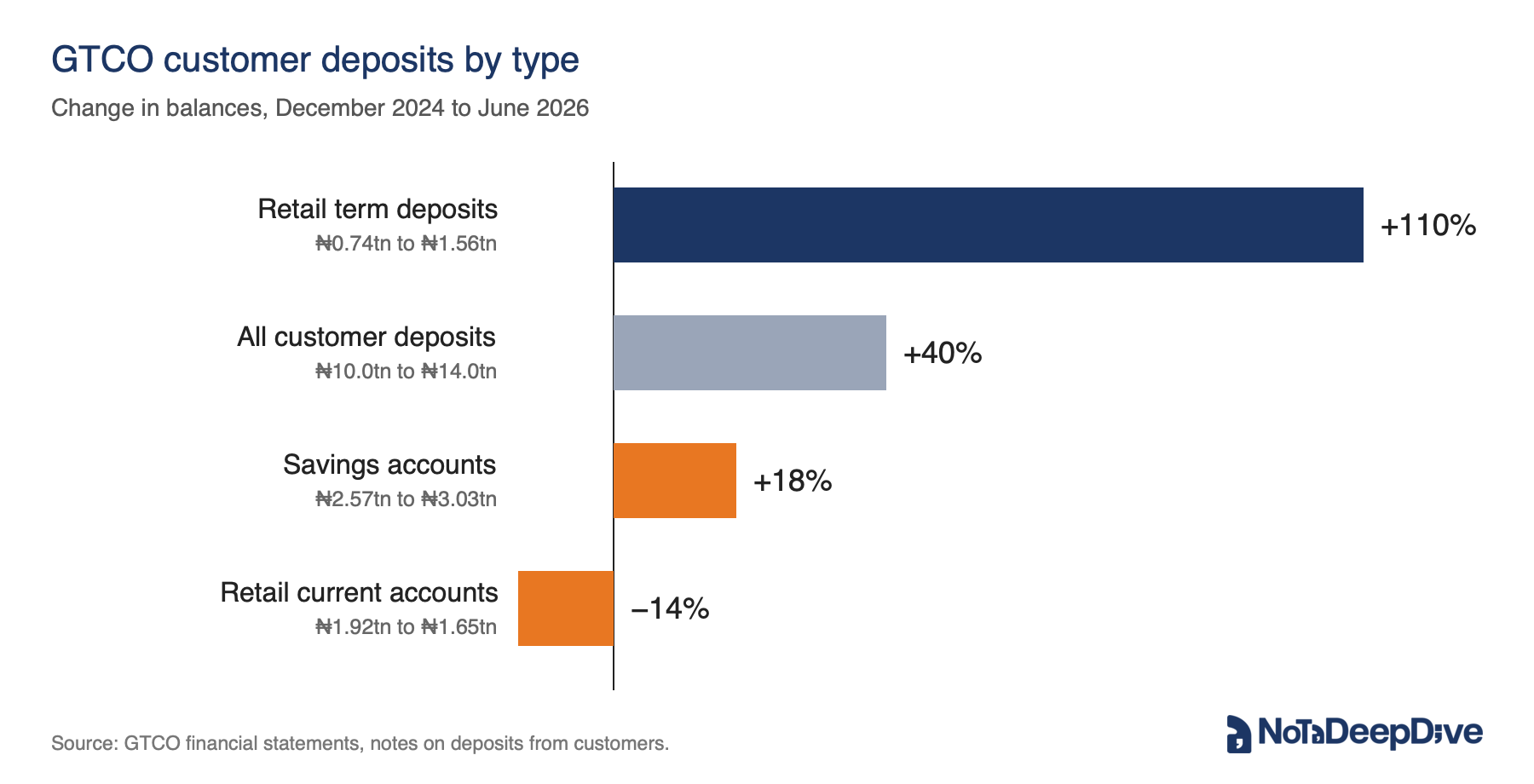
Between December 2024 and June 2026, GTCO's total deposits grew 40%, but savings balances grew only 18% and barely moved at all in the first six months of this year. Retail current accounts, which earn no interest, shrank 14%. Term deposits, which pay something close to what a treasury bill pays (15.9%), have doubled.
Banks pay so little interest on savings accounts because, while the CBN mandates a rate of about 7% a year, you earn nothing in any month where you make more than four withdrawals. If you live from salary to salary, as most people do, you can immediately see the problem.
Another reason bank apps are losing the war to become a daily habit for millions of customers is the growing popularity of bank transfers. Nigerians pay for almost everything by transfer, whether that is the supermarket, the bus or the woman roasting corn at the junction. When transfers are how you pay, you keep your spending money in the app whose transfers never fail, and for tens of millions of people that app is OPay, Moniepoint or PalmPay.
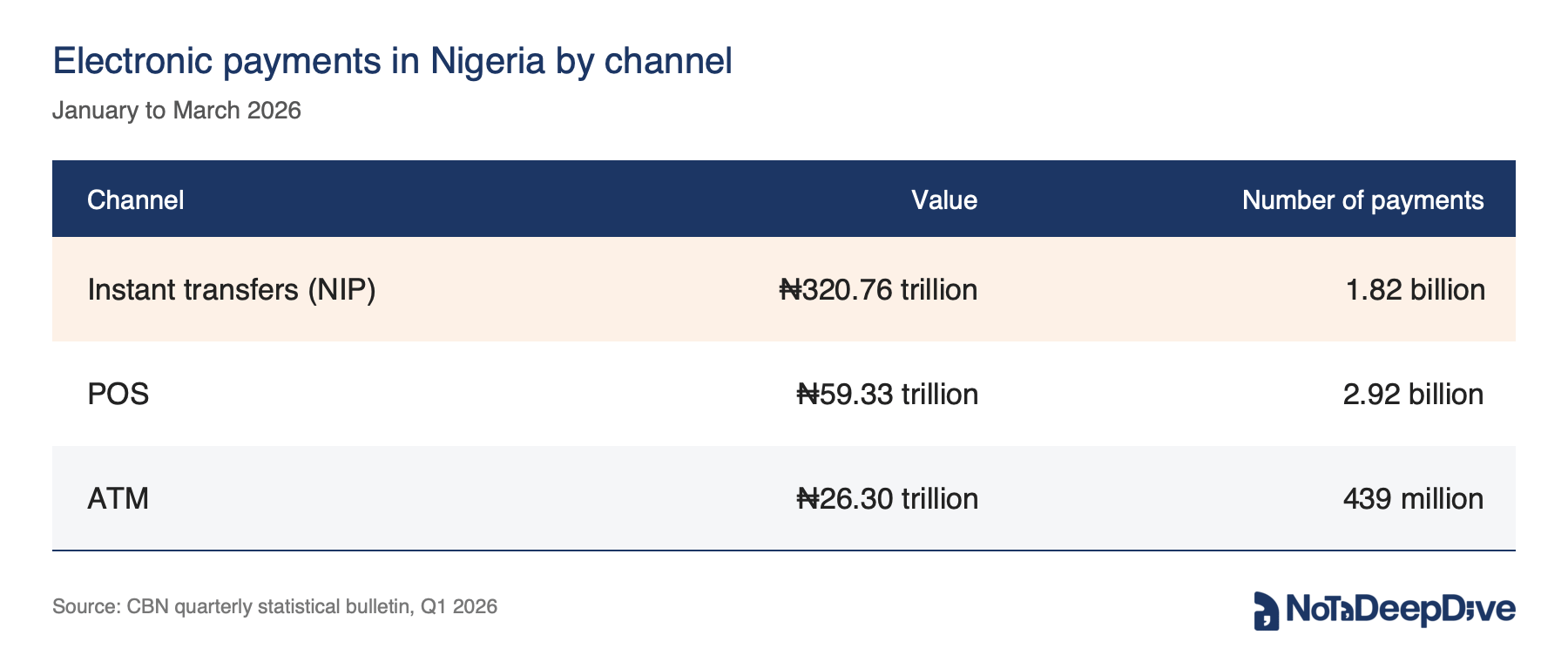
Piggyvest and Cowrywise, meanwhile, have spent years popularising the idea that your savings should earn more, and have basically educated customers not to leave balances sitting idle in a bank. So when the apps built on fast transfers wanted to grow deposits, they simply offered Piggyvest-type rates, 15% and up, in apps people already open ten times a day.
The fintechs are winning the habit war, but the deposit figures remain lopsided: microfinance banks, the licence OPay, Moniepoint and PalmPay all operate under, hold ₦3.85 trillion in deposits against the banks' ₦111 trillion. That might not be so for too long. With all of these apps offering yield on every kind of savings and deposit (Credit Direct, which sponsors this newsletter, advertises about 15% on money you can still withdraw and about 21% on money you lock away), the GTBank customer will certainly want more.
Of course, customers can already get market rates through GT Fund Managers, the group's asset manager, although I wonder how many people with small balances would ever think to call a fund manager. Those who do are keeping it busy. Balances there grew from ₦858 billion to ₦1.39 trillion in the first half of this year, and because the group counts them as deposits, they account for much of that jump in term deposits. Agbaje described it in May as "losing it to ourselves within our ecosystem", which is a cheerful way of saying that in the first nine months of 2026, GTCO's deposits rose 9.4% while the interest it paid on them rose 42.5%.
A rate GTBank cannot pay everyone
If GTBank offered 15% on savings on GTWorld, all ₦3.07 trillion of its savings balances would earn it, including the money of millions of customers who are fine with earning no interest. That works out to roughly ₦245 billion in extra interest every year, or about a fifth of what the group made before tax in 2025.
No bank wants to pay that, so it makes sense to tempt yield-hunting customers with another app that GTBank will hope also becomes a daily habit. TechNext's review of the 737 app found its Flex Savings product paying 15% a year, which happens to be the rate the fintechs advertise.
737 is a very different bet from HabariPay. Habari went after payments revenue that GTCO did not have, whereas 737 exists to hold on to deposits the bank already has, and more cynical people than me could read it as a defensive move.
Now you have to lend
In October I wrote that GTCO does not have to lend. When deposits cost you under 2% and the government pays you far more than that to hold its treasury bills, chasing borrowers is extra work for very little extra reward, and GTCO's loans are still less than a quarter of its deposits.
That assumption doesn't hold when you pay 15% for a deposit. The CBN takes 45 kobo of every naira a bank collects and holds it as a cash reserve that earns nothing, which leaves 55 kobo to invest. Put that in a one-year treasury bill at 15.9% and the bank earns about 8.7 kobo on a naira that is costing it 15, so every customer who moves savings into Flex loses GTBank money unless somebody borrows it at a much higher rate. Treasury bills will not come to the rescue either, because the CBN has cut its policy rate from 27% to 23% this year and yields are following it down.
OPay worked this out some time ago. About 60% of its revenue now comes from lending, and in the first half of 2026 it disbursed $928 million in loans, more than three times the size of GTCO's entire retail loan book of ₦381 billion (about $280 million). The fintechs can afford to pay 15% on deposits because they lend those deposits to people at rates no treasury bill will ever match.
I am not sure GTBank is ready for that part. The loan product on the 737 app is Quick Credit, which charges 2.95% a month and still wants to see a salary and six months of account history before it lends to you. GTBank has borrowed the expensive half of OPay's model, the half where you pay people for their deposits, without the half that pays for it, which is the willingness to lend ₦50,000 to a stranger and find out what happens.
What if everyone does this?
FirstBank relaunched LIT, its mobile banking app, eight days after 737 arrived, and Sterling stopped charging for transfers in April last year, which amounts to a bank giving up fee income to be the app you send money from. Both are fighting for the same daily habit GTBank is, and it is hard to see how they hold on to the balances that come with that habit without eventually paying for them too.
In 2013, China's Alipay launched Yu'e Bao, which paid people market interest rates on the spare balance in their payments wallet at a time when the government capped what banks could pay on deposits. Alipay was already where hundreds of millions of people did their daily spending, so the money followed the habit, and Yu'e Bao collected about 400 billion yuan ($65 billion at the time) in under eight months. Within weeks, the banks had launched imitations. Most of the money ended up back in the banking system, but the banks were now paying market rates for it. By 2018 the regulator had capped instant withdrawals from funds like Yu'e Bao at 10,000 yuan (about $1,500) a day, which made the wallet a worse place to keep spending money and handed some of the advantage back to the banks.
If Zenith, Access and UBA each answer 737 with an app built for daily transfers that also pays market rates on savings, Nigerian banks will probably keep their deposits. They will also pay a great deal more for them, and spend heavily trying to win back a habit their customers have already formed somewhere else.
Banks elsewhere have tried the second-app route, mostly without success. JPMorgan Chase, America's biggest bank, built a mobile-only bank called Finn for young people who would never walk into a branch, and shut it after a year. RBS, the British bank, built one called Bó to help people budget and closed it after six months, while in Brazil, Itaú and Bradesco each launched a digital bank to answer Nubank and each folded it into the main bank five or six years later. Those apps were built to win new customers, and they were judged failures when the people who signed up turned out to be the bank's customers already; more than half of Finn's users banked with Chase.
737 is the opposite case, because the bank's existing customers are exactly who it is for. A GTBank customer who does her daily spending on OPay is someone the bank is losing a little at a time, and GTBank would rather pay her more in an app it owns than watch her balance leave. The hard part is that she already has OPay on her phone and it works, so an app that merely matches it gives her no particular reason to switch back.
Among the fintechs, the danger is less to OPay, Moniepoint and PalmPay, which own the daily habit and make their money from lending, than to digital banks that have neither. Kuda offered free transfers years before OPay made them an everyday habit and has about eight million customers, yet in 2024, the last year it published figures, its retail deposits fell by almost 30%, from ₦67 billion to ₦47 billion. It lost that money when its only rivals were other fintechs, and it has since cut jobs twice this year and said its plans for 2027 are built around credit. If GTBank, FirstBank and the rest now turn up with decent apps and a name people already trust with their salary, the Kudas of this market are the ones with the least left to offer.
So will the orange bank go two for two? HabariPay earns its money by taking a small cut of other people's payments, which is about as safe as banking gets. 737 has a harder job, because it first has to become the app GTBank's customers open every day, in place of one they already like, and then it has to earn back what it pays them, part of which may mean lending to people the bank doesn't already know. For now, Segun Agbaje is probably right that he has nothing to fear from fintechs, although the cynics will note that people rarely copy what does not worry them. The three million long-suffering users of GTWorld finally have something to look forward to, and all that is missing is a jingle.
One more thing to watch
If you have not seen our latest video, I spent a whole day trying to pay for things in Lagos by tapping my phone, and it worked once. Watch it to see why a payment method the rest of the world takes for granted still struggles at a Nigerian till. I have since been tapping with a virtual card from the new 737 app, so you can think of the video as a prequel to today’s edition.
If you enjoyed this edition, please tap the like button and share it with one person who would argue with it. Likes and shares are how Substack decides who else gets to see Notadeepdive, so each one puts this newsletter in front of readers who have never heard of it.
And if somebody forwarded this to you, subscribe so the next edition lands in your own inbox.