


Last week, I wrote about the rise in cyberattacks on Nigerian companies and how attackers still depend on human error even as AI improves. Yesterday, attackers took about $6.3 billion from Binance, the world’s largest crypto exchange. Binance says the breach may have started with a compromised engineer’s laptop. Read last week’s Notadeepdive.
TOGETHER WITH CREDIT DIRECT

The best investors aren’t the ones watching the market every day. They’re the ones who made one quiet decision and let it compound.
Yield by Credit Direct grows your money at up to 21% per annum, no monitoring required.
BNPL Blues
Klump shut down this week, and its founders wrote one of the better shutdown notes I’ve read from a Nigerian startup. It says what they struggled with and that they turned down an acquisition offer this year.
Klump started at the top of the buy-now, pay-later cycle in 2021, when Klarna was valued at $45.6 billion (current market cap: $5 billion). Klump raised its $780,000 pre-seed round in March 2022 and raised $1.2 million throughout its existence.
Klump started with its own loan book but couldn’t raise the debt to grow it, so it became a marketplace. If you wanted to buy a fridge on Jumia, you’d pick “Pay with Klump” at checkout and choose a lender, say First Bank or Wema Bank. The bank would check your bank and ID details, and once approved, you would pay 20% to 30% upfront and the rest in installments over 6 to 12 months. Klump’s thing was being the spot at the checkout bringing the lender and the buyer of the fridge together.
The founders figured that banks have a mandate to lend, and Klump would put them in front of customers at checkout.
As the founders describe it, a Bank A customer borrowed from Bank A at checkout. The bank already had the customer, the salary account and the credit history, and could lend to them through its own app. Klump moved the loan to Jumia.
Getting a bank live took six to 18 months from the first conversation, and one took nearly three years. Most banks’ underwriting systems weren’t built for outside platforms, so Klump usually designed the integration with each bank before the bank could build it and get it through legal review.
Even after going live, some banks wouldn’t finance certain sectors, and others capped loan sizes. “However ambitious our plans, we couldn’t make lenders move at our pace,” the founders wrote.
The founders concluded that to move at the speed they wanted, they needed their own capital and loan book. They never got it. The BNPL companies still operating in Nigeria either had that money or found a way to limit defaults.
CredPal secured $15 million in debt and equity in March 2022, so it had money to lend. It lends carefully, asking for work details and salary information and still holds customers to strict credit limits. Easybuy is owned by a Transsion subsidiary, and it can remotely lock your phone if you default. In March, it announced plans to hire 10,000 business developers. CDcare makes you save for months and pay at least half an item’s price before you take it home, which is closer to layaway than credit.
Others have dropped out. Zilla stopped offering BNPL to focus on cross-border payments, and one of its employees said most customers would rather wait until they had the full amount. Lipa Later shut its Nigerian unit by 2023.
Klump began talks to sell in 2023 to Lipa Later, the Kenyan BNPL company, and during those talks Klump’s valuation was cut from $8 million to $5 million. Lipa Later’s co-founder said Klump had poor financials, while people on Klump’s side said Lipa Later never handed over its own documents. Klump walked away, and Lipa Later went into administration in March 2025. Someone at another company claimed Klump “too expensive.”
The deals that did close this year look like the ones where sellers gave ground. Mono raised its Series A at a $50 million post-money valuation, according to PitchBook, and sold to Flutterwave for between $25 million and $40 million, all in stock. Across acquisitions this year, there’s a pattern of the buyer paying in stock and little cash changing hands. A fund paid in shares of a private acquirer still has nothing to return to its investors.
Please Keep Your Dollars Here
Say you’re a software developer in Lagos, working remotely for a US company that pays you $2,000 a month. Your salary lands in a Grey or Raenest account. You convert enough for rent, food and fuel and leave the rest in dollars.
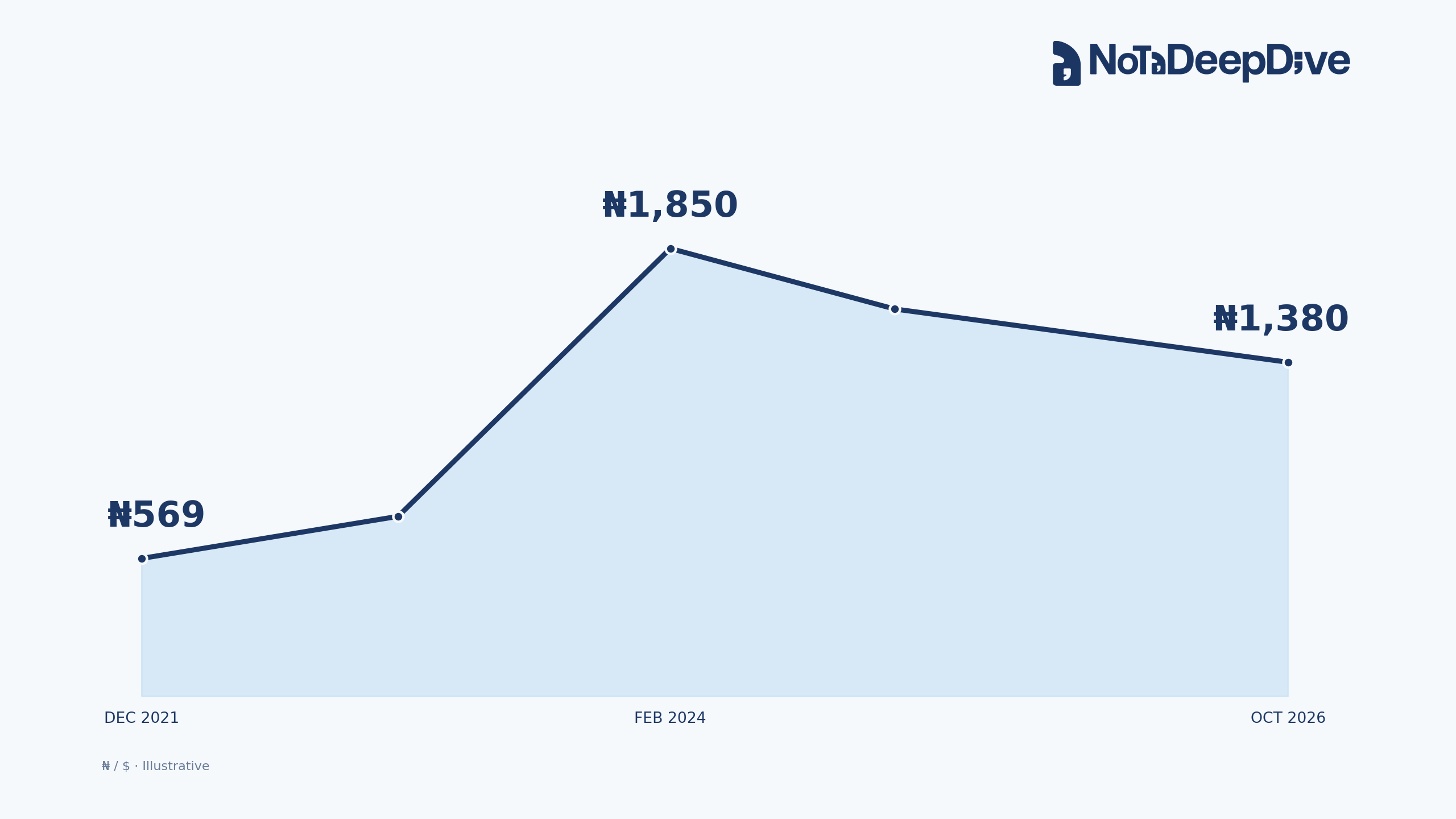
Between 2021 and 2023, leaving your dollars in your Grey/Raenest wallet was the best investment move. In December 2021, the street rate was ₦569 to the dollar, so your $2,000 was worth about ₦1.14 million.
By January 2023 it was ₦743, and the same $2,000 was worth ₦1.49 million. In late February 2024 it reached about ₦1,850, or ₦3.7 million for your $2,000. It swung through the rest of 2024 and was still around ₦1,600 in early February 2025. or more than two years, holding dollars reliably got you more naira.
Since February 2025, that trade has flipped. In early October, the street rate was between ₦1,370 and ₦1,390, so the $2,000 you left untouched in February 2025 now buys about ₦2.76 million, 14% less. Naira savings, meanwhile, pay up to 16%, and the Nigerian Exchange’s All-Share Index is up about 59% this year.
As long as the naira holds, the sensible thing is to convert on payday. You don’t need Grey or Raenest to save in naira, so your salary arrives on Wednesday morning and is out of these apps within the hour.
Grey and Raenest would rather your salary stayed; they earn interest on it. Your card payments, your bills and your eventual conversion to naira all happen on money that’s still in the app, and each one carries a fee. A balance also shows them how much you earn, how much you spend and how much you keep, which is what a lender needs to know before giving you credit. And with the right licence, deposits are the cheapest money a lender can get.
Wise, the company Grey and Raenest most resemble, shows how this works at scale. In its last financial year, its average cut on cross-border transfers fell to 0.52% from 0.58%, and almost half of its $2.5 billion in net revenue came from outside cross-border transfers, including interest and cards. It earned $806.1 million in interest on customer balances, at an average yield of 3.0%, and paid customers an average of 1.8%. Grey is now paying an introductory 3% on Paycheck savings. Three-month US Treasury bills have paid about 3.6% to 3.9% this year, so Grey keeps less than a percentage point, and less if its banks pay it below that.
Raenest advertises up to 7% on dollars, more than twice what Grey pays and nearly double the Treasury bill rate. That has to come from somewhere riskier, or out of Raenest’s pocket as a promotion.
Ultimately, if the naira starts falling again, dollars will pile up in these apps without anyone being paid to leave them there. For now, it’s time to pay up.
Nigeria’s OPay is set to begin trading on the NYSE today. It priced at the bottom of its $19–21 range, which values it at about $4 billion. OPay says it has more than 50 million users in Nigeria, Egypt, Pakistan, and Indonesia.