


I’m ending my three-week break a little early (is that proof that I’m well-rested?). Anyway, it feels great to be back!
TOGETHER WITH CREDIT DIRECT

The best investors aren’t the ones watching the market every day. They’re the ones who made one quiet decision and let it compound.
Yield by Credit Direct grows your money at up to 21% per annum, no monitoring required.
The Money Must Be Over There
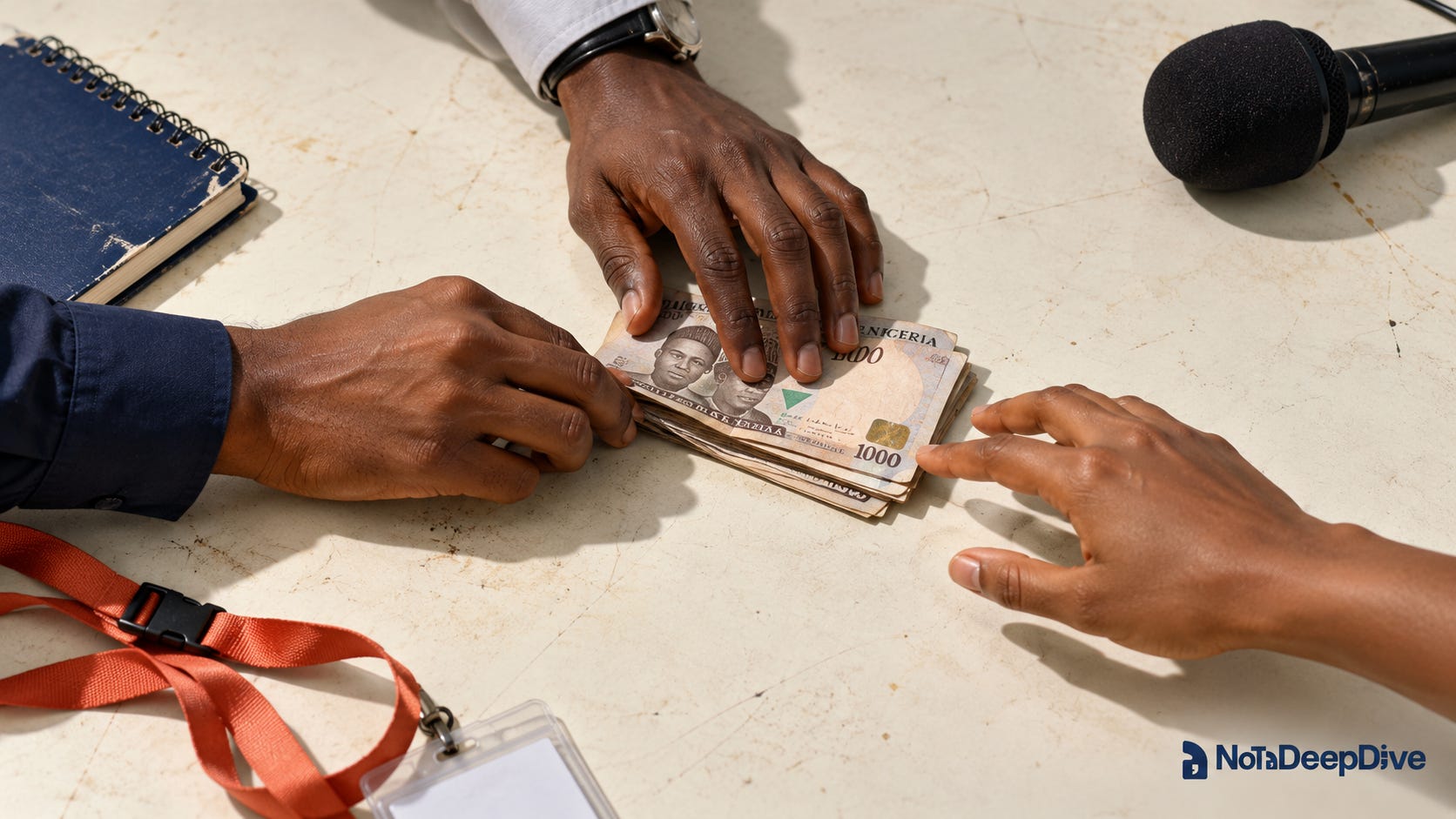
Tech publications spend all their time analysing other businesses and often seem reluctant to discuss themselves. Host a handful of journalists, and they’ll prattle on endlessly about our dear tech ecosystem. Will they debate how the media business they work in is hanging on for dear life? Don’t hold your breath.
I suppose anxiety over whether AI will take our poorly paid jobs, or our employers striking first and laying us off, makes these conversations difficult.
So tech journalists will only discuss the media business in the occasional but mind-numbingly predictable “tech startups vs. media debates.”
Fortunately, this week has given us quite a good deal of media fodder to analyse. On Thursday, Fatu Ogwuche of the Big Tech This Week newsletter launched her weekly live show (a format popularised by TBPN and The Information’s comically named TITV).
Semudara Abayomi, an independent creator who built his audience on video, also launched a daily digest he’s calling Bayomi. Independent publications and creators are expanding their surface area at the same time as established publications.
I’ve always thought that storytellers should experiment across formats. Some things are great to write about and would also be fun to make videos about and there’s nothing like figuring out a new format to keep you humble. Africa Built gives me room for audio conversations, and because I watch an unreasonable amount of YouTube, I also want to make fun videos.
There is no grand commercial revelation to report yet because I’m still trying to get videos out consistently and find editors who Nigerian skitmakers haven’t ruined.
You can start recording videos with a phone and free software, but the harder work is making something worth watching every week. If you cannot edit, your ability to make the thing in your head depends on surrounding yourself with people who know what they’re doing. Finding those people, developing a shared idea of what good looks like, and producing consistently is a tough education.
Still, we all must experiment because if subscriptions aren’t going to pay the bills for Nigerian tech media, something else has to.
In the last three or four years, the answer has been events. TechCabal has Moonshot, Condia held Borderless this year, and GITEX brought their spectacle to Lagos. Today, if you shake a tree, any tree at all, a technology-focused conference will fall out of it.
Events help publications connect the seemingly disparate things they’ve been doing all year. An event brings people the publication has been reporting on and building relationships with to discuss the issues that have captured imagination and fascinated WhatsApp groups for most of the year.
But events are expensive, demanding a worrying amount of time and attention. And when they’re over, you want to have made a healthy margin because it’s insane to put your team through two or three large conferences a year just to make the economics work.
But imagine that your conference goes off without a hitch, your sponsors are pleased, and attendees want another edition. Your team basks in the satisfaction of having pulled off something impressive, and you’ve broken even. Does anyone need to say that your event is now set for a second year?
A few editions later, you’ve progressed from breaking even to a net margin of 10%. Is that a success? It might be. But how much of the company’s year did it consume, and what else could your people have built with that time?
TechCabal ran Future of Commerce for years before arriving at Moonshot, suggesting that finding a commercially successful format can take several attempts, and a publication needs the resources to survive the search.
Video is a more accessible experiment that doesn’t need you to commit to a large production months in advance. You can also reach people who were never going to read your publication.
Skitmakers have proven the business case, showing that advertisers will pay to reach a large audience. Publications want some of that money, but the challenge is to make something people watch by choice rather than professional obligation.
OpenAI’s acquisition of TBPN made a live technology show look like a spectacular business opportunity. But the buyer was also interested in the team’s communications and marketing capabilities, and placed it within its strategy department.
This week, TBPN’s president, Dylan Abruscato, described a business in which some sponsorship agreements included communications and marketing advice. OpenAI wanted those capabilities for itself. The show had helped build something valuable beyond the programme viewers watched.
Publications will argue that they can take this one problem at a time; the first is developing shows people want to watch, but original reporting, industry knowledge and access to guests do not automatically guarantee a good show.
Creators start with an advantage here because their audience has already chosen them and their way of explaining the world; adding a digest extends that relationship.
Publications will tell you for free that original reporting is a painful process that requires sources, verification, chases that never become anything, and sometimes a reputation of being too critical or cynical.
Ultimately, the convergence is fascinating. Publications want the direct audience relationships creators have built, and creators want to use their authority to expand to other lanes in their bid to become bigger operations. Neither transition is as straightforward as opening a YouTube channel or launching a newsletter.
There is the less exciting matter of who pays for all of this.
Across the industry, everyone is adding things to sell to many of the same fintechs, telcos and banks. More programmes mean more opportunities, but they also mean more competition for budgets.
There are ways to grow beyond that constraint, like making something useful enough for an advertiser to spend more or broadening your coverage into industries whose advertising budgets you’ve barely touched.
That last possibility is one reason business and finance are attractive territory. But adding those words to a publication’s description is the easy part; you still have to produce work that earns the attention of people outside your existing circle.
None of this is an argument against experimenting. I am making videos because I want to make them, and because I think some of our stories deserve to be seen as well as read.
Publications and creators will keep crossing into each other’s territory. Some will build much better businesses as a result, and others will find a healthy respect for the new lanes they cross into.
And before you run off, I’m making videos too.
We started with a question: how did OPay lend $1.5 billion in one year? Watch, like it (it’s by force), share it with your friends and enemies and leave a comment.
See you on Sunday!
You people are getting paid?