


Today’s newsletter took an inordinate amount of time to work on. It refused to come together on Friday but here it is in the most coherent form. Don’t forget to leave a comment!
If this email was forwarded to you, pleaseeee subscribe:
TOGETHER WITH CREDIT DIRECT
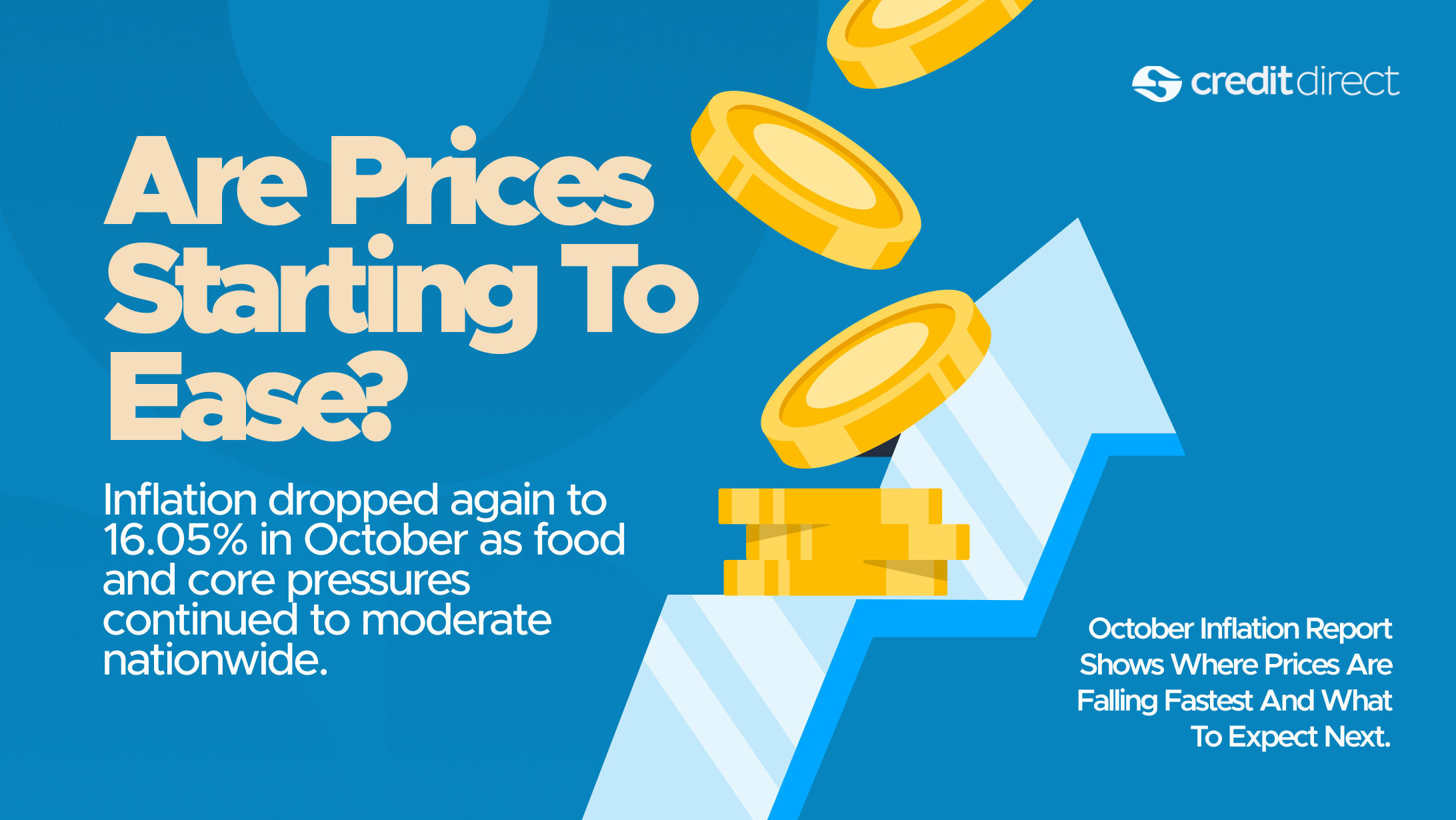
Inflation eased 16.05% in October, raising the question of whether price pressure is finally easing. Food and core prices moderated nationwide, but there is more to understand beneath the headline number.
The October report shows where prices are cooling, the factors driving the shift, and what it could mean for spending as the year wraps up.
Should Cardoso be our new obsession?
Every November, the Chartered Institute of Bankers Nigeria Annual Dinner is the stage for the CBN Governor to signal the mood of the country’s financial system. It is basically the State of the Union for the financial sector.
In 2024, the new-ish CBN chief, Yemi Cardoso, stood on that stage as a man asking for patience. He was the clean-up CBN Governor, tasked with flushing out the unorthodox excesses of the Meffy era. He promised to take the hard medicine: clearing the FX backlog, hiking rates, and stopping the reckless printing of money.
“The Central Bank of Nigeria will discontinue direct quasi-fiscal intervention initiatives and instead pivot towards our core mandate of price stability.” — Yemi Cardoso, CIBN Annual Dinner 2024.
This year (2025), Cardoso returned in a strapping mood and for good reason.
“Our tight monetary policy stance has altered the previous dire trajectory, and we expect a downward trend in 2025.” - Yemi Cardoso, CIBN Annual Dinner 2025.
If you delete the Binance debacle, the scorecard looks impressive. Inflation has eased from 34% to 16.05% (questions remain on the Consumer Purchase Index rebasing mechanism). The Naira is stable and foreign inflows are back ($21bn year-to-date).
The cynics will insist that inflows are tied to investors looking for easy yields on government debt (hot money), and that prices have only stabilized because the average Nigerian is too poor to drive up demand. Ultimately, whether it is rented stability or the real deal, the markets are relieved to simply have a boring currency again.
If you look past the victory lap, the speech revealed the structural engine for 2026. Cardoso highlighted three critical shifts: the creation of a dedicated Compliance Department, the Modernisation of Payment Rails, and a renewed push for Digitalisation.
The creation of a dedicated Compliance Department within the CBN (operational as of September 2025) may explain the velocity of regulation we’ve seen in Q4.
In 2024, the CBN fought almost reactively. For instance, the customer onboarding bans for leading fintechs was pretty lowkey until it surfaced in the media.
A compliance department suggests a shift from firefighting to policing. While we don’t know the inner workings yet, it is reasonable to assume that 2026 will bring systemic enforcement. This is stuff some conservative players will love.
Remember my argument that fintechs should “launch first and ask for forgiveness later?” It’s not legal advice.
Modernising payment systems, which Cardoso also mentioned feels very in line with current conversations. NIBSS has moved from NIP (NIBSS Instant Payments) to the National Payment Stack (NPS). There are great explainers on why the shift makes sense, especially on the OpenAfrica substack, so go and read.
If the Rails (NPS) are being upgraded and Compliance is being tightened, should fintechs be worried, especially when the CBN’s strategic priority for 2026 is “Fostering responsible fintech innovation.”
Enter Cardoso:
“Fostering responsible fintech innovation: support fintech expansion while protecting consumers, strengthening cybersecurity, and safeguarding financial integrity. This includes enhanced data governance standards, stricter licensing requirements, and clearer guardrails for digital-asset experimentation.”
Whenever a regulator uses the word “responsible” in the same sentence as “innovation,” it is usually code for “slow down.”
The CBN’s posturing exposes the illogic of the Nigerian Fintech Regulatory Council Bill (the “Fintech Bill”) currently floating around the National Assembly. If the CBN is already enforcing stricter licensing and cybersecurity standards, a new Fintech Council is redundant. The CBN is the regulator. It does not need help.
The Liability Shift
Finally, the sting in the tail for 2026 is the Draft Guidelines for Handling Authorised Push Payment (APP) Fraud (released Nov 26).
To understand why this is a bombshell, you first have to understand what APP Fraud actually is.
For the last decade, Nigerian banking regulations were designed for Unauthorized fraud (where a hacker steals your password and drains your account without your permission). In those cases, the bank was often liable.
APP Fraud is different. This is when you send the money yourself. You get a call from a “customer care agent” who convinces you to transfer funds to a “safe account.” Or you pay a vendor on Instagram who turns out to be fake. Technically, you authorised the payment. Under the old rules, the bank could wash its hands of the matter. You entered your PIN. It’s your fault.
Under the new guidelines, the liability shifts to financial institutions (draft regulation for now). Modeled closely on the UK’s PSR rules (which went live in October 2024), the guidelines propose that banks and fintechs must reimburse victims of APP fraud unless they can prove the customer was “grossly negligent.”
Currently, banks have little incentive to stop accounts that receive stolen funds because the loss sits with the victim. Under the new rules, if a bank facilitates the receipt of stolen funds, it is on the hook.
The cynical take is that banks will hate this. They will argue it creates a moral hazard and that customers will become careless because they know a refund is guaranteed. But the CBN has looked at the NIBSS data (which shows social engineering is now the #1 cause of fraud) and decided that the only way to make banks care about security is to make fraud a line item on their P&L.
See you on Wednesday, when you get one extra newsletter.
"see you on Wednesday"
One week later...
So what's your outlook for the CBN 2026 policies?