


If you missed last week’s Notadeepdive editions, catch up here, here and here.
TOGETHER WITH CREDIT DIRECT

You’re already doing the hard work. We’re here to help you go further. 💪🏽
Get everything you need to manage and grow your business, in one place.
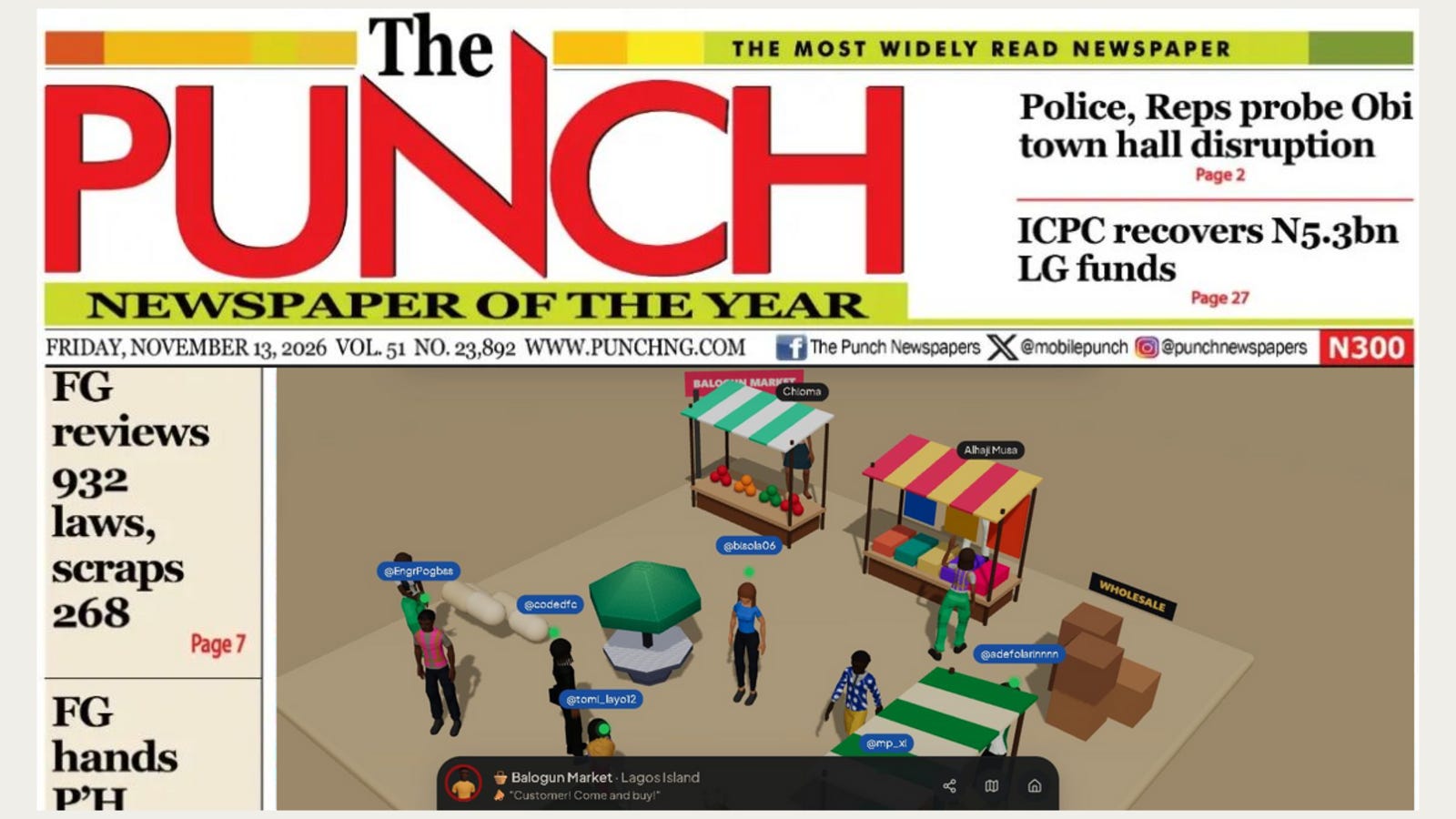
In the last week of September, Berlin-based Nigerian engineer Opeyemi Adeniran posted “Lagos Run,” a small web game, on Twitter. Lagos Run put you behind the wheel of a danfo, loading passengers and fighting traffic from Ojuelegba to Yaba, and it was an instant hit, attracting seven thousand players in two days. It spurred other developers to post their versions; there was a London bus one, a Port Harcourt one, you get the drift. It was fun, and for a while that was all it was. It felt like the kind of thing Nigerian Twitter adopts on a Monday and abandons by the weekend.
Yet, one game from twenty-six-year-old developer Shalom Rayhamen rose above the noise and claimed the moment. “Lagos Life” was released right as Nigeria’s President was giving his Independence Day speech, and three hours later, it was trending on Twitter.
Lagos Life was more immersive and had a larger world than the games before it, allowing players to hustle through a virtual version of Nigeria’s chaotic and energetic commercial capital and have near-real-world experiences. Users could pick from twenty-five careers, sit in traffic, make ridiculous amounts of money, and pay rent every Saturday.
Within three days, one million people were playing Lagos Life, and that number ballooned to seven million on day ten. On the back of all that activity, the startup generated $170,000 in revenue; look away now, pre-revenue startups.
Imagine on day three, with the whole country talking about the game, the chairman of Punch, or Guardian, or even TechCabal, offered to buy it outright. Cash, stock, whatever number a solo developer would have said yes to before the term sheets started flying in.
The buyer would have gotten a game that was driving a daily habit at scale, which is something the Nigerian press no longer has. A daily audience of millions of young people is the raw material from which a subscription business can be built, especially if you have some patience.
A newspaper buying a game sounds eccentric until you remember that the most successful subscription business in journalism did this. In January 2022, the New York Times bought Wordle, a game one man built for his partner, for a sum in the low seven figures. The BBC put the Gray Lady’s intentions rather plainly: “The NYT wants to use the game to boost its online subscriptions. The media group said it will “initially remain free” to play, raising questions that the intention in the long term is to charge.”
By early 2025, NYT’s games were adding more subscribers in a single quarter (110,000) than its journalism was (81,000). Bundle subscribers pay nearly four times what news-only subscribers pay, and the company closed last year with 12.78 million subscribers and about 69% of its revenue coming from subscriptions.
Wordle is usually explained as an obvious move because the NY Times has a crossword, and by that same logic a Lagos simulator would be too strange for a serious newspaper. But when the Times bought Wordle, it was buying a free web toy with no app, no ads, and no revenue. Nothing about it was obvious until it worked, at which point everyone reached for the crossword to explain why it had always been inevitable. Had it failed, the same crossword would have been Exhibit A in how far the paper had strayed from its core business.
A sports site was not a natural fit for the NYT either (it bought The Athletic for $550 million), and neither were recipes or product reviews.
Newspapers were always bundles of habit anyway, crosswords and horoscopes and comics and TV listings, with the news as anchor and the rituals as glue. Somewhere along the way we threw out the rituals and kept the news, which is the part nobody will pay for. Lagos Life would actually fit a Nigerian paper better than Wordle fits the Times, since it is a playable version of the economy the papers cover.
For years my position was that subscriptions cannot work in Nigeria. At their peak, legacy papers sold something like two million copies a week. When Babaginda’s Structural Adjustment Policy triggered a naira devaluation in the 80s, the newspapers were reluctant to raise prices, and when circulation collapsed in the 2010s, they squeezed whatever was left of the advertising lemon instead of experimenting with products people might pay for.
When the internet came, they joined small digital upstarts in the race to the bottom for pageviews and belatedly discovered that pageviews alone cannot sustain a publication. Today, bar BusinessDay, none of Nigeria’s legacy newspapers has a subscription business.
Nigerian media has been too busy surviving the last decade to even think about acquiring habit machines. It did not in the blogging era, when the properties that defined Nigerian internet culture were built by individuals who could have been acquired for modest money.
It has not in the podcast era. I Said What I Said sells out live shows in minutes, and recently, they put an episode behind a paywall. No publication made them an offer when it was possible, and none did this month with the game.
The Guardian published a long, thoughtful feature about Lagos Life in the middle of all this, and it was genuinely good journalism. But while the journalist was writing, four tech investors wired $500,000 at a $10 million valuation and closed in a day with angel investors like GB Agboola of Flutterwave, Nathan Nwachuku of Terra, Abdulhamid Hassan of Mono, and Oo Nwoye writing cheques.
Of course you can argue that viral things fade, and Lagos Life could be a long forgotten thing. You could even argue that if a publication had bought it, ownership is the easy part. The Times could buy Wordle and leave it alone because it has eighty years of games behind it and about a thousand engineers; it knew to keep the thing free and not touch it.
A Nigerian buyer would need the discipline to keep the founder, resist the registration wall, resist drowning it in banner ads, and keep servers alive for two hundred thousand concurrent players, all with a small technical team. It suggests the harder truth about acquisitions is that Nigerian newspapers don’t believe they can run anything that is not a newspaper.
Every few years, Nigeria produces another machine that millions of people return to daily: a blog, a podcast, a game, and every few years the buyer turns out to be anyone except the people whose business is audience. The institutions that behave like modern media companies in this country are banks. GTBank built Ndani TV while actual media companies argued about pagination, and Access Bank did something with Accelerate TV.
Subscriptions will not work here as a paywall on the news, because news is the least differentiated thing any publication makes. They can work as membership built around things like a game they play daily, a podcast whose shows sell out in minutes, a conference whose tickets cost more than a month’s salary. The journalism becomes the trust layer that makes membership worth keeping. ISWIS built that funnel without meaning to; Lagos Life built it in ten days.
Somewhere right now, in someone’s bedroom, the next one is being built for release at seven in the morning on an ordinary day. Who will call first? A publisher, or another fintech founder?
One thing to watch.
Our YouTube video on how newspapers have almost become obsolete has now been watched over 900 times, so naturally we made another one. Catch up!