


If you missed Friday’s Notadeepdive, catch up here. If this email was forwarded to you, subscribe for free:
TOGETHER WITH CREDIT DIRECT
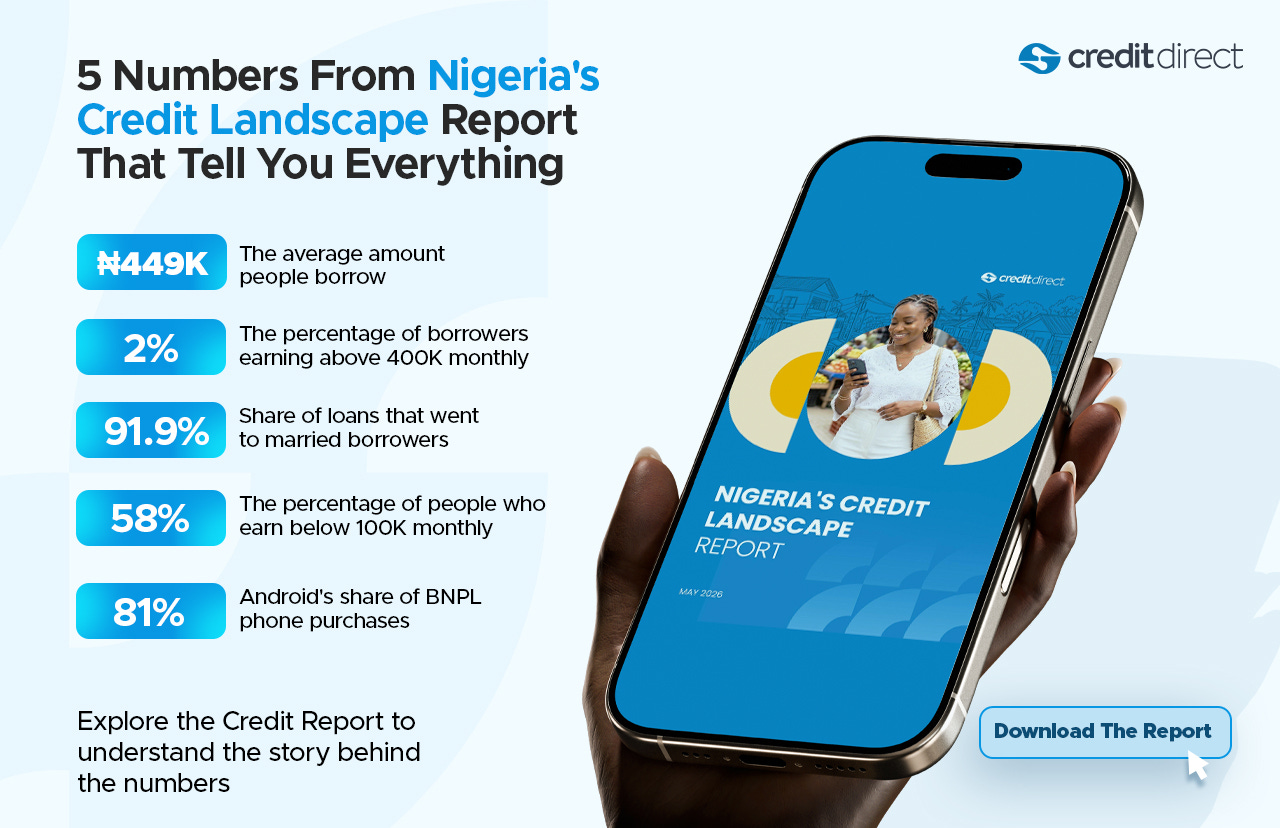
These are the most crucial numbers from Nigeria’s Credit Landscape Report.
On their own, the numbers say a lot, but the report explains why they matter and how they’re shaping the future of credit in Nigeria.
Understanding the Latest CBN Memos on Holdco Structure

On June 10, 2026, the Central Bank of Nigeria published consequential policy directives as part of its drive to sanitise the financial services sector. One policy updates the rulebook for financial holding companies while the other is called “ring-fencing operations of closely linked entities,” which sounds like nothing.
Yet, these are the biggest shake-ups the CBN has handed the industry since the recapitalisation directive, and most of the people affected haven’t read them yet.
Here is what it means.
For about fifteen years, Nigerian finance has used a quiet trick. You don’t build one company; you build one brand and collect licences under it. The bank sits in one company, the payments business sits in another, and the lender sits in a third, sometimes licensed by a different regulator entirely.
Then you stitch them together with a single app, and most customers have no idea (or have no reason to care) that the wallet, the loan and the transfer they just made were legally facilitated by three different businesses.
OPay’s app takes your deposits through one licence and gives you loans through a microfinance bank you’ve never heard of. Moniepoint’s business app sits on top of a microfinance bank and a separate payments company. Sycamore, a bootstrapped Lagos lender, runs a moneylending business, an asset manager and a microfinance bank through one app and is structured as a group. Paystack also initially tried to do it with Zap before having to retreat and comply.
The big banks played the same game at a grander scale: Access Bank owns banks in more than twenty countries, all hanging off the Nigerian bank’s balance sheet. And VFD built a listed company on the premise that if you call yourself an investment company rather than a holding company, you can own microfinance banks, a mortgage bank, an insurance broker, hotels and restaurants in the same portfolio and answer to nobody in particular.
The CBN has looked at all of this and decided that a lot of regulatory arbitrage is at play. Companies are doing things their licences don’t allow, through sister companies whose licences do, while the customer thinks he’s dealing with one business.
So the new rules attack the trick at its root, which is the connection between the companies. By inventing a category called “closely linked entities,” the draft is deliberately ambiguous in its definition.
You’re closely linked if one company controls the other, obviously. But also if you share directors, systems or branding. You’re also closely linked if one of you depends on the other by contract. With that definition, almost every financial group in Nigeria is one organism, no matter how many CAC registrations it’s spread across.
And once you’re one Holding company, three things follow.
Your app can no longer do everything. Each company’s app may only offer what that company’s licence permits. If your customer wants a loan from your sister company, the sister company must onboard them, which means doing its own KYC, wallet, getting explicit consent, and a disclosure telling customers that they’re free to get the loan elsewhere. The loan money lands in the sister company’s wallet, not yours. The seamless super-app experience where customers tap for savings, credit, and insurance, all inside one interface, goes from being a delightful innovative product decision to a compliance violation.
Customer funds can’t be lent across the group, can’t secure the group’s borrowing, and can’t pay a sister company’s salaries. Customer data also can’t be shared between linked companies without explicit consent. The CBN can(in theory) even order you to run separate data centres.
This unfortunately eliminates the whole point of an ecosystem as the data flywheel, cross-subsidy, and cheap internal funding become unplugged piece by piece.
On the financial side, any loan a banking subsidiary sends up to its Holdco gets treated as a return of capital and struck off the bank’s capital base when its capital adequacy ratio is computed. Loans to a sister company carry a 100% risk weight if secured, a full capital deduction if not.
Every naira a bank lends to its own group costs the bank a naira of regulatory capital. The cheap internal funding that made the ecosystem worth building is now the most expensive money in the group, and the Holdco is left to run on dividends, treasury-bill income, and whatever it can raise from outside. Expect to see more public responses on this from listed financial services entities, as this changes their reporting guidelines.
Every set of closely linked entities must put a non-operating holding company on top: a company that does nothing except own the others, licensed by the CBN, holding at least 51% of each subsidiary, and capitalised at the sum of all its subsidiaries’ minimum capital plus 20% — in real paid-in money, not reserves. If you’d rather not build that, the alternative is to merge everything into one company, hand back every licence except one, and stop doing whatever the surrendered licences allowed.
How does this affect today’s Players?
The groups that already became holding companies like GTCO, Stanbic IBTC, FCMB, FirstHoldco, Access Holdings, and Sterling Holdings have to redraw their org charts again.
Their Nigerian subsidiaries must hang directly off the Holdco, and foreign subsidiaries must sit under a separate intermediate holding company. Access Bank’s twenty-something foreign banks currently sit under the Nigerian bank itself. Moving them means change-of-control approval from every regulator from Nairobi to London, with tax and capital consequences. Access was already under shareholder pressure to sell its weaker foreign units; this turns that debate into simple arithmetic, because every subsidiary you keep is a subsidiary you must lift out of the bank and re-approve in its host country. The cuts and divestments will be brutal and devoid of sentiment.
Zenith just received the CBN approval for its holding company, barely a month before the rules for being a holding company changed.
The rules also reach down to the board table, and that is where even the most compliant Holdco of them all gets a reorganisation. A Holdco director may now sit on only one subsidiary board; Holdco directors together can’t hold more than a fifth of any subsidiary’s seats; Holdco staff can’t be non-executive directors anywhere in the group; and the old habit of subsidiary directors sitting in on the parent’s board meetings is banned outright.
Take GTCO. Segun Agbaje, the group chief executive, sits on the boards of GTBank Ghana, GTBank UK, GTBank Kenya and GTBank Tanzania and chairs the UK bank. Under the draft, that’s three boards too many.
Every group of any size typically runs on the same overlapping cast of executives, which is precisely how the Holdcos run its subsidiaries with the same uniform goal, and cross-pollination of ideas. Once that synergy is cut, these groups suddenly need a far deeper bench of fit-and-proper independent directors than Nigeria has lying around.
UBA, despite not being a Holdo, is affected. As a big bank with multiple subsidiaries, the draft mandates that closely linked entities form a non-operating Holdco. And if the group contains a commercial bank, the full holding company regime applies. UBA, its African banks, and pension custodian are a closely linked group by every part of the definition. This means that the same Holdco conversion Tony Elumelu has spent fifteen years avoiding for the UBA group now needs to be had.
There is also the monetary consideration of all these changes. By asking for a 20% buffer on top of every subsidiary’s minimum capital requirement, the CBN is asking some of these non-compliant entities to return to their shareholders for fresh capital to restructure equity distributions across companies.
Aspiring Conglomerates are also affected here as the Holdco rules ban holding companies from owning anything outside financial services. This is defined narrowly as businesses regulated by the CBN, SEC, NAICOM or PENCOM.
Sterling has spent years telling anyone who’d listen that its future runs through health, education, agriculture, energy and transport. As a lender to those sectors, nothing changes; banks can lend to anyone. But the version of the story where the holding company “allegedly” has ownership stakes in clinics, EVs, Energy grids and farms it finances is now illegal by design.
A financial holding company, the CBN is saying, is a filing cabinet for financial licences and nothing more. Zenith’s newly announced “beyond banking” ambitions have also hit the same wall.
VFD ran the opposite play of this by becoming a conglomerate that engineered its way around ever becoming a financial holding company. My unconfirmed theory is that they and Sterling were the ones this draft had in mind at inception, as their “proprietary investment company” label worked because microfinance and mortgage banks did not technically count as banks under the old Holdco rules.
The new rule is no longer about what you own, but about how connected these entities are. VFD’s forty-plus subsidiaries share the same owners, directors and a brand name. The regulated half of that portfolio must now go into a licensed Holdco that cannot also own the real estate portfolio.
This means the likely ending is a split: a clean financial group on one side, everything else on the other and even then, if both halves keep calling themselves VFD, the shared-branding clause may follow them across the fence. (Luckily, the founder honed his craft at the feet of Tony Elumelu, so a Heirs Holdings - UBA group type split should be on the horizon for them)
For fintechs, however, this becomes a template for how the industry should be built in the future. Paystack, for example, seems to have already built the template the CBN wants with their Stack Group restructuring with a switching licence on one side, Zap(powered by Fidelity Bank) and the Brass + Ladder microfinance banks on the other.
However, even this has a potential landmine on the horizon, as the fine print mandates the holding companies to be Nigerian entities. Stack’s ultimate parent is Stripe. Moniepoint is a foreign Inc. Nearly every venture-backed fintech in the country runs its Nigerian licences out of a Delaware, UK or Mauritius parent, because that’s what foreign investors require. According to the draft, this structure is already non-compliant.
Finally, these rules also masquerade as death sentences against ambition. An example is the shared-services section. It says a Holdco may centralise office space, legal and IT for its subsidiaries. Risk management, compliance, internal audit, the company secretariat must now live inside each subsidiary, independently staffed and independently funded. That means the Group Chief Compliance Officer function that covers three companies from the Holdco floor is no longer allowed to exist.
That means a smaller holding company must either build a holding company capitalised above the combined minimums of its individual licensed businesses, with multiple boards, multiple compliance functions, recovery plans, twice-yearly continuity drills and an annual independent audit of every shared service, or merge down to one licence and divest the other business lines.
This does not matter if the group is profitable and bootstrapped, or if these entities have little chance of survival as standalone side projects. There are hundreds of two- and three-licence companies in Lagos doing the same maths this week. Most of them will merge, sell, or hand licences back. The Cardoso-led CBN has been adamant about the sanctity and capital adequacy of the industry, and these new rules will produce exactly that.
So who wins?
The lawyers and consultants who bill the restructuring, the senior executives drafted in to fill all those new independent boards and standalone compliance functions, and the few groups already built the way the CBN wants.
The CBN’s document admits the 2014 framework caused a surge in overheads, and its fix is more boards, more audits, more duplicated infrastructure across more companies. Everybody in this market knows compliance is the moat nobody wanted to pay for. The CBN has now named the price, and it is paid in structure — more boards, more audits, more standalone entities — with no opting out.
These are still exposure drafts, and affected institutions have until July 9 to engage the CBN on this.
*The Opinions shared here are the independent analysis of the author and do not represent the views of any organisation they may be affiliated with. Nothing in this opinion piece should be regarded as Tax, Legal, Financial, or Regulatory advice.
Please do your own research and engage licensed practitioners wherever necessary.

Would we get a Substack on the latest CBN circular on market structure requirements?
One question, how does this benefit the Nigerian customer?