


If you missed this week’s off-schedule Notadeepdive editions, catch up here and here. And if this newsletter was forwarded to you, subscribe here for free:
TOGETHER WITH CREDIT DIRECT
Fewer loans. Better repayment. Higher amounts. Women in Nigeria’s credit market are quietly outperforming the averages, and the full picture is even more interesting.
Nigeria’s Credit Landscape Report breaks down who borrows, why, and what it means for the future of credit in this country.
MTN Tries Video Streaming (Again)
Profitable companies can spend decades throwing good money after bad, chasing an idea their executives fell in love with. Nine times out of ten, that idea was pitched by a very well-paid consultant and money must not waste.
For outsiders watching said company, our instinct is to scoff and call them stupid. This is emotionally satisfying, but usually wrong. Many of the people who fall in love with these ideas are very smart, so now and then, it is worth figuring out how they think. There was a room where the idea made sense; the work is to enter that room, engage with the idea and then work backwards.
This may or may not be related to this week’s announcement that MTN is launching yet another video streaming service.
This week, MTN Group announced MTN One TV, “a new entertainment proposition” designed to make digital video more accessible across African markets. The service is tied to MTN’s Ambition 2030 strategy and promises the usual mix of local storytelling, live channels, international programming, free-to-view content, advertising-funded viewing, pay-as-you-watch access and subscriptions.
This is MTN’s nth attempt at streaming. One TV belongs to a family that includes FrontRow, VU, the eVOD partnership, the media layer inside ayoba, and now this new pan-African entertainment proposition. It’s safe to call streaming a company obsession.
One TV arrives at a moment when “video streaming is a dead business” has hardened into a continental cliché.
Canal+ shut down Showmax in April, presumably worried about the streamer’s losses and business model fit. Amazon and Netflix famously stopped funding African originals barely two years after they made splashy starts. And Jason Njoku’s IrokoTV, the most documented of the lot, spent $100 million over a decade and concluded that there is no Nigerian market for paid streaming. Yet MTN will not be deterred.
So let’s get into the mind of the execs. They’re running a company that spent twenty years making billions from setting up networks and connecting calls, a.k.a revenue from voice calls. As internet penetration started to deepen, in came Whatsapp/Telegram/iMessage offering the ability to make endless calls with very little data.
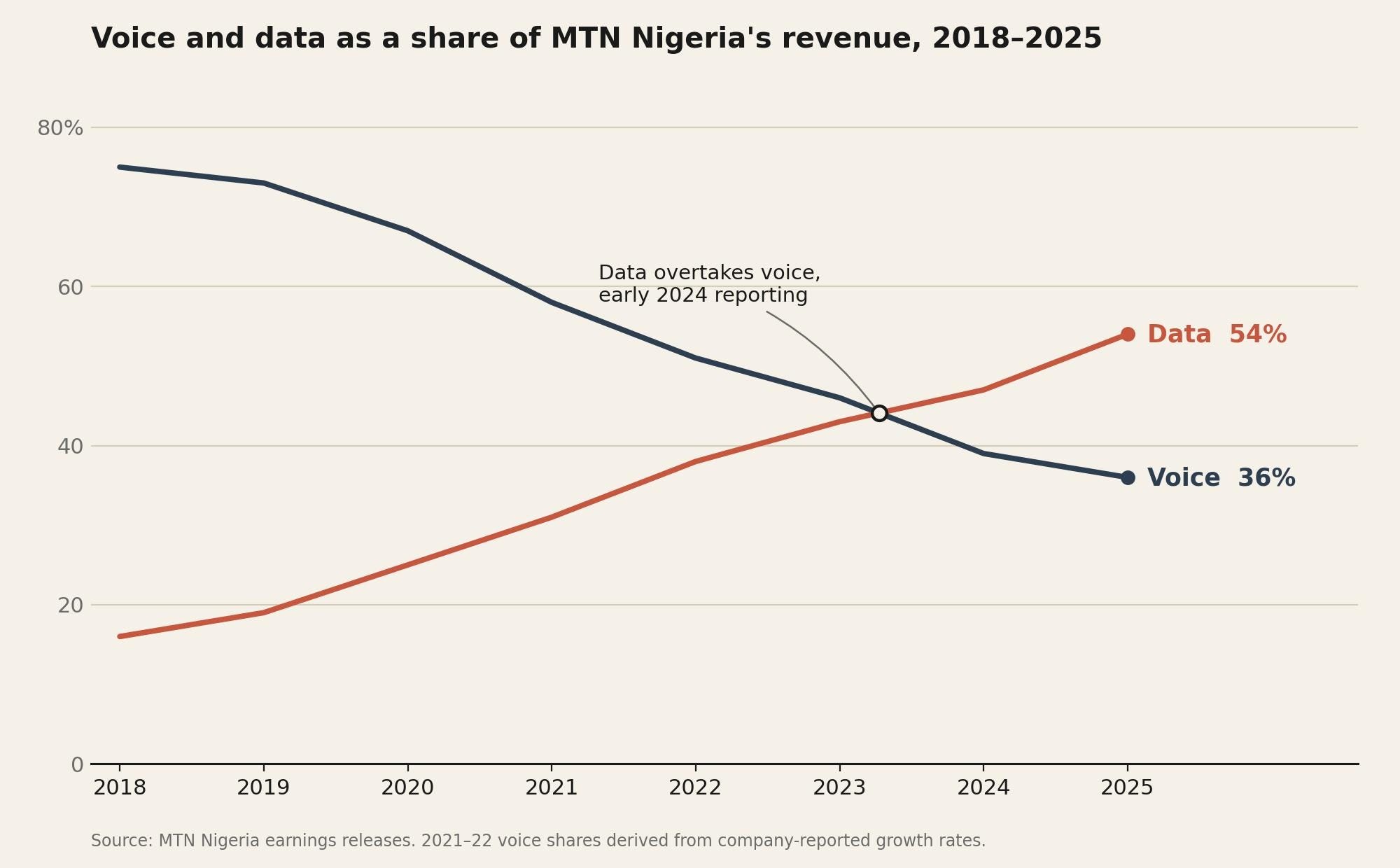
Nigerian telcos made peace with this shift and rebranded around data. Airtel called itself the Smartphone network, and Glo crowned itself the Grandmaster of Data.
But data is a crueler business than voice. To sell more data, you have to lay fibre cables, build network towers, buy spectrum, acquire customers, and now and then, hold a townhall swearing you’re not stealing customer data.
After spending all that money, you will enter price wars with competitors while regulators take ten years to approve price increases. Your customers will also have two SIM cards and buy data from whoever offers the better deal.
Investors understand this. They see a capital-hungry, price-pressured, churn-prone business. They also see the apps riding on top of that business like YouTube, TikTok, Netflix, WhatsApp, Instagram, DStv Stream. These companies keep customers glued to their phones, shape culture, collect attention, and, in the best cases, trade at the kind of multiples that make telecom executives stare into the middle distance during trading hours.
A savvy consultant does not need to work too hard here. Video is the single biggest thing on the network, and people buy data to watch things. The apps that make people watch things are building valuable consumer relationships on infrastructure telcos pay for.
So, MTN already has the customer, the SIM card, the billing relationship, the distribution, the call centre, the wallet, and the network. Why remain a landlord collecting regulated rent while the tenants get rich?
Capture the streaming layer, the consultant says, and you capture the customer. Capture the customer, and you can sell more data, reduce churn, build an advertising business, and give investors a platform story instead of a utility story.
Every sentence in that pitch is individually true. The trouble starts when you try to assemble them into a business.
Streaming drives data demand, and MTN sells data, so MTN already earns money when the customer watches a video, regardless of who owns the app. A customer watching YouTube on MTN is still an MTN data customer. A customer watching Netflix on MTN is still an MTN data customer. Owning the streaming service does not create extra gigabytes, because nobody in recorded history has watched more television out of loyalty to a network operator.
Ownership only matters if it captures something other than data revenue. Also, every time operators tried to make their own content services attractive, they all arrived at the same strategy: subsidise the data.
FrontRow launched with a paid subscription, but its quickly leaned on MTN data bundles and free-data promotions. The eVOD partnership gave MTN customers 4GB of free data monthly to watch. Ayoba grew by offering free data to MTN customers using its features. The products that are supposed to sell more data keep needing free data to be attractive.
If video is the great engine of data demand, why are you giving away the fuel?
If you argue that content bundles reduce customer churn, that mostly works where a customer signs a 24-month contract and the free streaming tips the decision. If a family is choosing between two 24-month mobile plans, free Netflix or Apple TV can tip the decision. That is a model in America and parts of Europe. It works because the contract is the wall, and the content is decoration on the wall.
But the Nigerian prepaid customer renews her relationship with MTN every few days, often in increments of ₦500, with another SIM card as an option. There is no 24-month contract to defend, so there is no wall.
So the old telco streaming thesis made sense in the boardroom but broke upon contact with the market. Telcos saw video eating their networks and assumed the video layer was where the money had gone. A customer using your network to watch a film is not secretly asking you to become a film company.
Daily Investor, after speaking to senior executives at South African operators, put the diagnosis bluntly: consultants kept recommending streaming because it was what operators wanted to hear. The publication reported that “consultants and consulting firms had a big role” in these streaming strategies. Voice revenue was declining, and Data was pressured while Over-The-Top companies were growing. The operator wanted a way to climb up the value chain, and the consultants sold one.
Yet, if streaming was truly strategic, the budgets didn’t match the conviction. Most telco streaming ventures were funded like side bets, small enough that failure would not hurt, which also guaranteed they were never large enough to matter. If you compete for attention with Netflix, MultiChoice, YouTube, TikTok, and pirate Telegram channels, you either bring frightening amounts of money, a distribution advantage that changes the economics, or a product so cheap and useful that people forgive its limitations.
Netflix’s content budget in 2022 was roughly $17 billion, more than the market capitalisations of MTN and Vodacom combined at the time. That comparison is unfair in the strict sense because MTN was not literally trying to outspend Netflix globally. But it is useful in showing the scale of the war that telco executives were entering.
What if the side bet was never meant to fight?
A streaming service too small to compete is exactly the right size for slide 14 of a capital markets presentation, under a heading about ecosystems. The CEO needs a story in which his utility is secretly a platform. The app becomes the physical evidence the story requires, and the funding is calibrated to the story’s needs, which are modest, rather than the market’s needs, which are not.
When you think about it this way, chronic underfunding stops being only the reason these services failed. It paints a picture of the apps as props, and props are not supposed to be expensive.
MTN’s Ambition 2025 promised that ayoba, its WhatsApp challenger and super-app experiment, would reach 100 million monthly active users. Ayoba reached roughly 35 million monthly users, helped by free-data incentives, before MTN began pulling it from app stores this March. Ambition 2030 has now arrived, and within months, it has produced One TV.
To be fair, the 2026 pitch is not the 2014 pitch because nobody can walk at the telco believes it should build the Netflix of Africa. Too many people have tried and too many expensive bodies are already on the floor.
The new consultant would sell the inverted thesis. Everyone who tried to be Netflix in Africa is dead, which is precisely why MTN should enter. MTN can stop pretending that streaming is the business; the business is billing, advertising, discovery, data, and distribution. The video is just the merchandise.
One TV is mostly being framed as a flexible layer rather than a premium subscription streamer. Free-to-view content where users will not pay. Advertising-funded viewing where attention can be monetised. Pay-per-view where the event is strong enough. Subscriptions where the market can bear them. Airtime and Mobile Money payments where bank cards are rare. Technology rented from Synamedia rather than painfully built in-house. Content assembled through partnerships rather than a suicidal originals budget.
The asset every dead streamer lacked, and burned fortunes trying to build, is the ability to collect small amounts of money from customers with no appetite for monthly commitments. MTN can collect ₦100 from a customer several times a day. Across its footprint, it serves more than 300 million people. It has Mobile Money, airtime billing and customer data. It has an advertising business that wants inventory. It has a network that benefits when video consumption grows, even if the streaming product itself is not glamorous.
Understood as a merchandising layer for carrier billing and ad inventory, One TV is not obviously stupid. It might never be loved and it will never be cool. It will not produce a single show anyone fights about on Twitter or Instagram. But it could still be useful if it gives advertisers more surfaces, creates more reasons for customers to transact through MTN, and turns the streaming product into one component of a larger system.
That is the charitable case.
The difficulty is that MTN has already tested most of the components separately, with a lot of evidence.
VU had the network relationship, the billing proximity, a subscription subsidy, and the MTN brand. It shut down in 2017.
FrontRow had MTN data bundles and later free-data promotions. It became VU, then disappeared.
eVOD outsourced much of the content risk to a broadcaster and still needed free data to make the proposition attractive. The three-year exclusivity came and went without becoming a continent-changing model. MusicTime had sachet pricing and data-inclusive listening. It was folded into ayoba. Ayoba had messaging, music, channels, mini-apps, free data, and the full weight of a super-app ambition. It is now being phased out.
Every pillar of the new thesis has an individual obituary somewhere in MTN’s archive.
The remaining claim is that the combination works where the components did not. Billing plus ads plus free content plus pay-per-view plus MoMo plus local partnerships plus rented technology. Maybe the old attempts failed because they were too early, too subscription-heavy, too South African, too content-led, and too eager to imitate Netflix.
One TV appears to be a third bet that streaming is a thin commercial layer on top of assets MTN already owns.
Can MTN create habitual viewing without spending like a media company? Can it sell enough advertising without becoming just another low-value ad surface? Can airtime billing turn curiosity into recurring revenue, or does it merely make it easier for customers to spend tiny amounts once and disappear? Can a telco build an entertainment product people choose, rather than one they tolerate because it comes with free data?
The answer may still be no. But at least this time, the no has to work harder.
See you on Sunday!
Just remembered Reliance Jio has a streaming service as well
Yes that was a proper pitch deck to sell this to MTN.