


If you missed last week’s Notadeepdive, catch up here.
TOGETHER WITH CREDIT DIRECT

This term, Credit Direct Checkout is going all the way with you.
Get up to N1,000,000 to purchase iPads, laptops, and other school essentials from over 500 merchants.
In the beginning was Taxi Park
The news of Uber’s exit from Nigeria has dominated conversations this week, and you’d be forgiven for thinking it was the first cab-hailing service in Nigeria. That distinction belongs to a startup called Taxi Park (later called Tranzit), which launched sometime in 2012 at a time when TechCabal used to write snazzy paragraphs like this:
“Ironically, I quickly dismissed it [Taxi Park] as crud at the time. Partly because it was being pitched by one of its founders, whose SMS/BBM style of writing made him seem barely literate…Right off the bat, they were asking for my phone number, and I remember thinking “hey I just got here, the fuck do you want my phone number for?”
Bring back that TechCabal.
By 2013, more ride-hailing startups were springing up. There was the Rocket Internet-backed Easy Taxi, Afrocab, Taxipixi and Saytaxi.
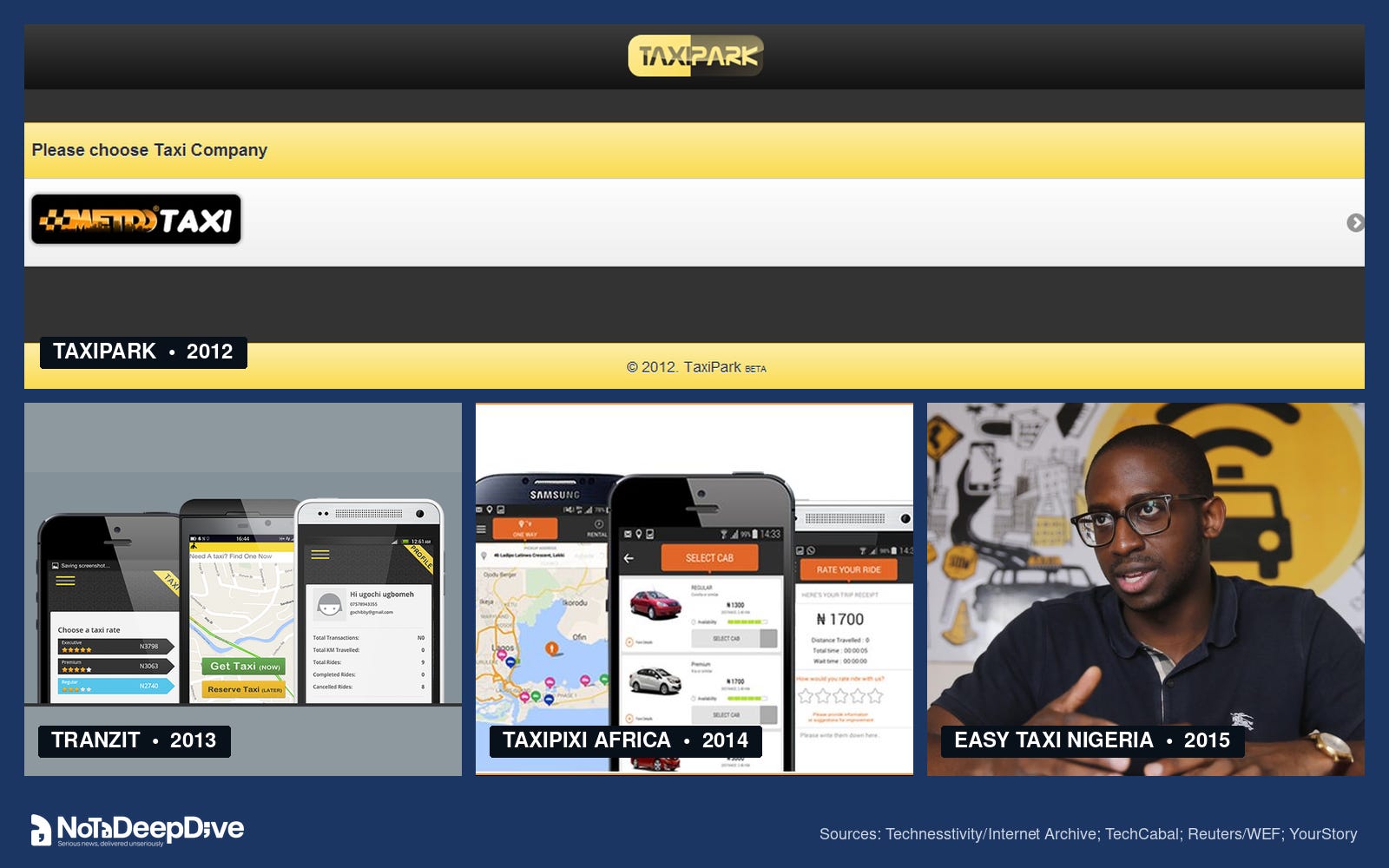
Most of the apps worked roughly the same way. They recruited drivers, trained them on how to use smartphones and maps, matched them to trips, and collected a commission. Easy Taxi charged drivers 10% and, in its early days, gave them smartphones.
Given where smartphone and internet penetration were at the time, you could also hail some of these services through SMS.
When the first signs that Uber would launch in Lagos, the “Vegas of Africa,” were visible by April of 2014, the existing ride-hailing players welcomed the challenge.
“The beautiful thing about competition is that it prevents you from being complacent and forces you to continue innovating,” said Bankole Cardoso of Easy Taxi. Taxi Park’s co-founder Nicole Ugbomeh was even open to collaboration. “We think working with Uber could be beneficial to both parties.”
Nigeria had just rebased its GDP to about $500 billion, overtaking South Africa as the continent’s largest economy. Lagos felt like a city in which almost anything could work.
Despite this optimism, the funding gap would have worried Uber’s competitors. By April 2014, Uber had already raised about $307 million, and by the time it launched in Lagos, it raised another $1.2 billion. Easy Taxi had raised around $37 million globally at the time, while Tranzit’s funding was somewhere in the region of $300k.
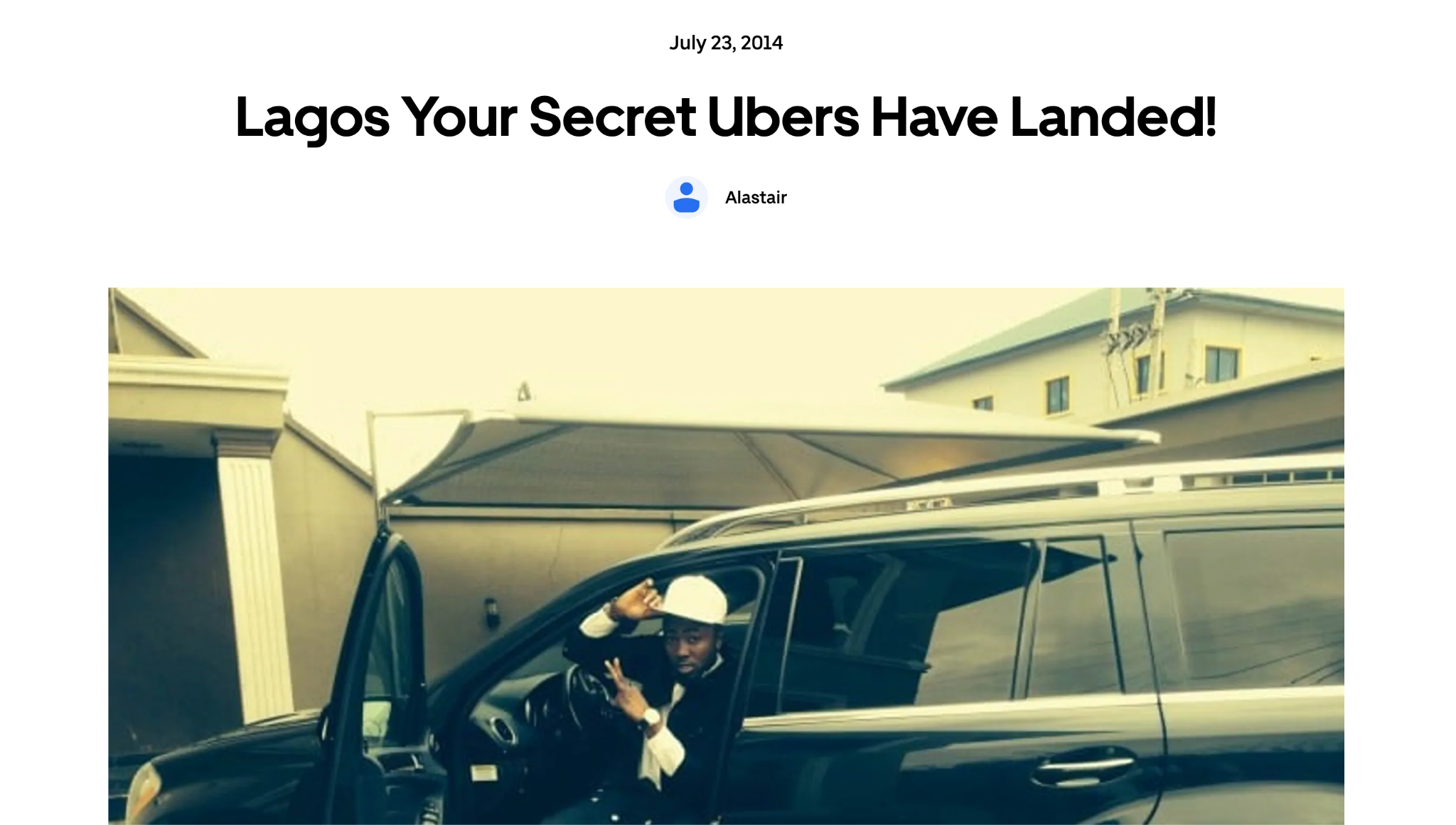
While it was great to be so flush with cash, Uber’s main advantage was that it understood that the ride-hailing product was not really the app, but how quickly a decent car showed up. While Easy Taxi and Tranzit spent years recruiting taxi drivers and trying to bring them online, Uber was looking to make a driver out of everyone with a really nice car. It was paying bonuses to existing drivers when they referred new drivers to sign up. Those new drivers earned ₦40,000 once they completed forty trips.
Uber began in Lagos with the expensive UberBlack: SUVs and new-ish cars for customers willing to pay a premium. In December 2014, it introduced the mass-market UberX and began relentlessly wooing customers.
New users got ₦5,000 first-ride credits, and the ride-hailing company attached itself to events and corporate partnerships. The fancy foreign app was now coming down the price curve to meet everyone else.
Beyond the customer incentives, Uber’s early decision to build a community around its drivers was brilliant. It held sessions and lunches where drivers could meet the Lagos team, ask questions, complain, and hear about changes to the service. It also called them “driver-partners,” language that would become meaningless once the economics of the business changed.
That community provided a steady source of feedback about riders and what was happening on Lagos roads while making drivers feel invested in the company’s success. People who had joined to earn money were soon convincing friends to sign up and defending Uber as though they had joined a movement.
Uber initially charged Lagos drivers a 20% commission, twice Easy Taxi’s rate, and by the middle of 2016, it jacked the commission to 25%. Yet drivers didn’t complain because Uber offered enough trips and bonuses to offset the commission.
By July 2016, two years after launch, Uber had completed more than one million trips in Lagos. Its millionth trip, from Yaba to Lekki, happened on July 16.
Its march to dominance was not without stumbles; Uber launched with card payments only, an important part of the Uber experience globally. But Uber’s merchant accounts were outside Nigeria, so local banks treated rides as international transactions.
As Nigeria’s foreign-exchange crisis worsened in late 2015, some riders were charged more than 20% above the fare shown in the app, while others reported double debits.
In January 2016, Uber began experimenting with cash payments in Lagos and partnered with Paga to accept local cards. Cash brought many more Nigerians within reach of the service, but complicated Uber’s otherwise clean model. Drivers would collect the entire fare, including Uber’s commission, which the company had to deduct from their subsequent card earnings. It was inelegant, but it worked.
By this time, the competition Uber met in the market was fading into the horizon. Easy Taxi left Africa in April 2016 while Tranzit’s public trail simply went cold. The companies had their own problems, but Uber had read the market better and knew that this was about who could put the most and best cars on the road.
Yet as the market began to change, Uber stopped adapting and made strategic missteps that allowed Bolt, and later inDrive, to trounce it.
On Monday, May 8, 2017, Uber driver switched off their apps and drove to the company’s office in Lekki to protest a decision to cut Lagos fares by 40% in response to a price reduction by the increasingly popular Taxify. Drivers, who Uber had courted for years, were not consulted.
The cut exposed how little the word “partner” meant. Uber still took 25% of every fare, while Taxify took 15%. Drivers organised through WhatsApp groups and began moving to Taxify in their hundreds.
Taxify didn’t care about loyalty or exclusivity; it only needed to make trips more attractive on its platform than on Uber. Drivers could keep both apps open and accept whichever request paid better; as more of them chose Taxify, Uber’s wait times rose and riders followed. Taxify was using the same supply advantage Uber had once used against Easy Taxi and Tranzit.
Two months later, Uber tried to repair the relationship by opening a large driver-support centre in Maryland, promising drivers “a voice and a choice.” But the relationship had become increasingly one-way, and by 2020, a drivers’ union accused Uber of avoiding repeated meetings over pricing, safety and regulation.
Uber also squandered its momentum by moving too slowly outside Lagos and Abuja. In December 2020, Bolt launched in ten Nigerian cities at once, taking its total to 21. Uber, which had arrived two years earlier, was still only in Lagos, Abuja and Benin City.
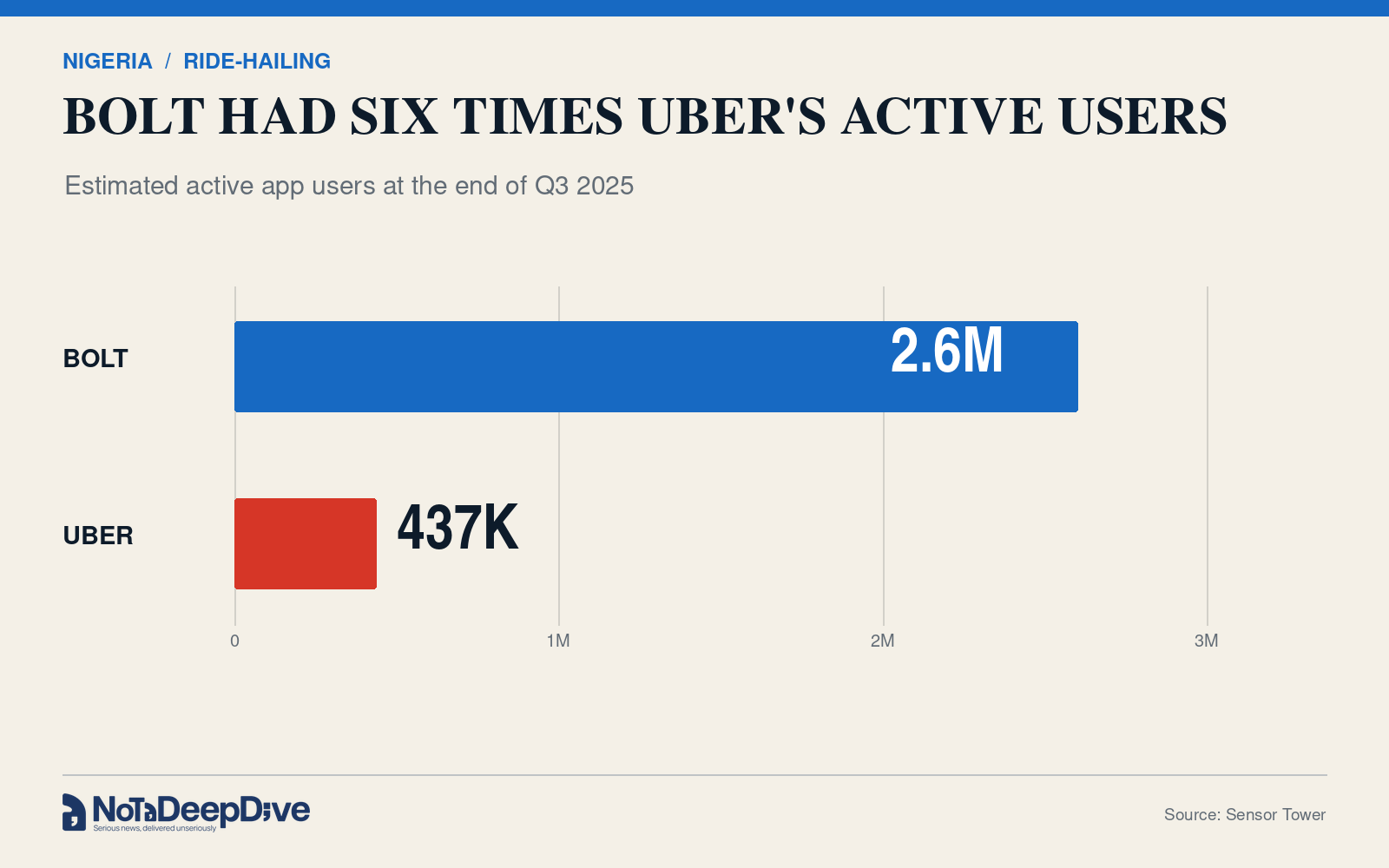
Bolt was operating in 33 cities by 2025, and was, according to Sensor Tower, Nigeria’s most-downloaded travel and mobility app. There is no public breakdown of trips or revenue that gives us a neat final score, but Uber no longer set the pace.
Uber did not get chased out by some uniquely Nigerian hostility; instead, it spent years losing relevance through strategic missteps.
The manner of its exit completed the journey from driver-partners to disposable suppliers. The company gave no warning, with drivers learning of the shutdown in real time as some riders received the notice while they were still in an Uber.
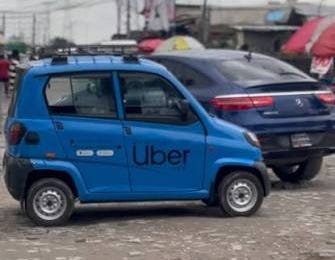
Twelve years after inviting drivers to lunches and promising them a seat at the table, Uber did not even tell them the table was being cleared.
Justice for the 437K people who had high standards and now have to download bolt.
I really enjoyed reading this.