


If you missed Sunday’s Notadeepdive, catch up here. Subscribe for free if this email was forwarded to you:
TOGETHER WITH CREDIT DIRECT
Smart shoppers use Checkout so they spend only what they need to.
Become a Smart Shopper today and buy your favourite gadgets from over 500 merchants with Credit Direct Checkout.
The money is not in delivery
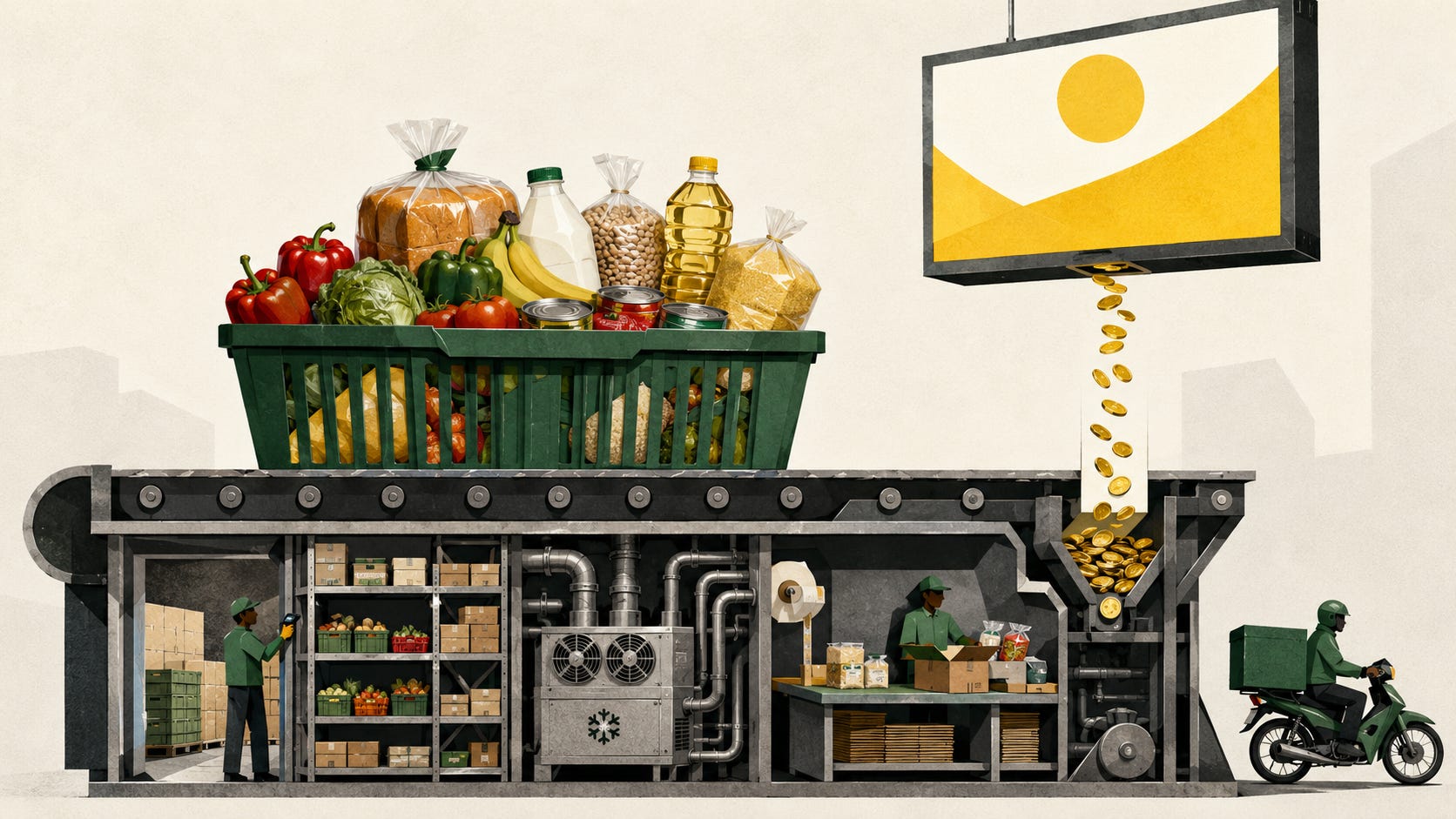
One of the most underrated things about a physical supermarket is that the customer does most of the hard work.
You walk to the store, browse the shelves, pick items, and join a queue to pay. If you’re at one of those new-age stores, you might even have to pay for the shopping bag. When you’re done paying, you carry all that stuff to the car and then into your house.
Despite all this activity, a physical supermarket only manages the in-store experience, ceding pickup and last-mile delivery to the customer.
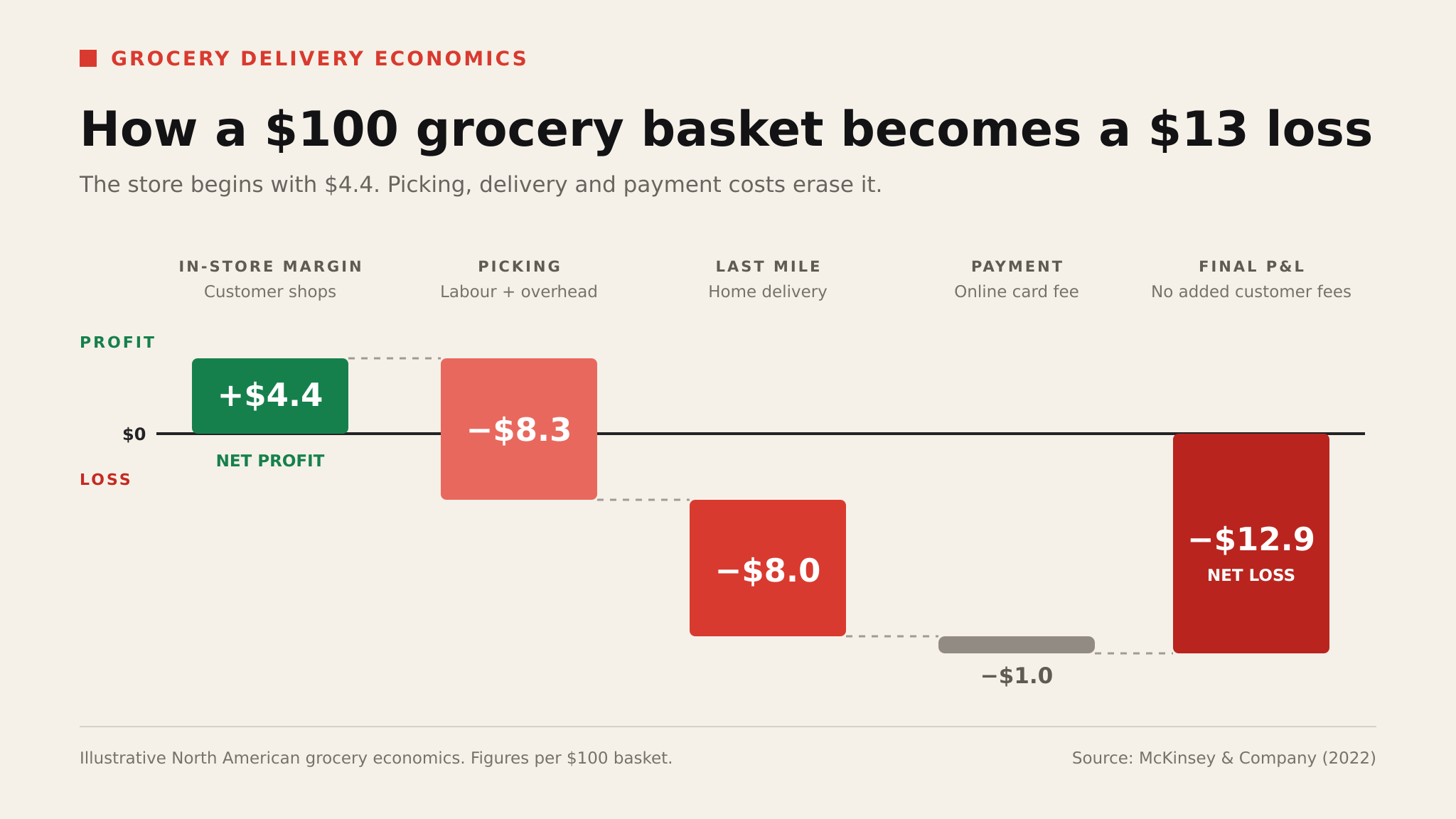
A grocery delivery company, on the other hand, will recreate your shopping experience while you lounge at home or deliver shareholder value at work. It can do this in three broad ways:
(a) The asset-light marketplace owns no inventory, stores or warehouses. It plugs into existing retailers such as Bokku, Addide and Ebeano, then uses shoppers, store employees and gig drivers to deliver orders. This is Instacart and the grocery businesses in Uber Eats and DoorDash. The model requires less capital and can enter new locations quickly. The tradeoff is that the startup has limited control over prices and product quality.
(b) Quick commerce / dark stores own small warehouses called dark stores, stock a few thousand products, and deliver within a two-to-three-kilometre radius. The promise is usually 10–30-minute delivery for small, frequent orders. This is Blinkit, Zepto and Swiggy Instamart in India. It is also the model that produced Gorillas, Gopuff and much of the Western quick-commerce graveyard.
(c) The vertically integrated online supermarket is built for planned, large-basket shopping. The company buys and stores inventory, manages quality, picks orders and arranges delivery from one or more fulfilment centres. Ocado, Jüsto in Mexico and Nigeria’s GoLemon fit here.
Each configuration begins with a set of assumptions about what will make the numbers work.
The five assumptions
The first is that large baskets can carry the cost of delivery.
A ₦2,000 order with a ₦500 delivery fee leaves little after paying the rider. A larger basket produces more gross profit while the delivery cost remains almost the same. But bigger baskets take longer to pick, require more packaging, and may need larger vehicles.
The second assumption is that the company will find enough orders in a small area before it runs out of money.
Density means orders concentrated in space and time. It keeps warehouse workers busy, allows drivers to carry or route multiple orders, and spreads rent, salaries, and electricity across more customers.
This was GoLemon’s decisive bet, and at its second anniversary, the company said it had delivered about ₦2.5 billion worth of groceries. Using the ₦43,700 average basket it disclosed to TechCabal this week, that works out to roughly 57,000 orders over two years, or about 80 daily on average. Its later run rate was likely higher, but the figure shows the scale of the challenge.
Swiggy’s Instamart averaged 1,093 orders per dark store per day in the first three months of 2026 and still lost about $90.8 million at adjusted EBITDA. Across 112.6 million orders, that was a loss of roughly $0.81 per order. Its contribution loss after variable costs was much smaller at about $0.13 per order, showing how close a business can get without actually covering its full cost base.
Instamart and GoLemon served different shopping habits, so there is no universal number of orders at which a warehouse becomes profitable. Store size, basket size, rent, delivery radius and product mix all matter. The common requirement is to spread infrastructure cost across thousands of orders.
The third assumption is that customers will pay full cost for delivery.
Even in rich countries, many customers do not pay the full cost. Delivery fees are waived, discounted, or spread across memberships and service charges. The company then depends on the gross profit from the basket to subsidise picking and delivery, which makes basket size important again.
The fourth assumption is that grocery order frequency will produce valuable, long-term customers.
People buy groceries every week. Win a customer once, keep them for years, so a high acquisition cost seems reasonable. Jumia made a similar bet when it operated food delivery.
Yet the lifetime value calculation only works if the customer stays. Grocery shoppers can split their baskets across several stores, follow discounts, and abandon an app after repeated substitutions or out-of-stock items. High frequency does not automatically produce loyalty.
The fifth assumption is that removing middlemen will produce better prices and higher margins.
Jüsto and GoLemon figure they could source directly from farms and manufacturers, capture some of the intermediaries’ margin, pass some to customers as lower prices and keep the rest.
FEMSA’s investment thesis for Jüsto argued that vertical integration would remove intermediaries and produce fresher food, higher margins and a better customer experience.
Every removed middleman, however, becomes a job for the startup to handle. Supplier relationships, procurement, quality control, inventory management, warehousing, spoilage, picking and delivery. There is no free lunch.
GoLemon did all the work
GoLemon sourced groceries from farms and manufacturers, ran a warehouse and processing centre, managed quality control and built cold-chain capacity for perishables. It also operated the technology for customers to order and arranged delivery to their homes.
It acquired inventory, tying cash up in stock and absorbing the risk that fresh produce would spoil. Supplier prices kept changing in an inflationary economy while its customer proposition promised consistently low prices. That made the business a working-capital machine.
GoLemon told TechCabal that its average order produced a positive contribution after direct costs, although the result varied with basket size, product mix, distance, fulfilment volume and the presence of fresh produce.
That meant GoLemon could buy, pick and deliver an individual basket without losing money on that transaction. It still needed enough of those baskets to pay for warehouses, engineers, supply-chain staff, electricity and the rest of the organisation.
Contribution-positive orders were not enough. GoLemon needed contribution-positive orders at scale.
TOGETHER WITH AFRICA BUILT PODCAST
Episode 1 of the Africa Built podcast does deep into the history of Africa’s first technology unicorn, how it started as two separate companies, Kasuwa and Sabunta. It also shows how it went from launch to IPO in seven quick years.
The other side of the basket
Grocery delivery companies have two routes to survival. They can make fulfilment/delivery progressively cheaper, or they can find another large revenue source.
The first route rewards density, large baskets, efficient picking, short delivery distances, and partnerships that keep fixed costs low. Patient capital can buy the company time to reach that density, but the economics have to improve as orders increase.
GoLemon began splitting the work with Chowdeck in December 2025, supplying groceries to Chowdeck’s dark stores and handling sourcing and quality control. Chowdeck listed selected products inside its app, managed the dark stores, and completed instant deliveries. GoLemon continued serving planned, large-basket orders through its own platform.
The partnership reduced duplication, but it introduced another trade-off. Chowdeck owned the frequent customer interaction, checkout, and instant-delivery data so GoLemon increasingly supplied the groceries for someone else’s interface.
That matters because the best grocery businesses eventually make money from more than groceries.
Instacart generated $1.065 billion from advertising and other revenue in 2025, almost entirely from ads. That was 28.5% of its total revenue and about 2.9% of the $37.2 billion spent through its platform. Its grocery transactions created an audience of shoppers, and brands paid to influence their decision-making.
At Instacart’s mature advertising rate (forgive this tenuous mathematics!), GoLemon’s cumulative ₦2.5 billion of grocery sales would have produced roughly ₦71 million in advertising revenue over two years. That would not have supported warehouses and some employees.
Yet ads cannot rescue an “undense” grocery business because density creates the surface area for an advertising business in the first place.
The same principle applies to subscriptions, private labels, software and financial services. Each becomes more valuable as the platform aggregates more customers, purchases and data. The delivery gets the order to the customer, but the repeated shopping habit creates the profit pools around it.
TL;DR: Grocery delivery is a low-margin retail business with an expensive fulfilment layer attached. Scale makes that layer cheaper. The real money comes from everything the shopping habit eventually makes possible.
Nothing but respect to people in the arena.
See you on Sunday!
Fastest I have ever opened a substack article. 😂
Our Goat