


If you missed last week’s Notadeepdive, catch up here and here. Subscribe here for free if this email was forwarded to you:
TOGETHER WITH NOTADEEPDIVE

Smart shoppers use Checkout so they spend only what they need to.
Become a Smart Shopper today and buy your favourite gadgets from over 500 merchants with Credit Direct Checkout.
Two chances
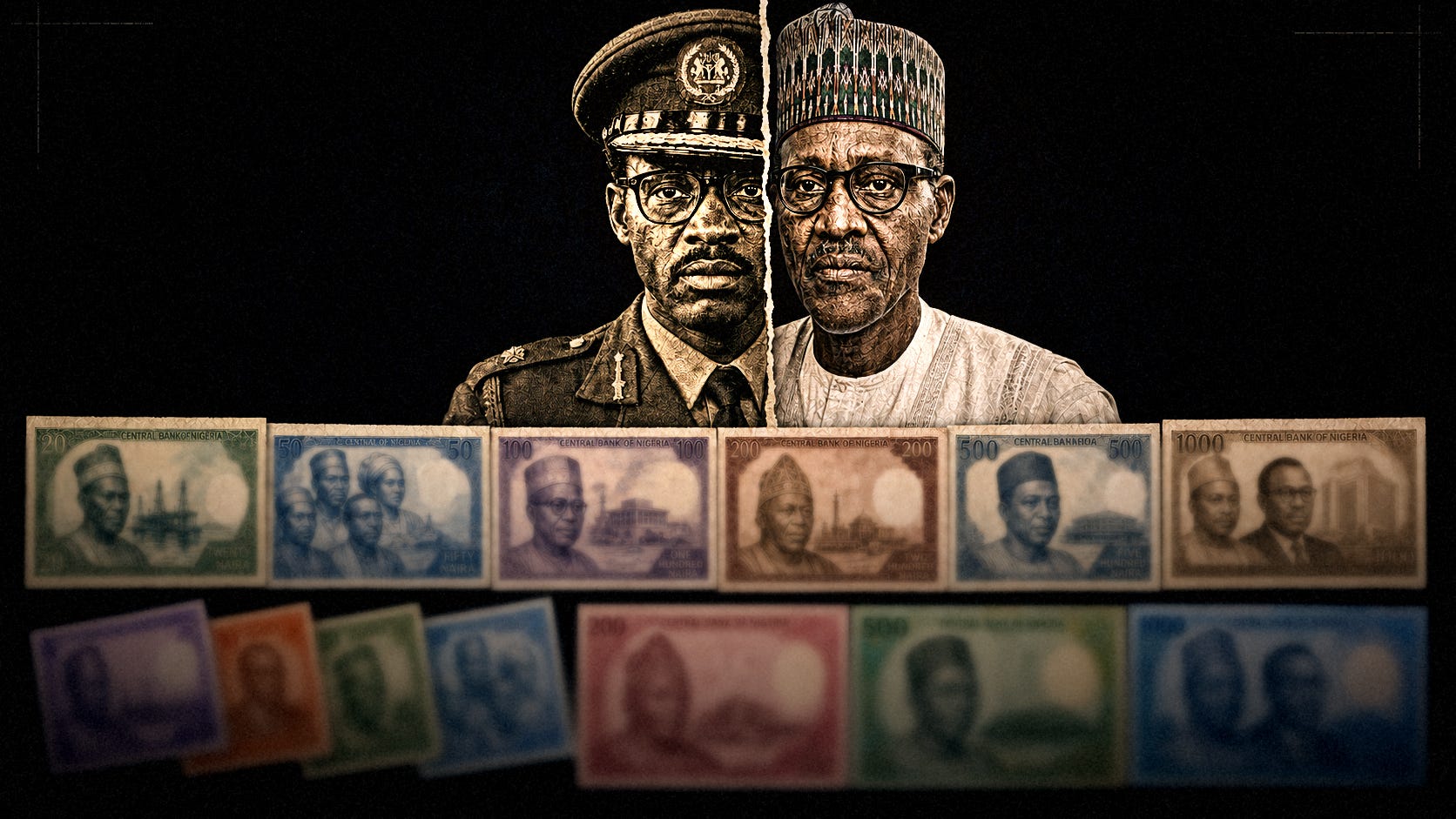
On Monday, 23 April 1984, Maj. Gen Muhammadu Buhari’s second-in-command, Brigadier Tunde Idiagbon, announced that Nigeria was changing the colors of its naira notes. The exchange of old notes for the new would begin at 8 a.m. on Wednesday and end at 6 p.m. on Sunday, 6 May. During that window, all land borders would be closed.
80 million Nigerians had twelve days to exchange almost every old note they had. With barely 1,240 bank branches nationwide, people abandoned offices and market stalls to join queues; in places without banks, they handed their savings to local government officials operating under armed supervision.
Anyone presenting more than ₦5,000—around forty months’ minimum-wage earnings—in old notes had to have a High Court affidavit explaining where the money came from and three passport photographs.
By October 1984, Buhari credited the exercise with reducing money supply and restoring confidence in the naira. The CBN’s figures showed a temporary victory; currency outside banks fell from ₦4.84 billion in December 1983 to ₦3.60 billion by June, and by September, it was back at ₦4.65 billion, recovering most of the fall within three months.
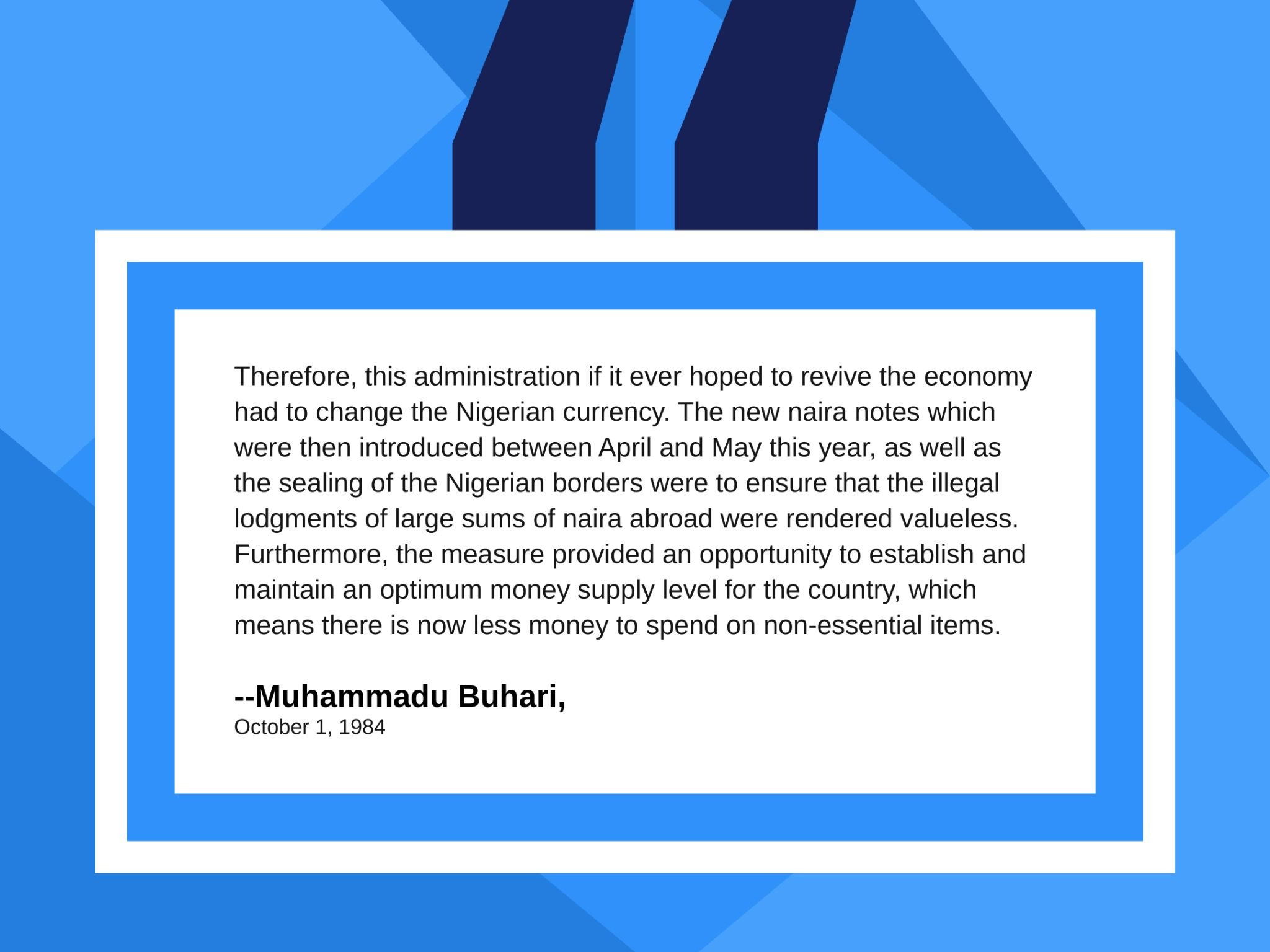
Thirty-nine years later, Buhari tried again, backing another redesign to pull cash into banks.
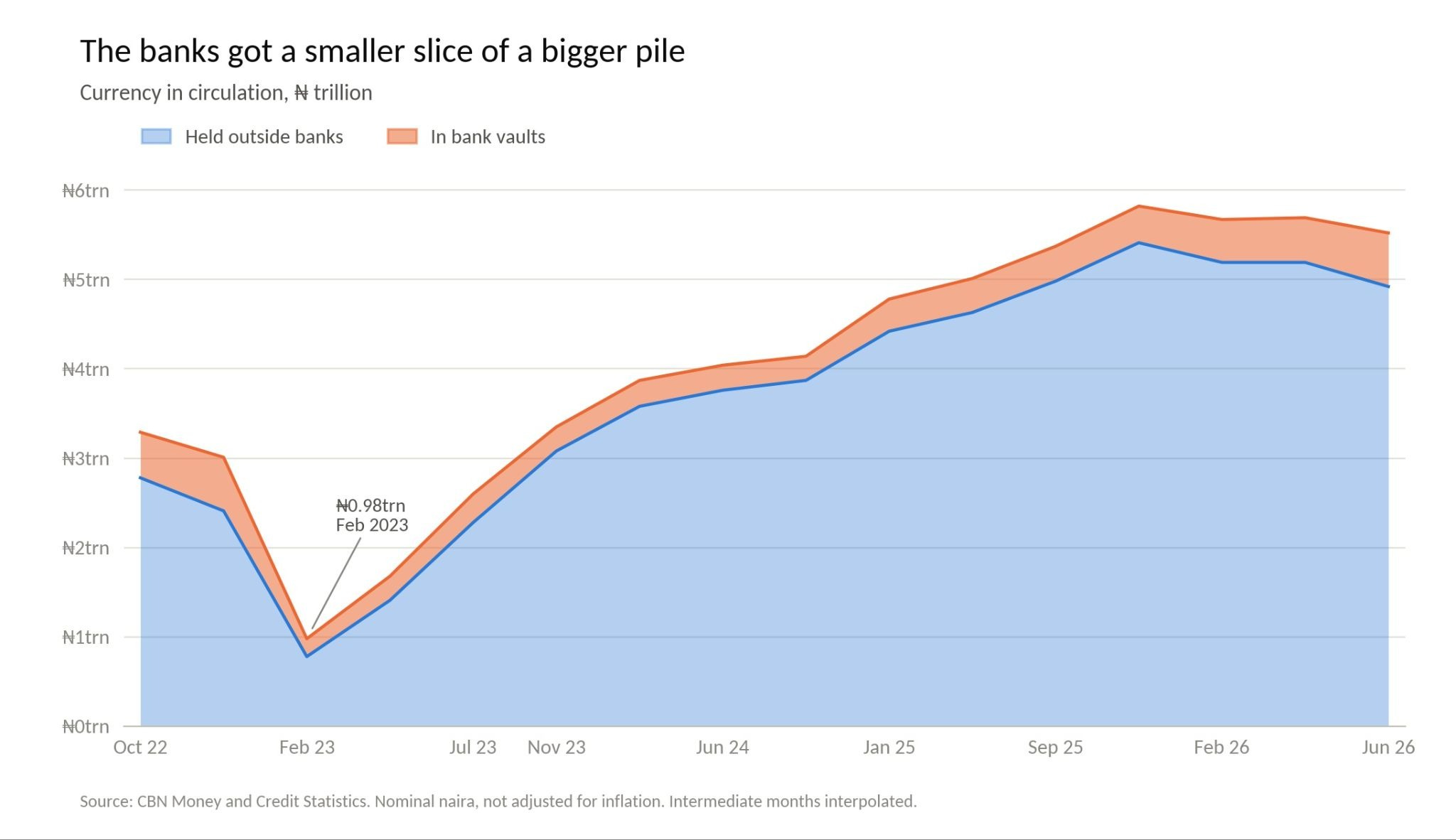
Instead, the 2022 cash redesign engineered the worst cash shortage in Nigeria’s peacetime history. Within two months, currency in circulation fell by more than two-thirds, upending trade and forcing anyone who could to switch to transfers and digital payments.
For more than two months, Nigerians slept outside ATMs and paid as much as ₦1,000 in fees to withdraw ₦5,000; traders lost sales, farmers watched produce spoil, commuters could not pay fares, and hospitals struggled to buy supplies or treat patients.
Godwin Emefiele, who proposed and ran the redesign policy, is on trial over how it was approved and executed. He has denied all the charges, and Buhari, who approved the policy and defended it through the worst of the cash scarcity, died in July 2025.
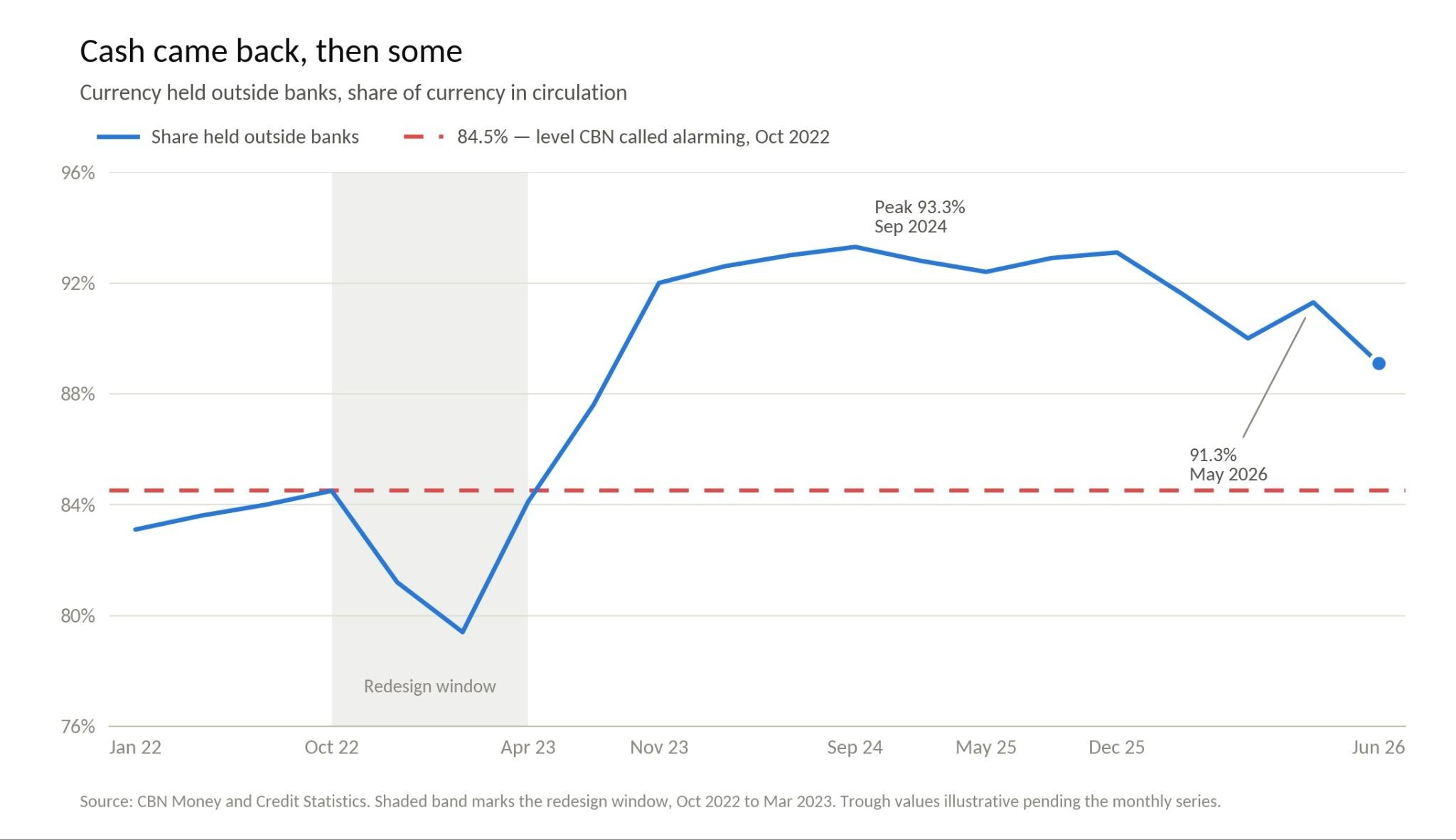
In May 2026, Nigerians held ₦5.19 trillion outside banks, representing 91.3 percent of all currency in circulation. Electronic payments have grown, but cash has returned alongside them.
PoS agents, the villains of the cash crunch, have become an even more crucial part of the financial system.
A number called hoarding
To justify a currency redesign in 2022, Emefiele cited a shortage of clean banknotes, advances in counterfeiting technology and the security situation. Redesigning the naira, he said, would reduce the cash available for ransom payments, reinforce the cashless economy and make monetary policy more effective.
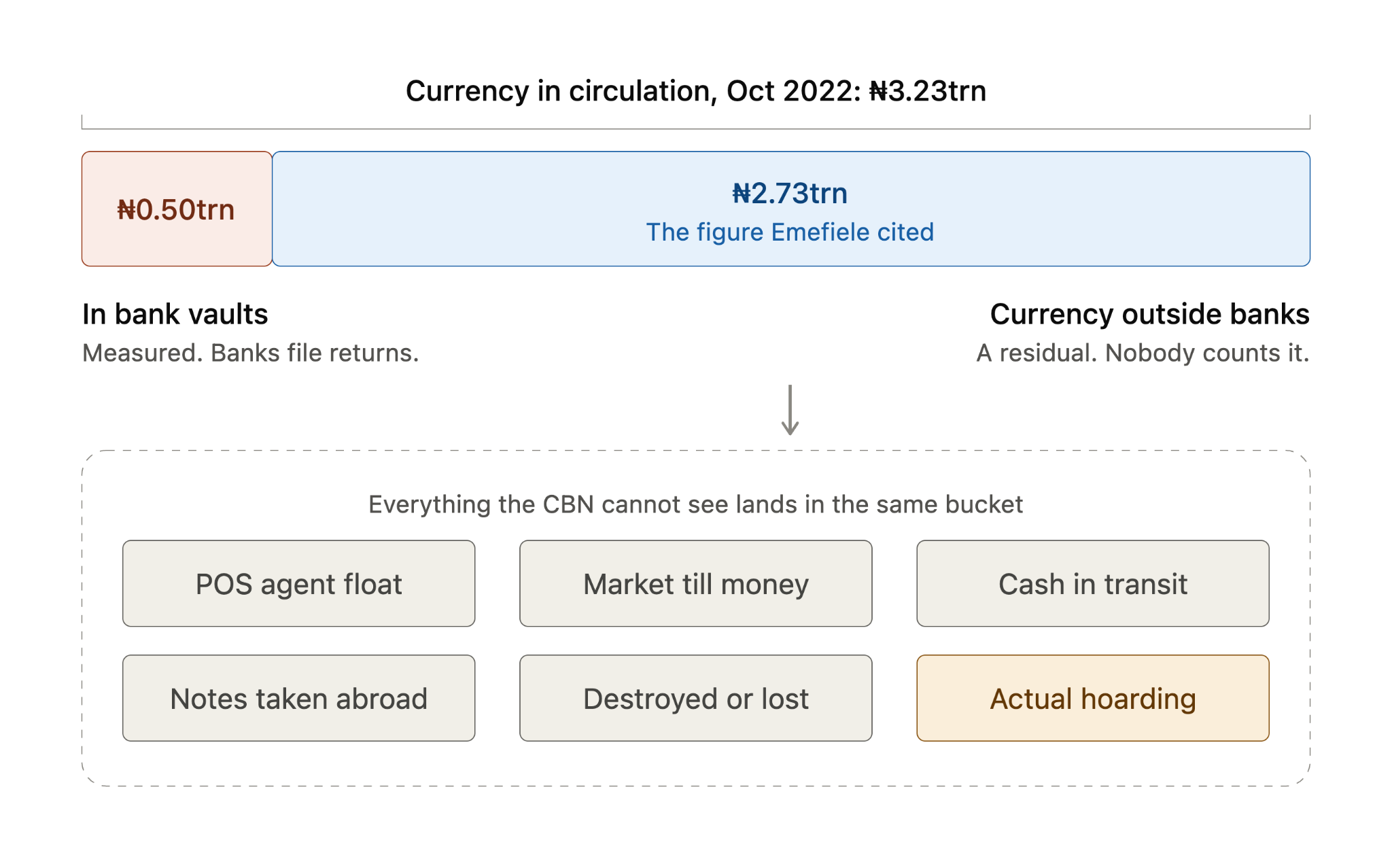
Emefiele said ₦2.73 trillion of Nigeria’s ₦3.23 trillion in circulation was outside commercial banks. He called it a “worrisome trend” and evidence of hoarding.
The figure could not distinguish hoarded cash from money held by households and businesses for daily transactions. Currency in circulation had doubled since 2015, but Nigeria’s money supply had nearly tripled. Cash had fallen from 7.8 percent of it to 7 percent.
The counterfeiting argument for a currency redesign rested on the CBN’s currency operations report, which recorded thirteen counterfeit notes per million banknotes examined in 2020, down from twenty in 2019. Their total face value was ₦56.8 million, or one naira in every fifty-seven thousand in circulation.
Eleven years against cash
The CBN piloted a cashless policy in Lagos in January 2012, imposing processing charges on withdrawals above ₦500,000 for individuals and ₦3 million for companies, while encouraging cards, transfers and other electronic payments. The policy aimed to reduce, not eliminate, the amount of physical cash in the economy.
Cash is expensive to print, transport, sort and secure; it also makes corruption and money laundering easier.
Some parts of this campaign worked because they produced useful alternatives. The Nigeria Instant Payment system enabled near-instant bank transfers while the Bank Verification Number made it easier to identify customers across accounts. The CBN’s 2013 agent-banking framework allowed individuals at corner shops to perform basic banking services in places where opening a branch made little economic sense.
Other alternatives required Nigerians to adopt the CBN’s preferred technology without offering a compelling improvement over products they already had. A year after its launch, the eNaira had yet to move beyond what the IMF described as an initial wave of limited adoption because fintech wallets and mobile-money services already performed many of the functions ordinary users needed.
Cash is a stubborn adversary because it works without electricity or mobile data, and settlement is immediate. It is accepted by a bus conductor or a roadside trader without either party needing to trust each other or a third party.
By 2022, the CBN had spent a decade trying to make electronic payments more attractive and cash more expensive. The currency redesign fused that technocratic campaign with the instrument Buhari’s military government had used in 1984; the CBN would withdraw the money and force Nigerians to adapt.
A controlled shortage
The CBN selected the ₦200, ₦500 and ₦1,000 notes for redesign, which together represented 95.6 percent of the value of all currency in circulation. Nigerians were given from 26 October until 31 January to return them, although the redesigned notes were not scheduled to enter circulation until 15 December.
That left forty-seven days in which old and new notes could circulate together.
On 6 December, before the new notes were released, the CBN added withdrawal limits. Individuals would initially be permitted to withdraw only ₦100,000 a week across counters, ATMs and PoS terminals; companies could take ₦500,000. Following protests, the limits were increased to ₦500,000 and ₦5 million.
The limits showed that the CBN did not intend to just exchange the old stock for an equivalent amount of new cash. It also intended to leave less cash in circulation after the swap.
By 29 January, Emefiele said banks had collected ₦1.9 trillion, with about ₦500 billion still outside the system. The Nigerian Economic Summit Group estimated that only ₦390.3 billion in redesigned notes had been made available by mid-December, against approximately ₦2.9 trillion that were required to replace the withdrawn denominations.
The monetary data showed that currency in circulation fell from ₦3.01 trillion in December 2022 to ₦982.1 billion in February 2023.
TOGETHER WITH AFRICA BUILT PODCAST

Episode 1 of the Africa Built podcast does deep into the history of Africa’s first technology unicorn, how it started as two separate companies, Kasuwa and Sabunta. It also shows how it went from launch to IPO in seven quick years.
Nigeria’s digital infrastructure had grown quickly, but it had grown around ordinary adoption. It had not been built for the forced migration of an entire cash economy within weeks. Bank applications slowed or failed under the traffic, which was unsurprising given that just about five in ten Nigerian adults had a bank account. Many communities had no nearby bank branch, unreliable mobile coverage and limited access to smartphones. A trader who accepted a transfer might still need cash to pay a supplier, load goods into a vehicle or take a bus home.
As the situation worsened, state governments took the federal government to court. On February 8, the court ordered that the old notes should remain legal tender while it considered the case. Eight days later, Buhari addressed the country and restored only the old ₦200 note. The old ₦500 and ₦1,000 notes, he said, would remain invalid.
On 3 March, the Supreme Court ruled that the policy had been carried out without adequate consultation or reasonable notice and ordered that all three old denominations should circulate with the redesigned notes until the end of the year.
The CBN did not formally direct banks to comply until 13 March. By then, traders refused notes they believed other people might reject and banks were unsure whether to dispense cash the president had declared invalid. A court order did not instantly restore public confidence in accepting them.
The World Bank estimated that non-agricultural, non-oil growth in the first quarter of 2023 could have been two percentage points higher without the redesign. Inflation rose from 21.3 percent in December to 21.9 percent in the first quarter. Bank deposits and broad money continued along their previous trajectory, and banking agents became entrenched in the financial system.
The price of money
A PoS agent has an electronic float in a bank or fintech account, and physical cash.
When a customer wants to withdraw, the customer’s account is debited electronically and the agent hands over cash. When a customer wants to deposit, the agent collects cash and sends its electronic equivalent. The agent’s job is to keep both inventories balanced while earning a fee on each transaction.
Before 2023, the fee was largely for proximity because an agent saved a customer the journey to a bank branch or the queue at an ATM. During the cash crunch, customers had to pay a premium for the cash.
Demand for notes rose at the same time that banks stopped supplying them, forcing agents to source cash from petrol stations, supermarkets, traders and any business that still received it from customers. Some agents paid to get cash and passed the cost to their customers.
The Nigerian Economic Summit Group recorded mark-ups of 20 to 30 percent at the height of the shortage.
PoS agents became easy villains because they were the people visibly collecting the fee, and some understandably exploited the shortage. Yet, the underlying cause of scarcity was the CBN, and the banks that had once distributed cash at no direct price could no longer do so.
The accidental migration
Nigerians made 5.2 billion instant-payment transactions in 2022. In 2023, they made 9.7 billion. The value processed through electronic channels rose from ₦387 trillion to about ₦600 trillion.
Some of this growth would have happened without the redesign because Nigeria’s digital-payment volumes had been rising for years. The cash crunch compressed several years of customer acquisition into a few months and forced millions of transactions onto platforms that had previously been optional.
During the crisis, Lagos phone-accessories merchant Oberry Agamah began using Moniepoint terminals because transfers into her regular bank accounts were slow and unreliable. Customers would show that they had been debited and leave with goods before the money reached her.
Payment companies did not create the shortage, but the shortage delivered them user volume and a national demonstration of their usefulness.
The PoS terminals fintechs supply could be used to pay a merchant electronically, but it was also commonly used to withdraw cash.
A customer transfers money through digital rails so that an agent can hand over banknotes. One half of the transaction is cashless, but the purpose of the transaction is to obtain cash.
The naira redesign made electronic payments indispensable without making cash dispensable, and fintechs succeeded by connecting the two forms of money more reliably than banks did.
What stayed
The PoS terminals banks had subsidised so merchants could accept card payments were the machinery of the cash business.
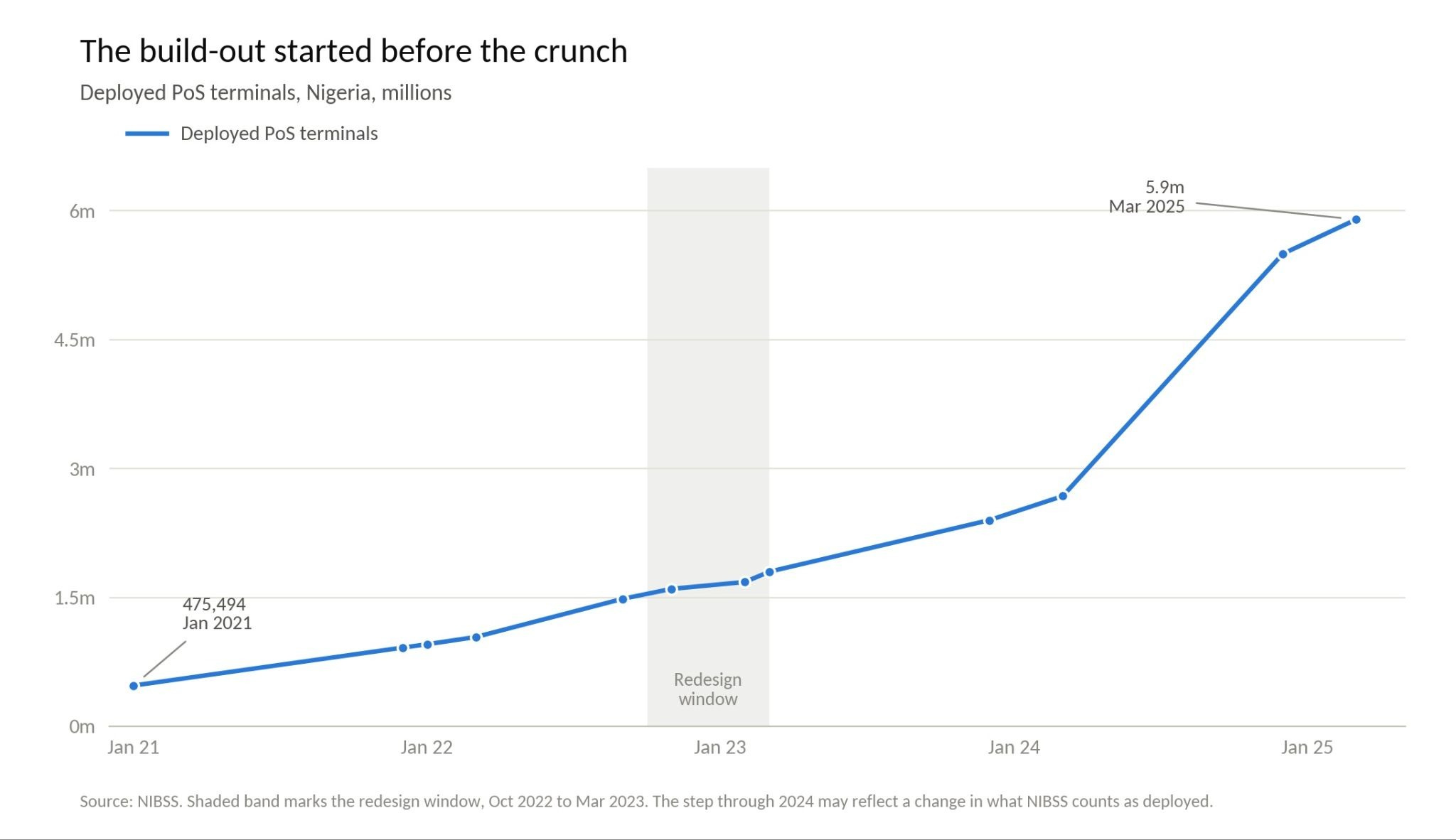
The terminals have become important enough for the CBN to prescribe where they may operate, how they connect to payment switches and how their owners are identified. The regulator that once treated cash outside bank vaults as evidence of a policy failure now regulates millions of businesses whose central service is distributing that cash.
The CBN has also returned to its older instrument. Since January 2026, individuals withdrawing more than ₦500,000 a week pay a 3 percent charge on the excess while companies pay 5 percent above ₦5 million. Forty percent of the charges go to the CBN and 60 percent to the financial institution processing the withdrawal.
Payment systems that gave Nigerians something better than cash grew; instant transfers were faster than cheques and agents were closer than bank branches.
Policies that relied on making cash unavailable worked only while the pressure remained. Cash outside banks fell after the 1984 swap and recovered within months. It fell more dramatically in 2023 and returned as soon as the old notes were allowed back into circulation.
There is still no public accounting of how much illicit money either exercise exposed. There is no figure showing how much counterfeit currency was prevented from returning or how much unexplained wealth was identified because its owner tried to exchange old notes.
Buhari’s two currency swaps demonstrated the reach of the Nigerian state. In both cases, the government could compel citizens to surrender the money in their possession. It could reduce currency outside banks for as long as it restricted the replacement.
It could not make the need for cash disappear.
Send you next week!
Surprising to see the cash outside banks rise to 91% while we break new records monthly on digital money movement.
How much money is in Nigeria really?