


If you missed last week’s Notadeepdive, catch up here and here.
TOGETHER WITH CREDIT DIRECT

Your business doesn’t need 14 accounts.
It needs a Credit Direct Business wallet.
Interswitch’s Revenue is Surging
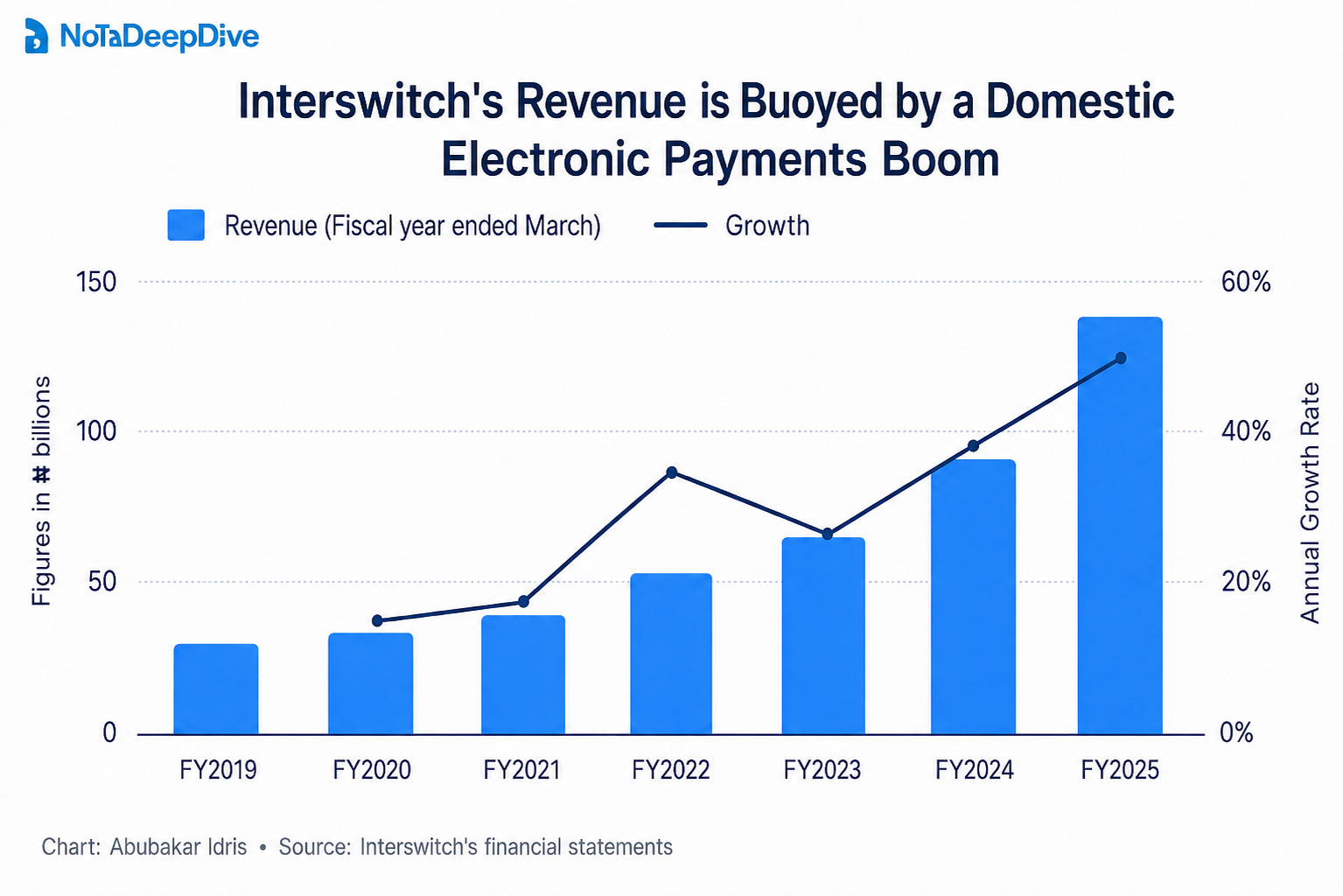
For a mature business, Interswitch is one of Africa’s fastest-growing technology companies. Last year, its revenue topped ₦100 billion for the first time, driven by an incredible 50% annual growth, according to its most recent financial report for the fiscal year ended March 2025. And over the last five years, gross revenue at the Nigerian payments company has surged fourfold, from ₦39 billion in 2021 to ₦137.5 billion last year. Interswitch is recording an impressive run thanks to the growing adoption of digital payments in Africa, notably in Nigeria, which accounts for 90% of its revenue.
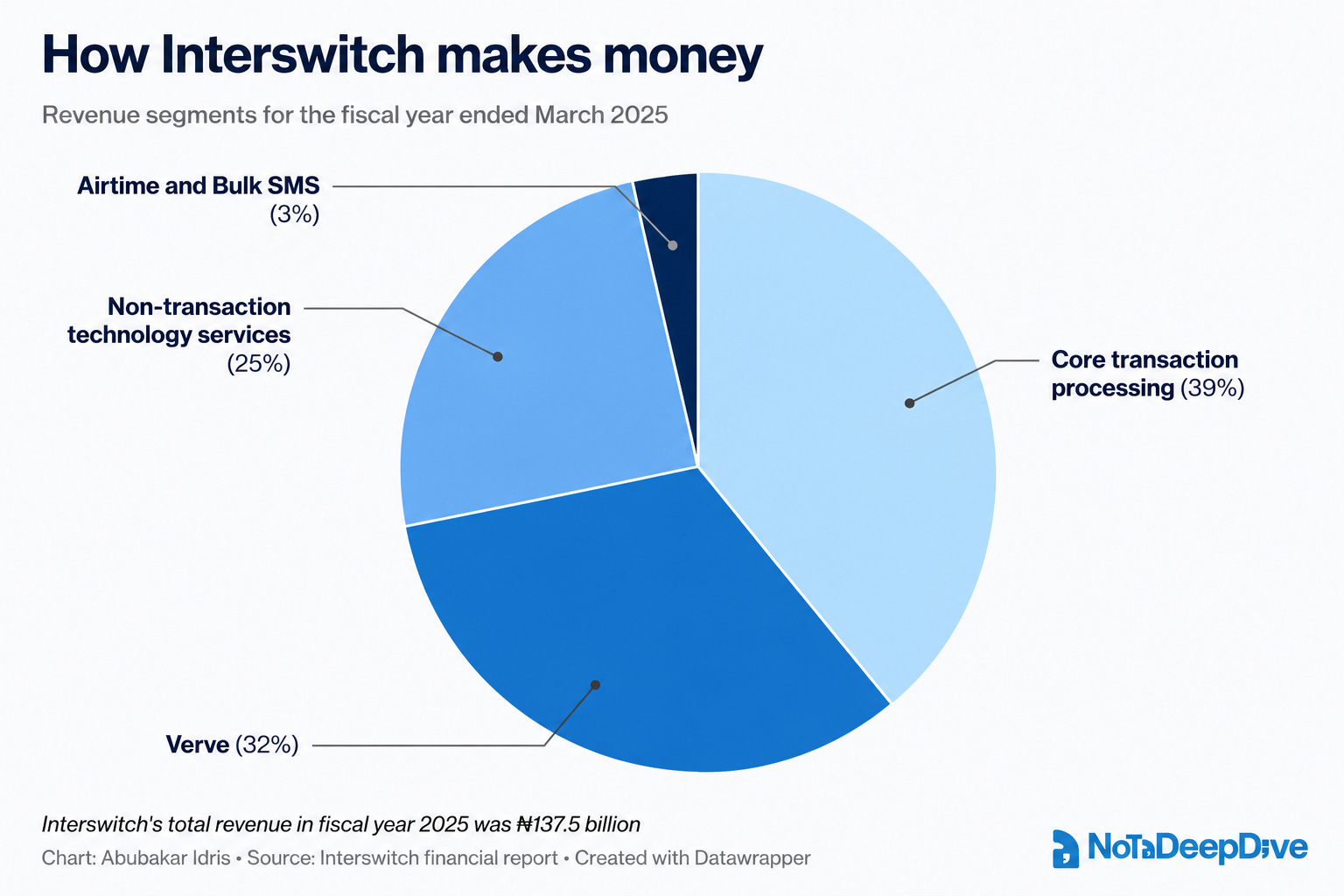
Founded in 2002, Interswitch is one of the pioneers of digital payments in Nigeria. For years, Interswitch’s bread and butter was providing switching and transaction processing infrastructure to banks and enterprises, internally branded as Purepay. Now, a growing share of its business comes from retail services, particularly Verve, its card network scheme, dubbed Paytoken internally, according to its financial statements.
Like Mastercard and Visa, Verve cards are issued by banks and consumer-facing fintechs to customers, while Interswitch takes a small cut on all transactions done with the card. First launched in the early 2010s, Verve is offered in a number of African countries, and partnerships with international platforms like Capital One’s Discover enable cardholders to make payments abroad.
Interswitch operates other direct-to-consumer financial services through the QuickTeller and M-Kudi mobile money brands. And, as expected of every Nigerian fintech, the company also sells airtime recharge and bulk telecom texting products.
Over the last decade, Verve has been the standout performer with sustained growth. It now represents 32% of Interswitch’s gross revenues, with year-on-year card revenue rising 39% by March 2025. On the one hand, Verve is benefiting from the faster adoption of card payments in Nigeria, a process that has taken more than two decades to reach critical mass. On the other hand, Nigeria’s challenging macroeconomic environment, especially exchange rate volatility in recent years, has discouraged financial institutions from issuing foreign cards, such as Visa and Mastercard, to manage dollar-related costs.
The size of the domestic market is also fueling Interswitch’s growth. The number of Nigerian adults who have access to financial services has jumped to over 64% or 111 million, up from 40 million in 2020, according to think tank Enhancing Financial Innovation & Access (EFInA). This is thanks to the rapid advancement of mobile payment solutions by merchants and customers. While fintechs like OPay and Moniepoint race for dominance over peer-to-peer and merchant payments, Interswitch has primarily positioned itself as an infrastructure provider to power the real-time payments and debit card issuing needs of these companies.
In 2024, the total value of the country’s electronic retail payments, which includes merchant and peer-to-peer transfers, reached ₦1.1 quadrillion, as I predicted a year earlier, according to data from NIBSS. That figure is three times the size of the Nigerian economy. To put this in perspective, US retail electronic payments represent only a third of its GDP. Interswitch now “processes more than 90% of Nigeria’s card and mobile money transactions”, according to LeapFrog Investments, which acquired a stake in the business in 2022. Interswitch doesn’t disclose its own payments data in its financial reports.
As a result of these good fortunes, Interswitch’s profit margin widened to 11% in fiscal year 2025, its first double-digit earnings since 2022, before the naira significantly depreciated against the dollar.
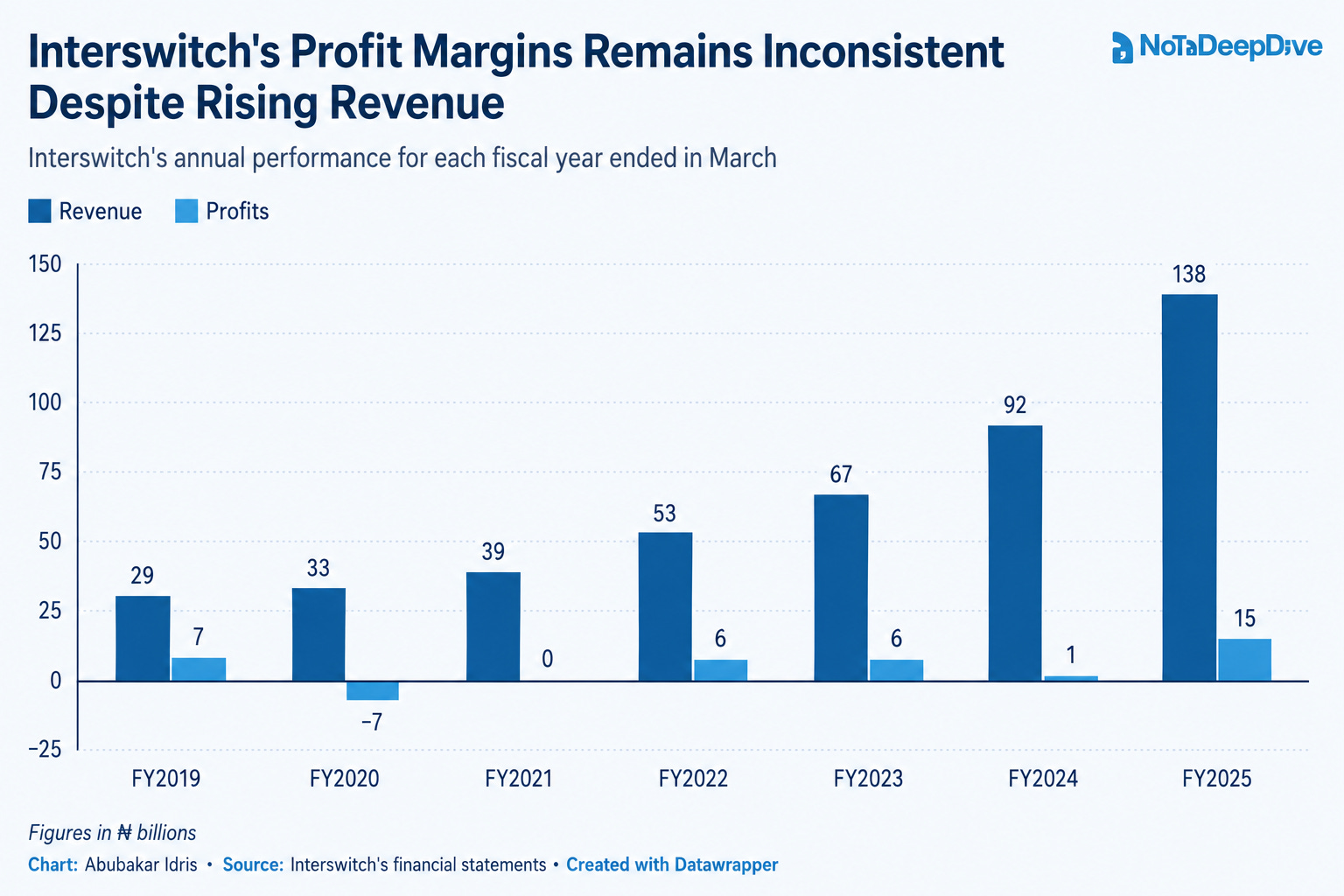
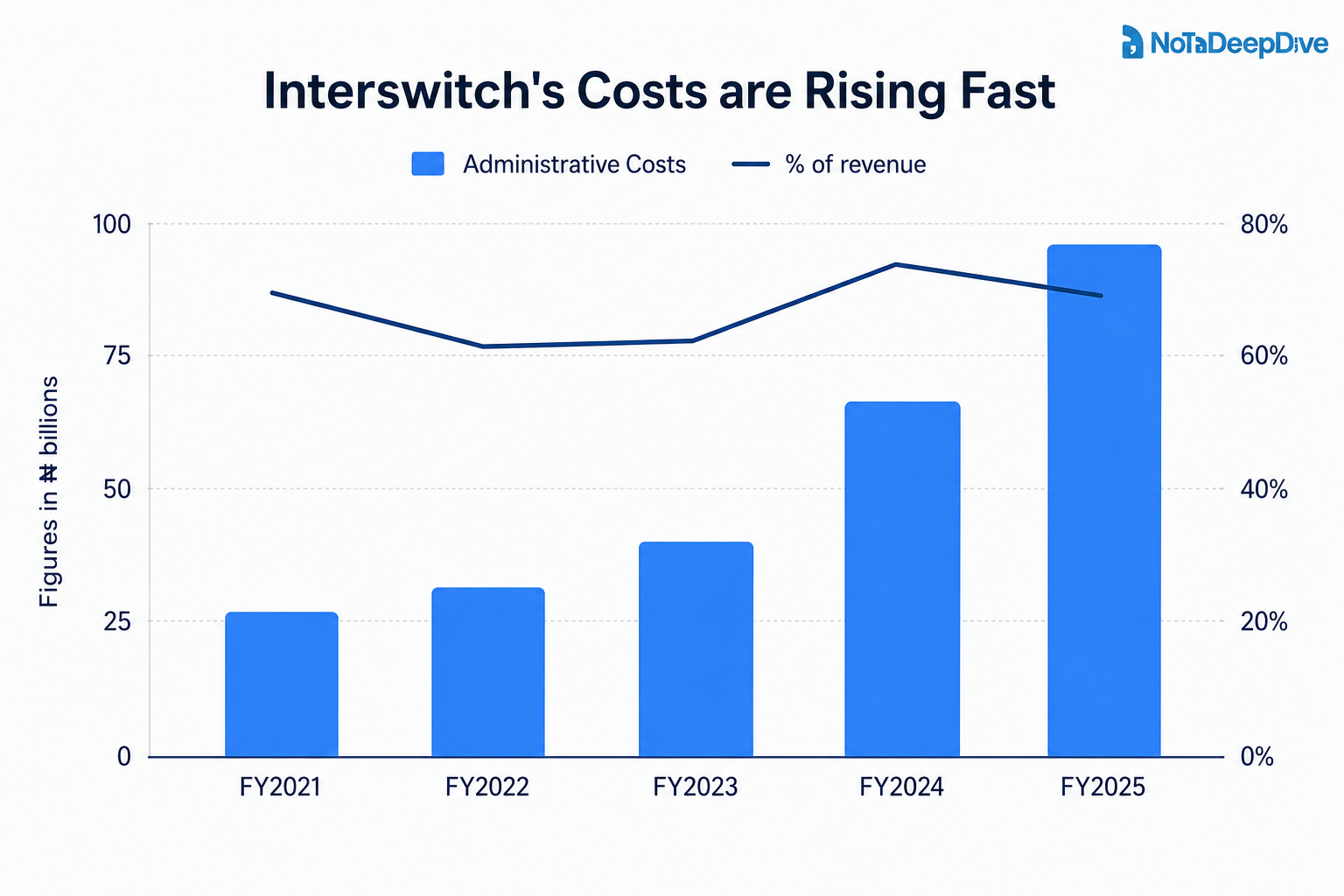
Despite its run of positive results, Interswitch continues to struggle with rising costs. Its administrative expenses, which include salaries and other operating bills, are growing much faster than its revenue. Costs have ballooned from ₦26.3 billion in 2021, representing 67% of revenue, to ₦96.2 billion (or 70% of revenue) in 2025, which itself was a 43% increase from the previous year. Interestingly, the company is incurring an ever-growing bill despite moderate staffing increases. For example, in 2025, its total workforce rose 16%, but salary expenses alone surged 78%.
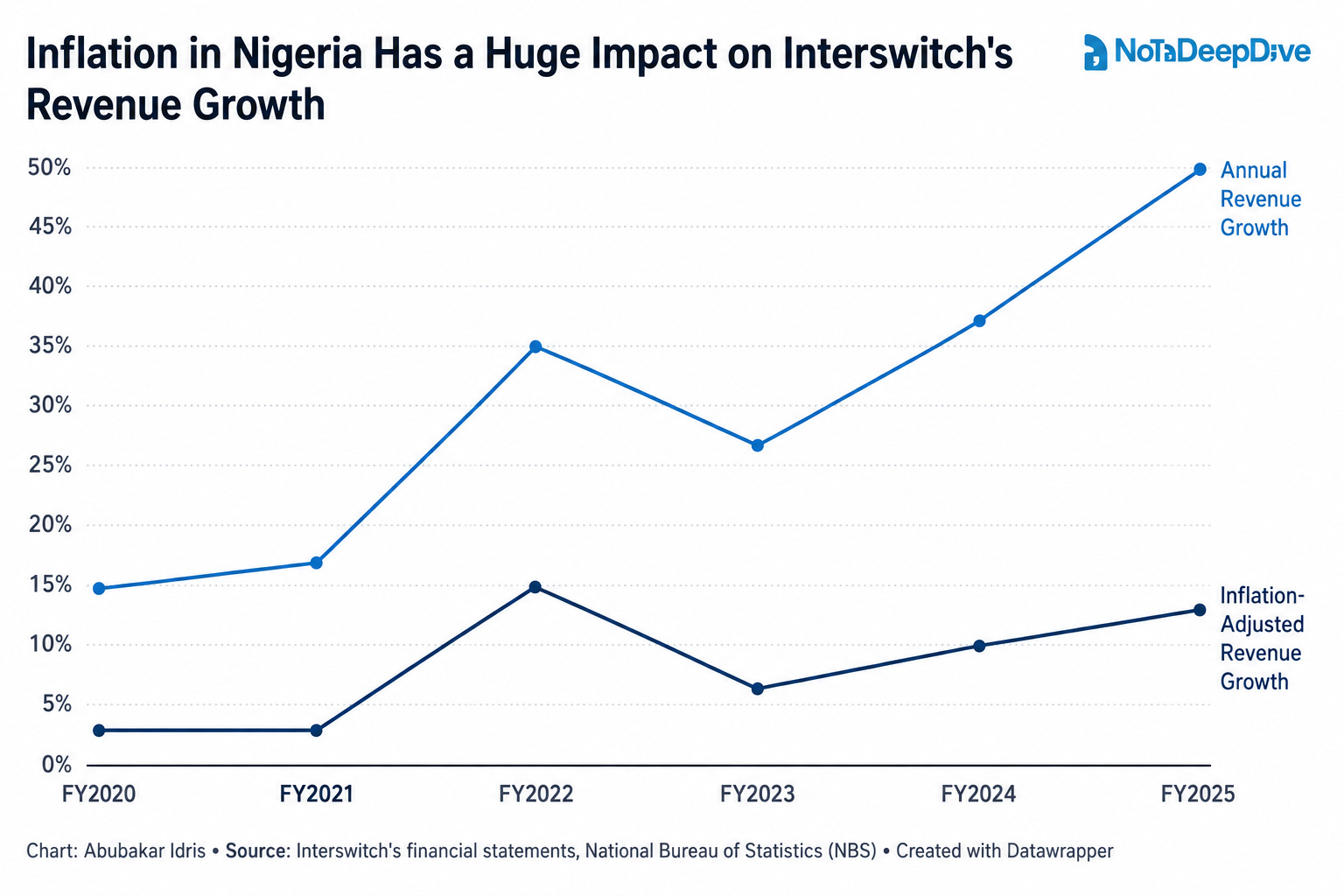
Even more crucial, Nigeria’s inflationary environment is hurting Interswitch’s top-line performance. While the company has achieved average revenue growth of 30% over the last six years, inflation-adjusted annual revenue for the same period grew at a mere 9%
Its investors have already priced in these challenges. In 2022, when Interswitch announced a $110 million investment from Tana Africa and LeapFrog, the round valued the company at $750 million, a 25% discount from 2019, when it raised at $1 billion, according to data from PitchBook, the market intelligence platform. Neither Interswitch nor its investors disclosed the company’s valuation at the time. But PitchBook’s figure is a highly reliable proxy. Perhaps that discount was due to Nigeria’s exchange rate decline, which has only worsened in subsequent years. However, this doesn’t tell the full story.
In 2019, Interswitch’s $1 billion valuation implied it was worth ₦306 billion in local currency terms at the time. Put differently, the fintech was valued at 11 times, or 11x, its fiscal year 2019 revenue. Revenue multiple is one approach to valuing a business, especially one that is witnessing high growth but has inconsistent profits.
Following the 2022 investment from LeapFrog and Tana, Interswitch’s revised $750 million valuation implied its naira market value had actually remained relatively flat at ₦315 billion, suggesting a multiple compression to just 6x its revenue for fiscal year 2022. The prevailing exchange rate at the time was ~₦421 to a dollar. Although Interswitch’s revenue had grown substantially between 2019 and 2022, the new investors were only willing to pay 6x for each naira of that revenue compared to the 11x investors paid in 2019.
Applying that 6x multiple to Interswitch’s fiscal year 2025 revenue (₦138 billion) would yield an ₦825 billion valuation — a massive jump — or just $611 million due to Nigeria’s significantly beaten-down exchange rate of ₦1,350 as of today.
The double whammy of devaluation and a challenging inflationary environment in Nigeria may have made it difficult to reprice the company upwards to account for its objectively faster growth rate. At an 11x multiple, Interswitch’s fiscal year 2022 revenue would have put its valuation at ~$1.4 billion.
Nevertheless, that round priced the fintech at a discount, even compared to the trading multiples of its peers like Visa (15x), Mastercard (16x), and even Adyen (32x) at the time. But at least it was better than the downtrodden PayPal (3x), which continues to be the sick man of the global payments market. In addition, Interswitch’s latest valuation puts it significantly lower than younger fintechs like Flutterwave and Moniepoint, valued at $3.3 billion and $1.4 billion, according to PitchBook data from each company’s most recent funding round.
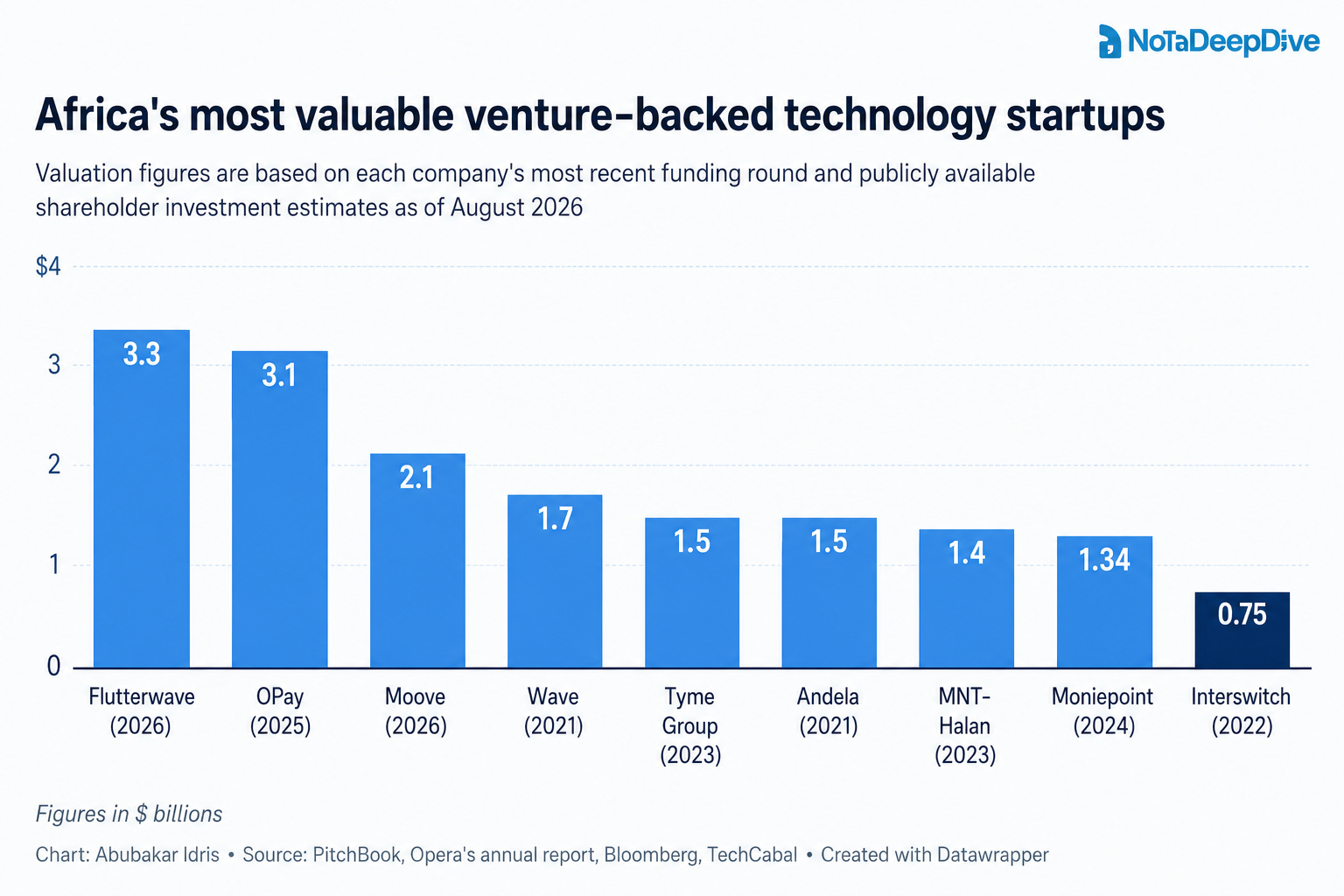
Elsewhere, Norway-based browser company Opera valued its 9.5% stake in Nigeria-based OPay at $294.6 million at the end of 2025, according to its financial statement filed with the US SEC. This implies that OPay’s valuation now stands at $3.1 billion, a 13% jump from its fair value in 2024. Eight-year-old OPay, which is backed by several major Chinese investors, is on track to go public later this year after hiring Citigroup, Deutsche Bank, and JPMorgan Chase for its planned stock market debut at a ~$4 billion valuation, according to Bloomberg. Interswitch, on the other hand, has remained majority-owned by UK-based PE firm Helios Investment Partners since 2010.
Going forward, Interswitch’s focus appears to be on revenue growth by reinforcing its core business and expanding into new areas over the next few years, especially in non-Nigerian markets, which represented 10% of total revenue in 2025, up from 6% one year earlier. The company is stepping up its presence across the continent through a seven-year partnership with Nebraska-based fintech, ACI Worldwide, to sell ACI’s payment services, including real-time infrastructure, in 32 Sub-Saharan African countries.
As Nigeria’s fintech market grows and inflation decelerates, Interswitch is poised to benefit as long as it brings costs under control.
See you on Friday!

If Interswitch is listed on the NSE, would it be worth less than it is worth now?
Interesting times. 😅