


If you missed last week’s Notadeepdive, catch up here and here.
TOGETHER WITH CREDIT DIRECT

This term, Credit Direct Checkout is going all the way with you.
Get up to N1,000,000 to purchase iPads, laptops and other school essentials from over 500 merchants.
IPO Fever

I read the essay “Is This IPO Halal” this weekend, the latest in Feyi Fawehinmi’s long-running critique of Africa’s richest man. That scrutiny has produced some fantastic articles, and this one raises pertinent questions about the quality of research Nigeria’s investment banks are publishing for a transaction of this size.
My small disagreement is with one small part: the suggestion that the excitement reflects Nigerians’ fascination with Aliko Dangote, a man who pretty much gets whatever he wants.
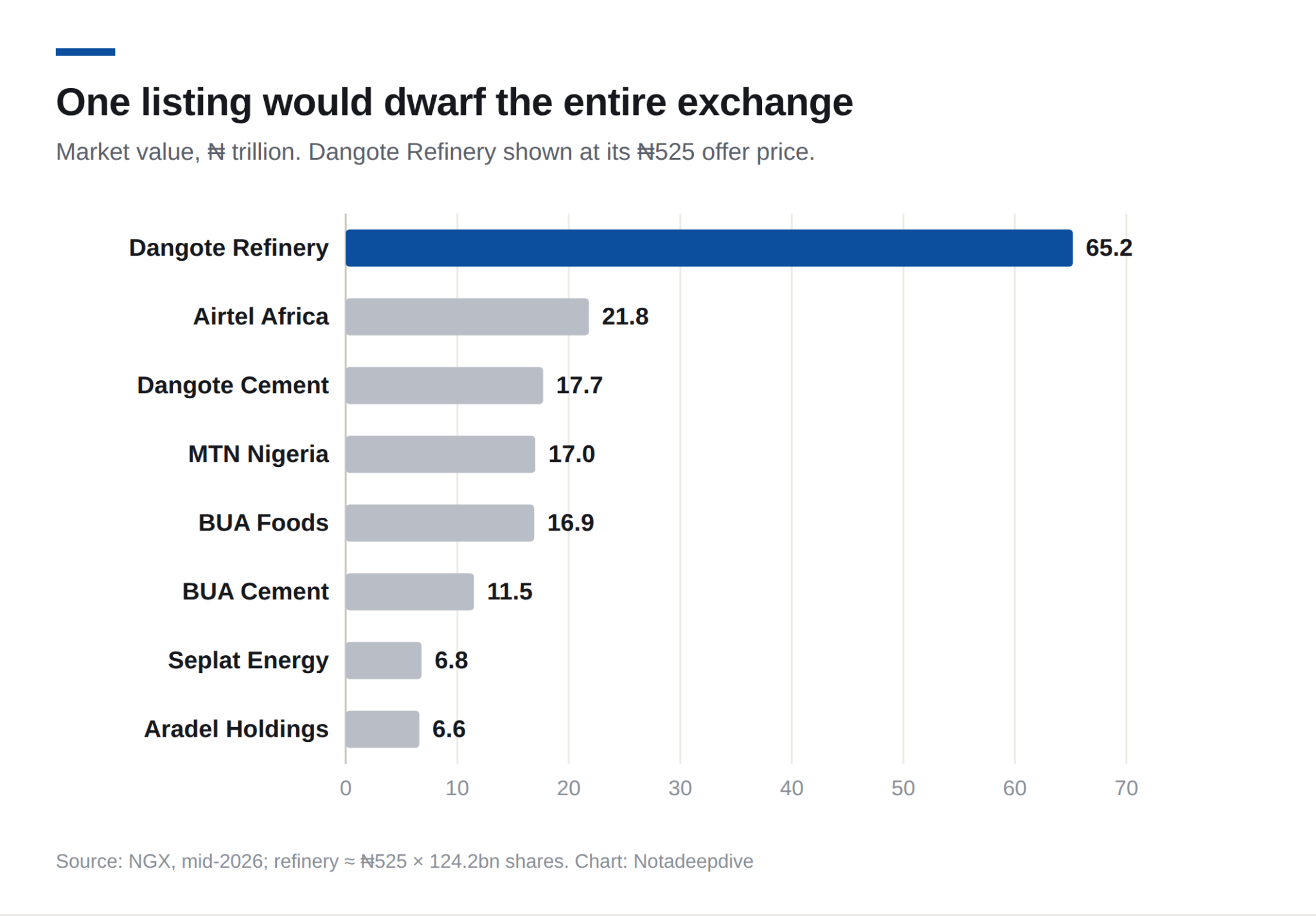
Huge Initial Public Offerings (IPOs) capture public imagination anywhere. At the offer price, Dangote Refinery would be worth roughly ₦65 trillion, nearly three times Airtel Africa, currently the largest company on the Nigerian Exchange. For investment banks, there are fees to earn; for ordinary people like me, a spectacle to follow. That gives the company considerable leverage.
For investment banks, there are fees to earn and, for ordinary people like me, a spectacle to follow.
In April, the New York Times reported that Elon Musk demanded that banks seeking a role in SpaceX’s IPO buy subscriptions to Grok. Some banks agreed to spend tens of millions of dollars annually on the chatbot. He also asked them to advertise on X, although he was less insistent about that.
Walking away meant leaving a potentially enormous payday to another bank.
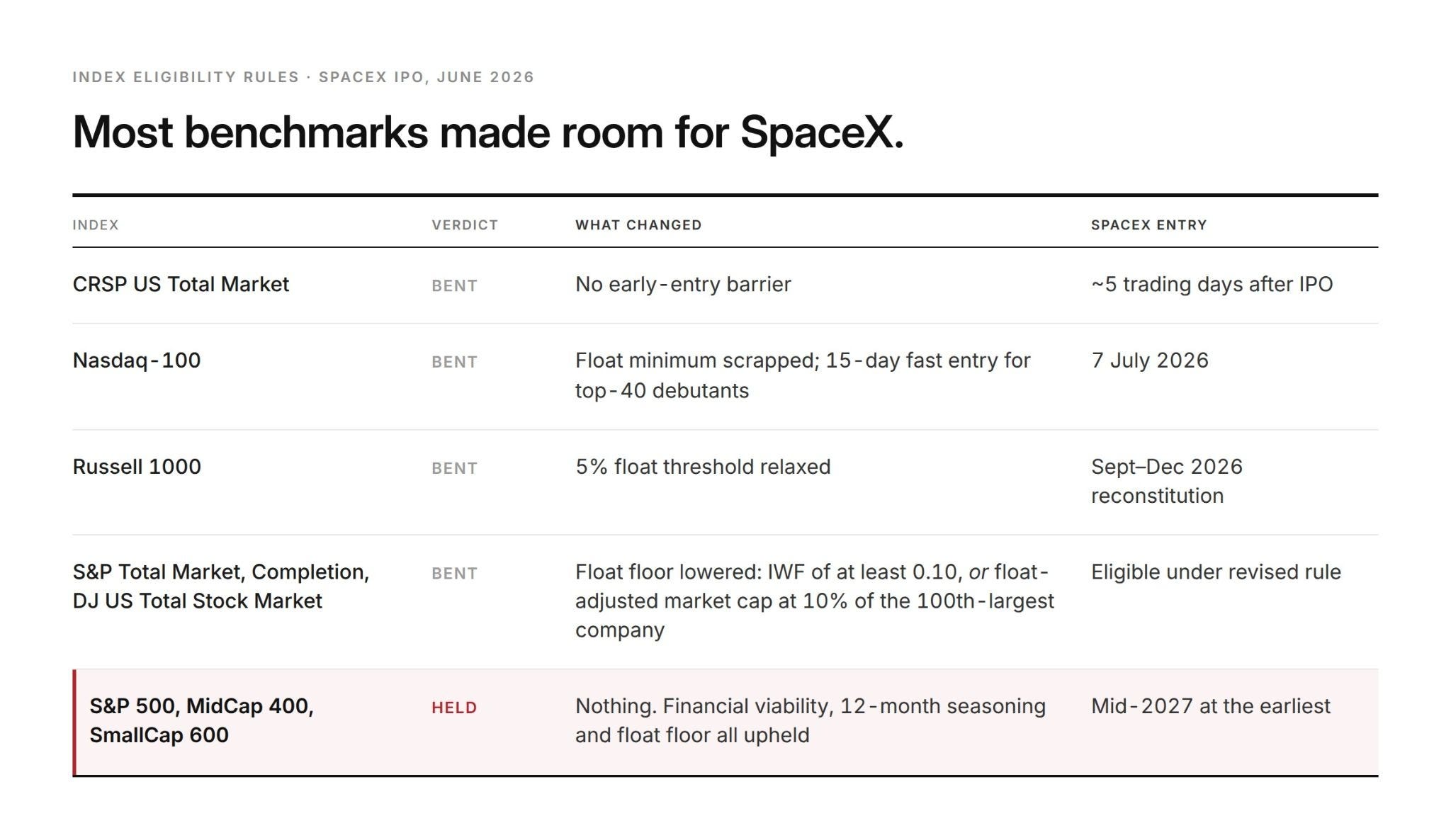
Index providers had a different problem: how long could they exclude an enormous new company before investors questioned whether their benchmarks still represented the market?
S&P Dow Jones Indices considered shortening the waiting period for IPOs from 12 months to six, and exempting really large companies from its profitability and minimum 10% public-float requirements. Nasdaq introduced a route to allow qualifying large listings into the Nasdaq-100 after just 15 trading days.
As Matt Levine wrote: “At some high enough valuation, you gotta defer to the market.”
In Nigeria, PenCom waived existence, profitability and dividend requirements for the Dangote Refinery IPO, citing its strategic importance and fundamentals. That could reflect the accommodation an unusually large issuer attracts. PenCom still owes retirement savers the assessment behind its decision.
Ultimately, with a sufficiently large offering, even established rules become negotiable.
MTN’s fintech business
I’ve said a few times here that MTN Nigeria’s fintech business is basically airtime lending with a dash of mobile money. Its reporting puts both in the same revenue bucket, making it difficult to see how much each contributes.
This year, a dispute over applying the FCCPC’s consumer-lending rules to airtime advances interrupted the business. MTN suspended Xtratime in mid-April and began a phased restart in July.
MTN disagreed with the FCCPC’s definition of airtime lending as consumer loans, and the matter went to court. Before the court returned a decision, MTN suspended Xtratime, the said lending service.
This was bad news for customers who needed airtime and even worse news for MTN’s fintech revenue. But it was excellent news for nosy journalists who always wanted a look inside that fintech revenue bucket.
MTN Nigeria reported ₦64.2 billion in fintech revenue in the first quarter of 2026. With Xtratime suspended for most of the second quarter, that fell to ₦13 billion.
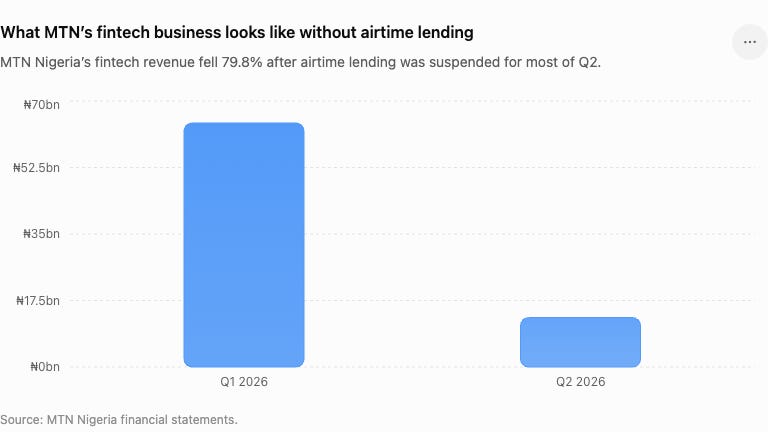
The remaining ₦13 billion is not all MoMo revenue, and Xtratime still operated for part of the quarter. Still, removing one product coincided with a four-fifths collapse in fintech revenue.
MoMo was growing throughout this as mobile-money revenue rose 132% year-on-year in the first half, and active wallets reached five million. The wider fintech category still recorded a 7.2% revenue decline.
The disruption even affected MTN Group’s outlook. It expects fintech revenue growth to remain below its medium-term target of roughly 30% as airtime lending in Nigeria rebuilds.
The dependence reaches beyond Nigeria as MTN Group expects fintech growth to remain below its medium-term target as it reintroduces Nigerian airtime advances.
There is nothing embarrassing about airtime lending, and it is a very good business. Many fintechs would kill for a lending business where the risks of default are tiny and said risk sits with a third party.
But a highly profitable lending product built on your telecom network is a different proposition from a mobile-money business that can compete with OPay, PalmPay or Moniepoint.
A MoMo question
At the end of March, MoMo had 3.3 million active wallets and ₦18.9 billion in customer deposits. By June, active wallets had risen to five million, but deposits had fallen to ₦14 billion.
That works out to roughly ₦5,700 in deposits per active wallet in March and ₦2,800 in June. It is a rough ratio, but it basically shows that more active wallets have also coincided with less money on the platform.
Are customers keeping smaller balances while transacting more, or using MoMo only occasionally?
See you next week!
Mr Fawehinmi has a worrying obsession with everything Dangote. That’s very concerning…..