


Raenest is launching a stablecoin vault for eligible customers to access a variable yield of up to 7% APY on their USDC and USDT balances. Check it out here.
If you missed Tuesday’s Notadeepdive, catch up here.
TOGETHER WITH CREDIT DIRECT
This term, Credit Direct Checkout is going all the way with you.
Get up to N1,000,000 to purchase iPads, laptops and other school essentials from over 500 merchants.
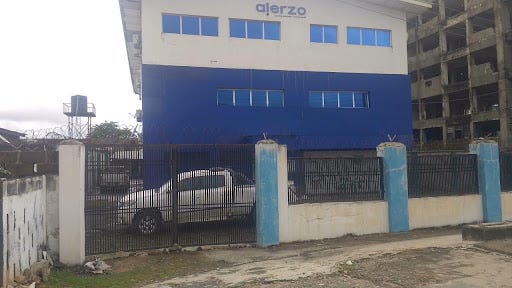
On Wednesday morning, the gates of Alerzo’s office on MKO Abiola Way in Ibadan were shut. Two Hilux trucks sat in the compound, but there were no security guards around. Shop owners on the street told Notadeepdive there had been no activity at the premises in months.
Alerzo, a venture-backed startup that bought fast-moving consumer goods such as soap, milk and sugar in bulk and delivered them to small shops, has paused operations, two people with knowledge of the business told Notadeepdive. Its Lagos office has been closed for more than a year, which the company attributed to a shift to remoto work. Two of its listed warehouses on Google were empty.
Its website returns an error page, and internet archives suggest it could have been inactive since April.
I asked Adewale Opaleye, Alerzo’s founder, if the company had shut down.
“We’ve had to mothball a significant portion of our operations,” he said. Mothball is a term for ships and power plants that are taken out of service but kept intact in the hopes of a possible return.
“We’re making decisions. Laying off employees who [are] obviously not doing anything. Since around November and December, we’ve let non-critical employees get jobs elsewhere.”
The company has also been looking for a buyer. The same two people said Alerzo approached UAC Nigeria about a sale, but no deal followed. Although Alerzo’s valuation has never been publicised, one person with knowledge of the business said a 2022 funding round took its valuation north of $80 million. Selling below that figure will force every fund on the cap table to book a write-down.
“We’ve had a lot of conversations with multiple people,” Opaleye said about sale talks, declining to discuss specific companies.
When he founded Alerzo in 2018, Opaleye’s inspiration was his mother, who ran two stores in Ibadan. Everytime she wanted to restock items, she had to close shop and travel for hours to buy goods. Alerzo promise was that retailers like her could order from their phones and have the goods delivered, leaving them free to keep selling.
It was an obvious improvement for the shopkeeper, but Alerzo’s task was to provide the service cheaply enough to make money on the goods it sold. That required some doing; traditional distributors have a 2-5% margin on products and they guard it jealously. Building a technology operation atop those margins would be herculean.
Investors were convinced it could work and in 2021, Nosara Capital led Alerzo’s $10.5 million Series A round. Its managing partner, Ian Loizeaux, praised the company’s “exceptional unit economics”.
Eight years after its founding, Alerzo is trying to sell what remains of that promise.
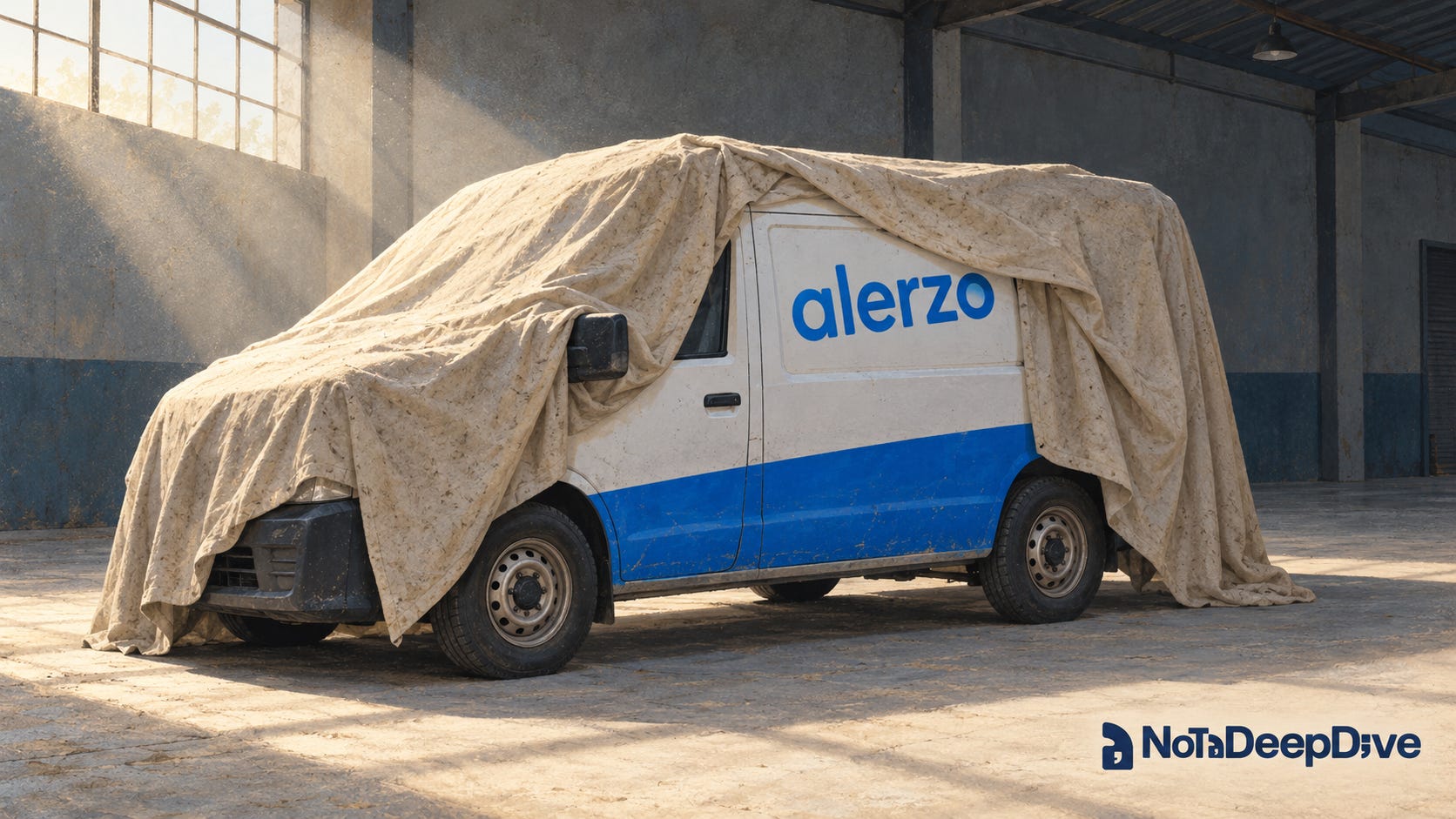
Opaleye said bad press had complicated conversations around a sale. In February, a video circulated on X showing rows of dusty Alerzo-branded buses and motorcycles at its Ibadan facility. An off-camera voice invited the public to buy them in bulk.
Technext reported that Alerzo was selling its delivery fleet after defaulting on a ₦5 billion working-capital loan from Moniepoint Microfinance Bank. Alerzo denied the story.
According to court filings, Alerzo took the loan in January 2025, with repayment due over 18 months but by December, ₦4.38 billion remained outstanding, with interest still accruing.
On January 30, a Federal High Court in Lagos ordered banks to freeze funds and assets belonging to Alerzo, Opaleye, three personal guarantors and the company’s Singapore holding entity, up to the value of the debt. The order was an interim measure to preserve assets pending judgment, not a ruling that Moniepoint’s claim had been proven.
But the bad press predates the Moniepoint loan and began when the company started laying off employees.
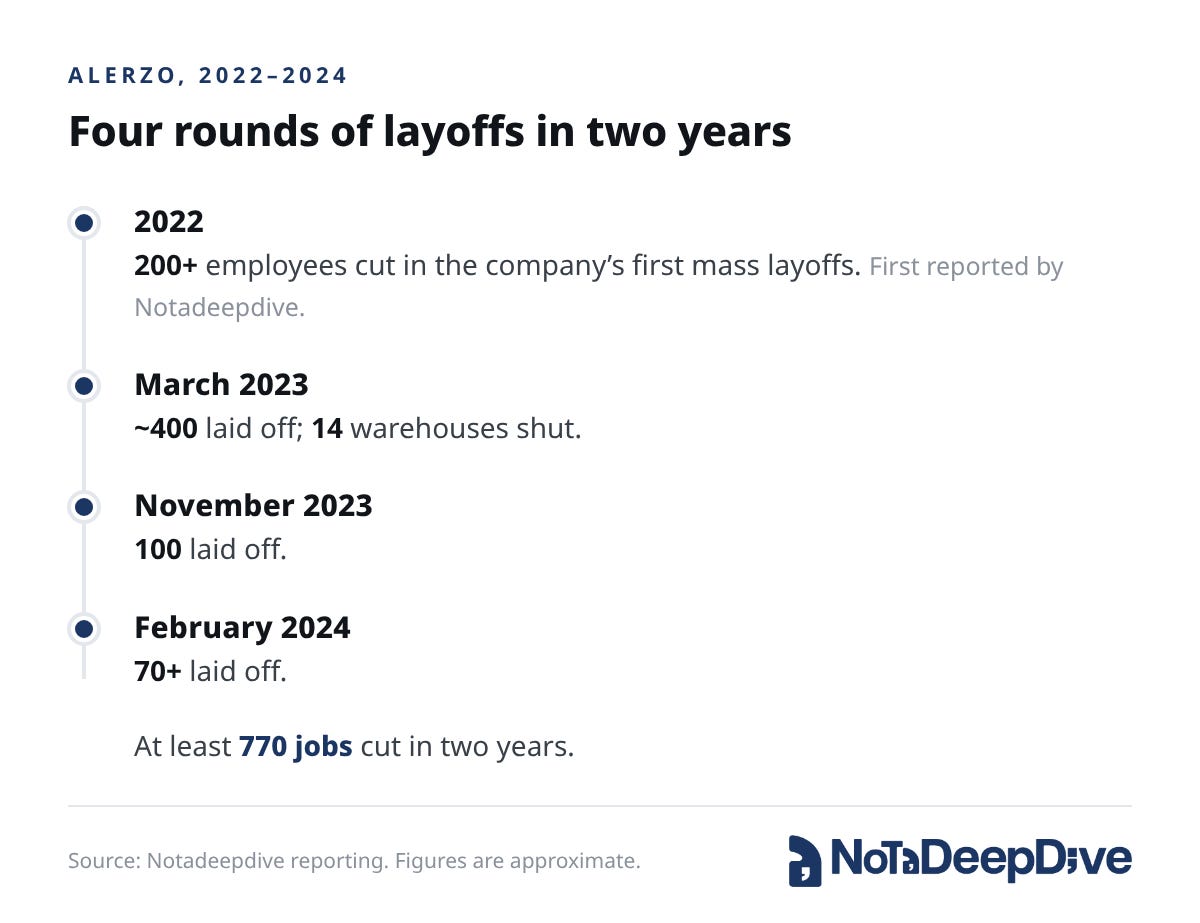
Alerzo has offered a different explanation for every round of layoffs. It has cited digitisation and a “profitability push.” It has also talked about a new warehouse management system that “meant streamlining and consolidating certain warehouse roles.”
On Glassdoor, where Alerzo was rated 3.7 stars in 2022, it now sits at 2.4, with only 27% of reviewers saying they would recommend working there to a friend. The reviews describe unpaid salaries, a “chaotic atmosphere,” and “unprofessional management.”
TOGETHER WITH RAENEST
As stablecoins become a more important way for people and businesses to receive, hold, and move money across borders, Raenest is expanding what customers can do with them.
Raenest Stablecoin Vault gives eligible customers access to variable yield of up to 7% APY on their USDC and USDT balances. APY is variable and subject to market conditions.
You can create dedicated USDC and USDT wallets; send stablecoins across supported networks; convert them to USD, GBP, EUR, NGN, and other local currencies; and spend directly from your stablecoin balances using the Raenest USD card.
For global earners, freelancers, entrepreneurs, and businesses, these capabilities provide greater flexibility in managing internationally earned money, from receiving and holding stablecoins to sending, spending, converting, and growing their balances.
Raenest serves more than one million users across 50+ countries, providing multicurrency accounts, international payments, cards, stablecoins, and investment products through a single global financial platform.
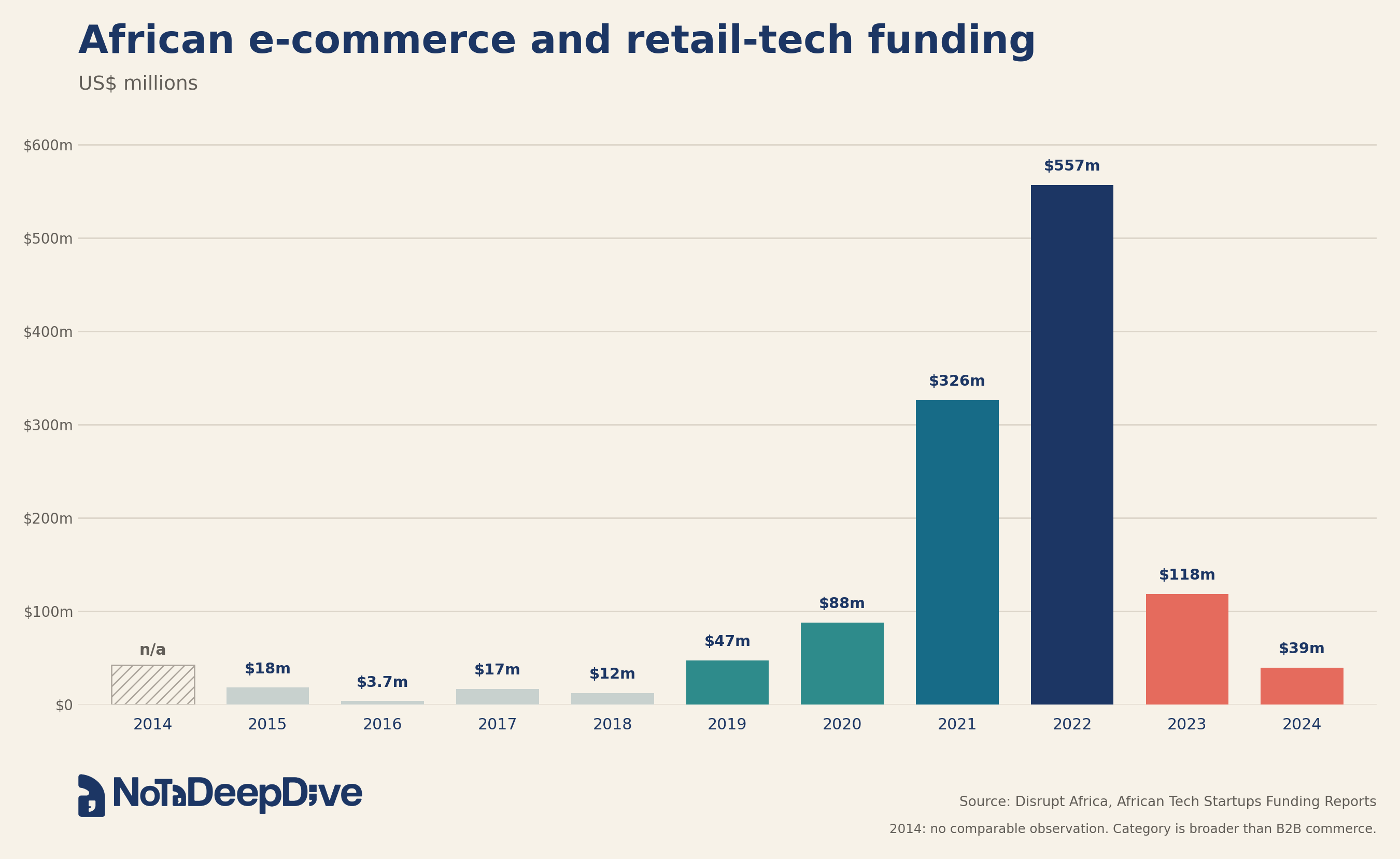
Between 2020 and 2022, African B2B commerce startups raised more than $470 million but their return to earth has been just as stunning.
MarketForce began laying off staff six months after raising $40 million. Zumi and Wabi shut down and last week, GT Flow, formerly Twiga Foods One, the continent’s first mover entered administration. Sabi, which once boasted $1 billion in Gross Merchandise Value (GMV) has pivoted to exporting traceable minerals.
The pitch that drew all that capital was centred on eliminating inefficiencies in a very analogue distribution chain.
A crate of soft drinks might pass from a manufacturer to a distributor, then through wholesalers and market traders before reaching the mallam’s stall on your street. Each intermediary must add their profit margin. The mallam on your street, who’s at the end of the chain, will then have to make a trip to collect the goods, losing hours he could have spent serving customers.
Startups proposed aggregating orders from thousands of shops and buying directly from manufacturers. That way, they could get a rebate because of the size of their orders. By delivering directly to the small retailers like the mallam’s stall, they could provide better prices and make more money. Win-win.
In practice, it wasn’t that simple; buying in bulk from manufacturers also meant having a warehouse to store items and winning over small shop owners meant promising delivery which also meant owning vehicles.
It could work if the small shops you’re delivering to are clustered around an area but the likelihood is that their retail customers just weren’t as tighly clustered.
Using technology also meant hiring engineers, customer support and other staff. The costs piled up quicky.
As I wrote in May 2025, traditional distributors kept their operations lean, often employing fewer than ten full-time staff and reserving delivery for bulk purchases. Alerzo had built a business around making that service available to small retailers. It was competing on convenience in a market where there were several other well-funded startups while selling goods customers could buy elsewhere.
A shopkeeper could appreciate the delivery and still switch suppliers for a cheaper bag of rice. She had little room to absorb higher prices because the shop next door sold much the same things. The cost of serving her could rise without a corresponding increase in what she was willing to pay.
Expanding the number of shops served was useful only if the extra business earned enough to cover the expense of reaching them.
Lending was supposed to improve the calculation because regular orders offered insights into a retailer’s buying habits, which could help a platform decide how much working capital to advance. TradeDepot built its fundraising pitch around buy-now-pay-later services, and Alerzo also introduced lending.
That brought credit risk into a business already struggling with distribution costs. In May 2025, I shared that at least two major players had suffered lending losses and paused their credit programmes. Alerzo’s lending performance remained unclear.
The same article compared Alerzo with OmniRetail, which used partner warehouses and third-party vehicles. OmniRetail said it had reached net profitability in 2024. Its approach illustrates why the cost of the operation matters as much as the ability to attract retailers. A platform that uses existing distribution capacity has a different bill to pay from a company building its own from scratch.
For Alerzo, the search is now for something beyond the business that attracted its investors. Opaleye suggested was working on something, although he did not “know if a pivot is the right word”.
“It’s obvious that being a middleman is not a sustainable business,” he said. “We’ve had to make a lot of decisions around that.”
The distributors Alerzo set out to replace would have reason to disagree. They’ll point out that while their reluctance to deliver a small order was part of what made restocking so inconvenient for Opaleye’s mother, it was also how they kept their costs down.
LISTEN TO AFRICA BUILT
In the fourth episode of Africa Built, we conclude our two-part series on Interswitch.
Part One ended in December 2010, when Helios bought two thirds of the company from the founding banks. This episode picks up the story from there and runs to today.
Revenue went from ₦39 billion to ₦137.5 billion in four years, while Verve, once the local alternative, became the card most Nigerian banks issue. Visa’s 2019 investment made Interswitch a unicorn. Three years later, a new round implied $750 million. Come October, the company repays a ₦23 billion bond it borrowed when the naira was worth three and a half times what it is now.