


TOGETHER WITH CREDIT DIRECT

When scale is the goal, Credit Direct Business is your partner.
Get funding, grow business funds and make bulk payments on one platform.
OPay’s Cheap Deposits
If you missed Friday’s Notadeepdive, catch up.
Around here, I often say that lending is easy and that you need cheap money to make it work. If you don’t have ₦1 billion sitting idly in a bank account or under your pillow, you want someone else’s money at almost no cost.
So if you get money at 35% interest, you must charge considerably more than 35% because you need to account for bad loans and the cost of running the business. It ‘s already so expensive that it will likely not work.
What if you had a bank? Customers will leave money in current and savings accounts, and regardless of the ads, you’ll pay them little or nothing for it. You can take some of those deposits and lend them at much higher rates (this is extremely simplistic but you get the point). The more deposits banks/fintechs attract, the less they depend on expensive borrowing to fund loans.
In 2025, OPay’s customer deposits soared from $244.2 million in 2024 to $705 million, roughly ₦1 trillion. Its deposit base is already roughly one-third the size of Sterling or Wema Bank.
These deposit figures have not previously been reported.
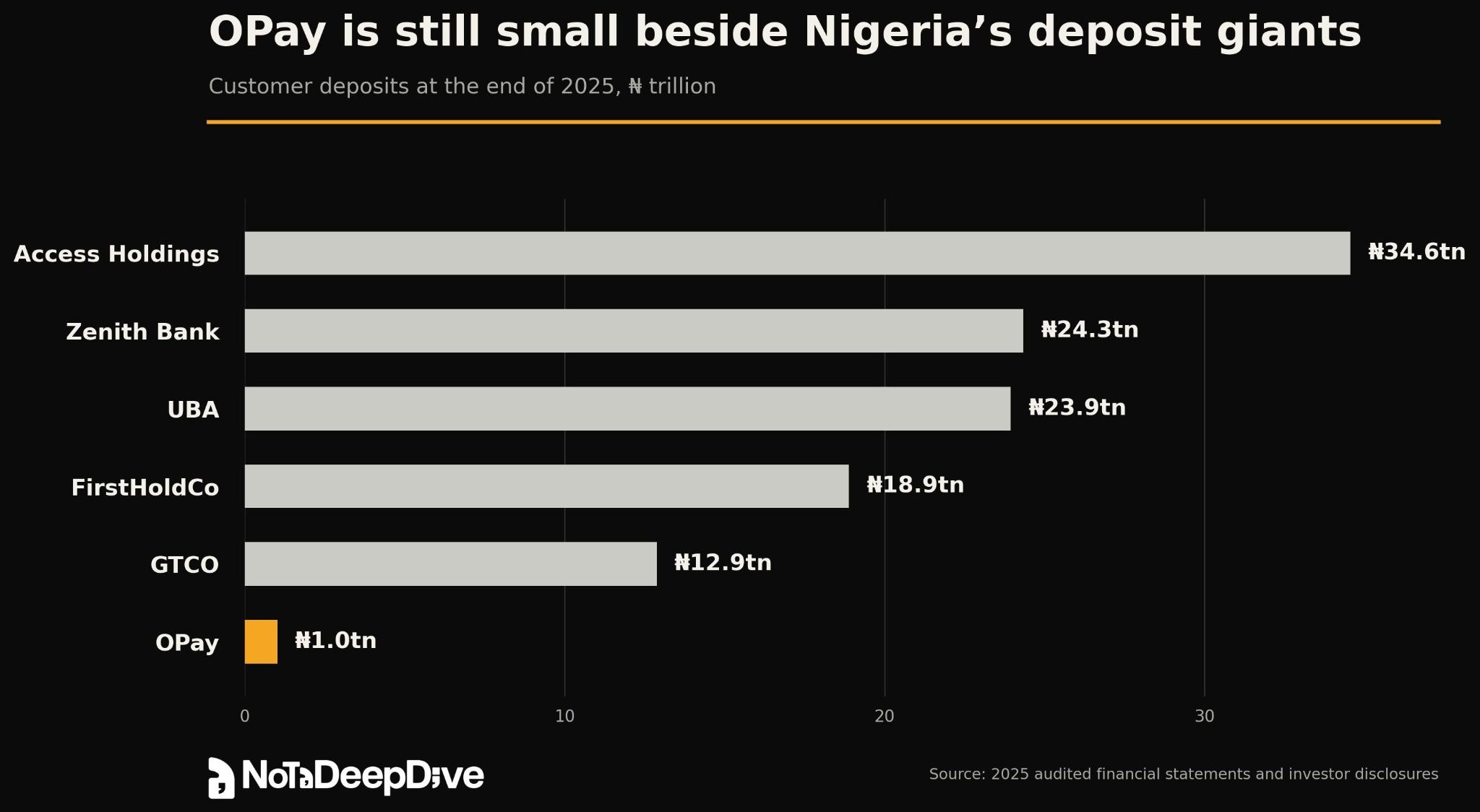
How much did all of customer deposits cost OPay? The company reported only $2 million in total interest expense in 2025, up slightly from $1.9 million a year earlier, even as customer deposits almost tripled.
We cannot tease out the exact cost of these deposits because the financial statements don’t show how much of that interest expense was paid to depositors or at what point in the year the deposits arrived.
What we know is that as customer deposits increased by $460.8 million in 2025, cash and short-term investments rose by almost the same amount. The close match suggests that OPay kept most of its money in liquid assets rather than lending it out (hello there, GTCO).
The financial statements do not explain why deposits grew so quickly, but we can take a stab in the dark and ascribe it to OPay’s payments business. People receive transfers, merchants collect payments, and customers pay bills inside the app. Some of that money remains in the app, while OPay’s interest-paying product (O’Wealth) gives customers another reason not to move it.
Beneath these deposits sat another $1.03 billion in redeemable convertible preferred shares supplied by investors.
These shares can be converted into ordinary equity, while their redemption provisions may eventually require OPay to repay the investors. In 2025, their carrying value increased by $89.5 million through accretion, an accounting adjustment that moves the balance towards its redemption value.
The accretion did not reduce OPay’s $72.5 million net income or require an $89.5 million cash payment that year. It was instead deducted when calculating the result attributable to ordinary shareholders. After the deduction, OPay reported a $17 million loss attributable to them.
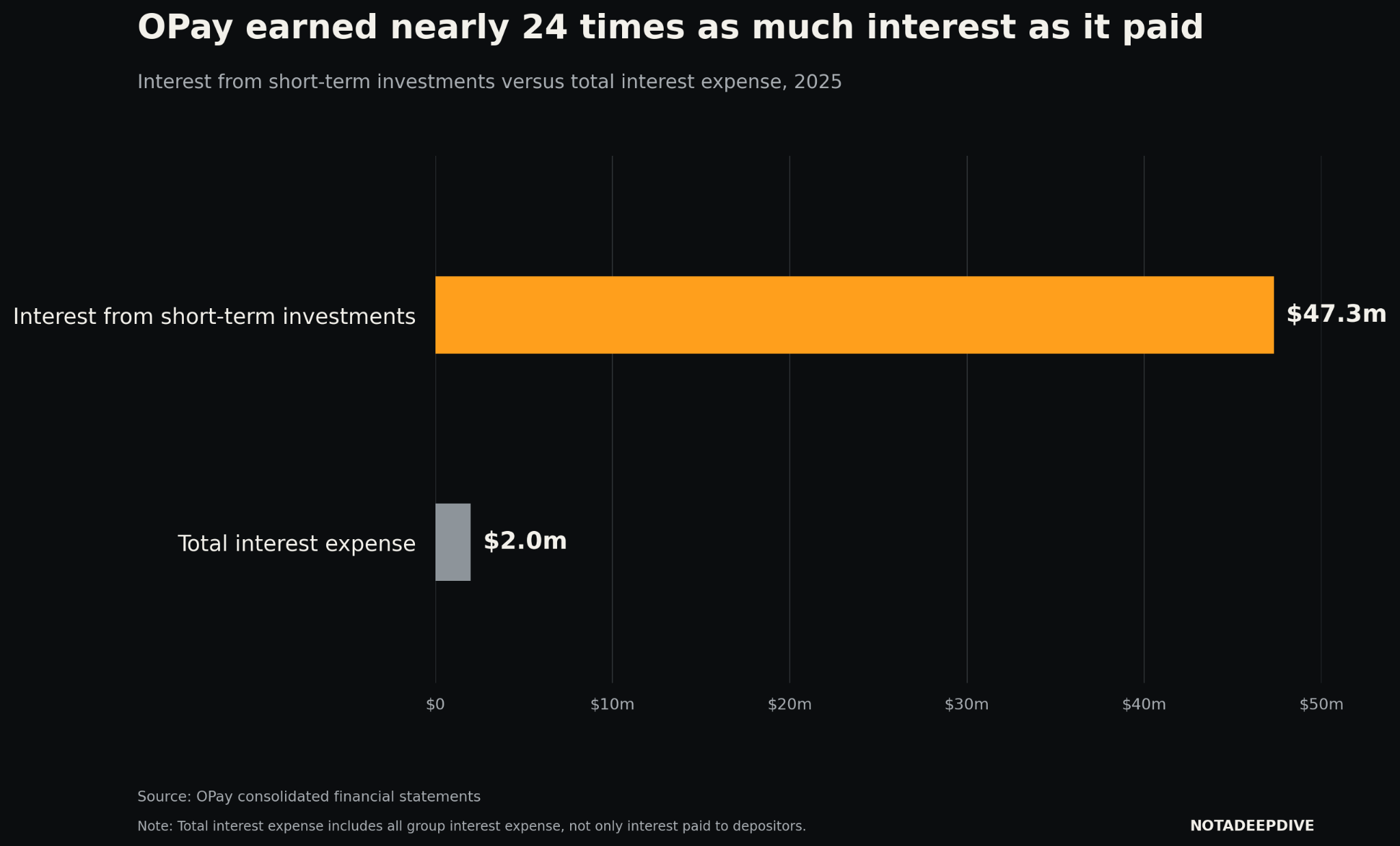
OPay therefore has two different funding advantages. Customer deposits provide a large supply of extremely cheap money. The preferred shares provide a substantial layer of investor capital beneath the company’s liabilities. OPay could keep much of the new funding in liquid investments, earn $47.3 million of interest from them and operate a growing loan book without relying heavily on expensive borrowing.
See you next week!
"These deposit figures have not previously been reported"
Showoff! 😂