


If you missed last week’s Notadeepdive, catch up here.
TOGETHER WITH CREDIT DIRECT

Your business doesn’t need 14 accounts.
It needs a Credit Direct Business wallet.
Retreat
During the 2020 and 2021 funding boom, fundraising rounds were frequently followed by expansion announcements. In that era of abundance, your startup story had to be expansive; there’s nothing that excites investors more than the idea that you’re pursuing a continental opportunity.
Expansion also allowed you to “derisk your Nigerian business” as promised in many a pitch deck. Multiple countries could reduce dependence on the naira and the Nigerian economy, and if your product could reach Nigerian users in the diaspora, even better.
Expansion became another step in the playbook, often without rigorous questions about what would allow the company to succeed in those new markets.
At its peak, Jumia was in Rwanda, Cameroon, and Tanzania, which in hindsight sounds quite ridiculous. It exited those markets once it became a serious company.
One of the ironies of Nigeria being a difficult market is that it can build exceptional operational ability while creating a company perfectly adapted to Nigeria.
A Nigerian fintech, for example, has to juggle painful integrations with banks and wicked regulators. It must combine a deep knowledge about how Nigerians move money with the deftness required for black swan events like the 2023 cash crunch.
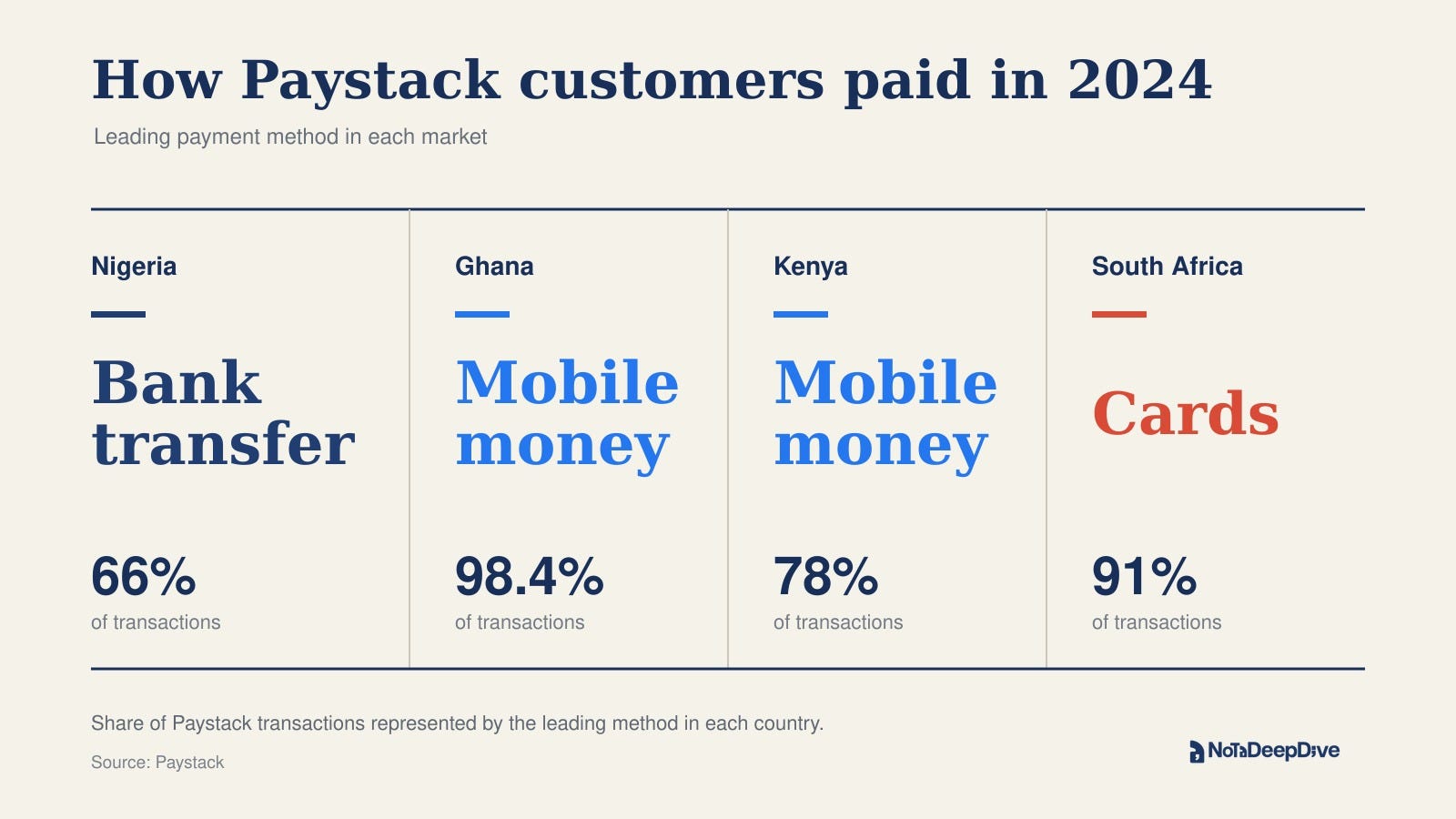
As the fintech expands, it will need to build new relationships and adapt to customer behaviour that is forever changing, forcing it to become a second startup in every new country.
Globacom expanded to Ghana, but its Nigerian network effects meant nothing to Ghanaian subscribers, who already had established expectations about coverage. After ten years, Globacom could only win 2% market share.
Sometimes demand is not enough
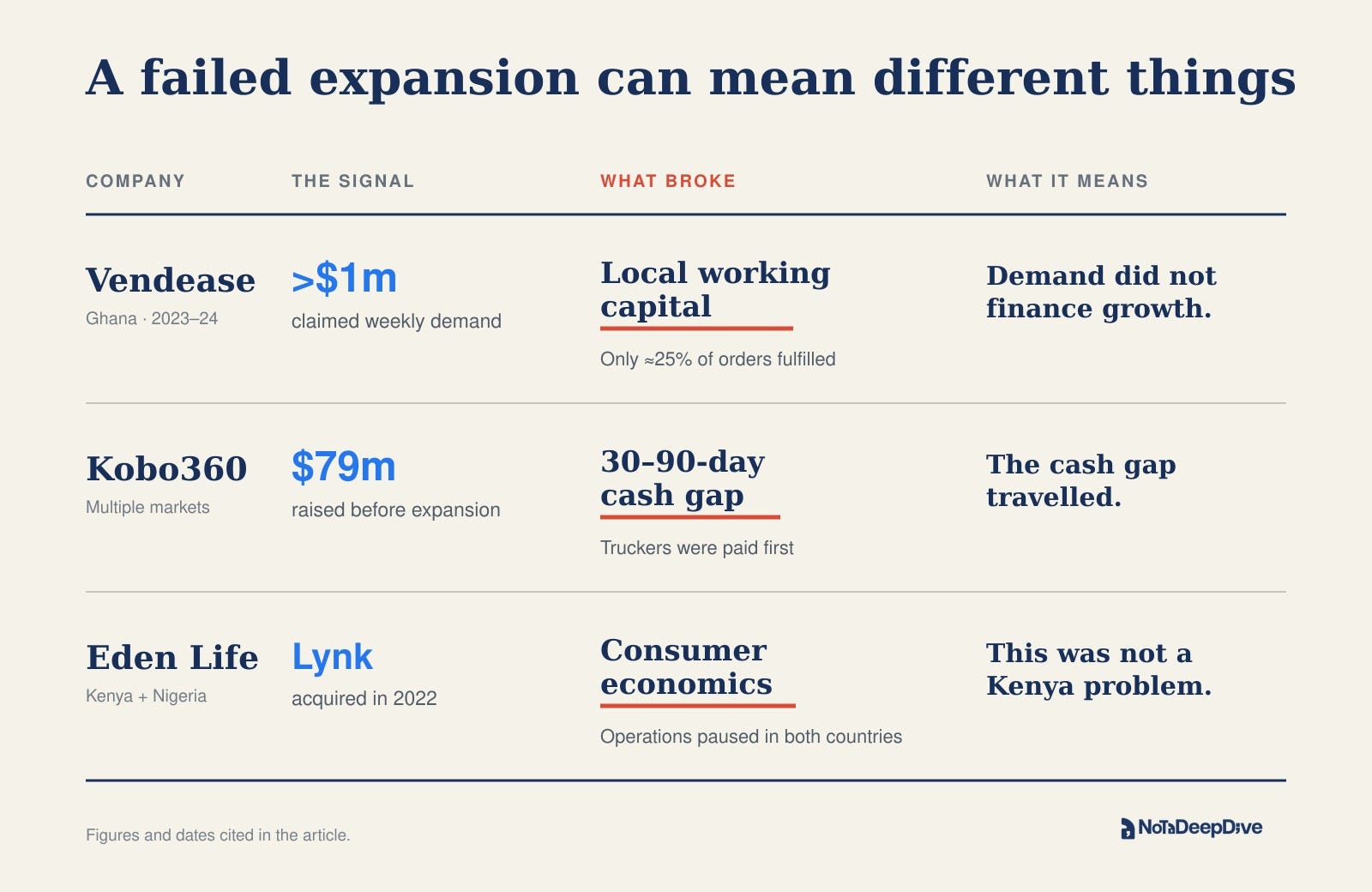
When Vendease entered Ghana in 2023, it claimed that weekly demand sometimes exceeded $1 million. But it could fulfil only about a quarter of those orders because it needed local funding. Its Ghanaian ambitions lasted one year.
Vendease supplied restaurants that often ordered food items without immediately paying for them. So the faster orders grew, the more money Vendease would have needed to meet working capital requirements.
The logistics startup, Kobo360, often paid truck owners upfront while its large corporate clients would pay 30 to 90 days later. While this problem remained unsolved, it raised $79 million and expanded into Ghana, Kenya, and other African markets.
The financing weakness that plagued its Nigeria business was replicated in every new country, and when credit and venture funding tightened, the system stopped working.
The concierge startup, Eden Life’s Kenya expansion followed its acquisition of Lynk in 2022, but by 2026, it had paused consumer operations in Kenya and Nigeria after the economics of the consumer home-services model simply didn’t work.
Olawale Ajai’s study of failed Africa-to-Africa expansions found that organisational and strategic weaknesses explained failure better than host-country conditions. Companies often explain new market failures with regulation and consumer behaviour, obscuring the possibility that the original decision to enter said markets may have been affected by insufficient local knowledge or managerial capacity.
African institutional investors interviewed for a 2025 study shared that the incentives for managers to expand did not always align with shareholder interests. Managers may gain status from leading a multinational company even when shareholders receive poor returns.
Yet the evidence is imperfect. Most studies interview companies that successfully became international, while failed subsidiaries disappear and their executives move on. One Nigerian banking study used only 25 observations and could not establish whether expansion improved profitability or whether profitable banks were simply better able to expand. Existing research is better at explaining the courage to enter than the returns after entry.
Advantages don’t always travel
This week, Moniepoint announced it would phase out MonieWorld, the UK remittance product it spoke about confidently last year.
Remittances promised foreign-currency revenue from a large Nigerian diaspora; cue that joke about shaking any tree and Africa-focused remittance companies falling out of it.
For a company of Moniepoint’s size and reputation, few people entertained the possibility that this expansion could fail but big companies fail at new things all the time.
The reporting since Moniepoint’s announcement has coalesced around how MonieWorld was growing in a difficult market and how we need to applaud the company for trying.
Those publications also cited Moniepoint’s claim of transaction-volume growth as proof that Moniepoint didn’t ditch this product because it wasn’t growing. But transaction volume growth alone tells us very little because a business can grow quickly from an irrelevant base and you can juice transaction volume with freebies.
In counting the cost, Moniepoint’s UK entity reported no revenue and lost about £1 million while the remittance product was being built in 2024. It also allotted £5.9 million in share capital to the entity and later acquired Bancom, an electronic-money institution, to obtain the necessary licence.
So we know that Moniepoint already spent heavily before launch and that sixteen months later, it could not justify continuing.
Kuda traveled down the same remittance road three years earlier.
Whatever happened to Kuda’s first remittance business?
Kuda launched a UK-to-Nigeria remittance product in 2022 through Kuda EMI Ltd, a dedicated British entity.
In 2022 and 2023, Kuda EMI recorded total revenue of £634 (yes, you read that right) while its direct costs were £252,157. Its cumulative losses over the two years reached £982,510.
Kuda has since relaunched another cross-border product built with a different structure, and it remains to be seen whether that attempt will work.
Kuda MFB, the Nigerian business, reported more than 300 million transactions worth ₦14.3 trillion in the first quarter of 2025 alone.
Increasingly, Nigerian technology companies establish offices and add countries to their maps, but their income statements remain overwhelmingly Nigerian.
Interswitch has operations across several countries, but generated about 90% of its 2025 revenue from Nigeria. That was an improvement from 94% a year earlier. You can’t describe Interswitch as a genuinely pan-African company by revenue.
OPay operates in Nigeria, Egypt, Indonesia and Pakistan but Nigeria contributed 88% of its 2025 revenue.
Why the banks eventually fared better
Nigerian banks are an exception to the struggles of international expansion. UBA reported that operations outside Nigeria generated 51.7% of group revenue in 2024. Access said its foreign banking subsidiaries produced 65% of its banking group’s profit before tax in the first half of 2025. About 35% of GTCO’s 2025 revenue came from outside Nigeria.
It took the banks roughly two decades to get there; they’ve been helped along the way by local deposits. A startup will use investor equity from the parent company to finance recurring foreign working-capital needs, while a bank can raise deposits in the country where it lends. Its assets and liabilities can grow in the same currency.
Banks don’t always begin with the expensive task of persuading millions of unfamiliar retail customers to adopt a new product. Despite these advantages, their progress was hardly frictionless.
Diamond Bank built businesses in Benin, Togo, Senegal and Côte d’Ivoire. Its main West African subsidiary was profitable in 2016, earning ₦911 million after tax, but that profit sat on more than ₦401 billion of assets, a very thin return for a parent bank that needed capital at home. Diamond sold the businesses and later gave up its international banking licence.
A foreign subsidiary can be profitable and still be a bad use of group capital. Banking regulators also ring-fence local capital and liquidity, which means money in one subsidiary cannot always be pulled home when the parent needs it.
The banks eventually found a model that travelled, but only after acquisitions, recapitalisations, exits and years of learning. Their present success should not erase the failed experiments that produced it.
Would the startups fare better if they focused on profitability back home first to use as a foundation to launch elsewhere? Case studies and research alone won't do it. Expanding into a new country is becoming a startup again like you rightfully said. They need patient source of funds to learn and grow elsewhere. That said, international expansion may not always be the right move sometimes.
Nigeria is equivalent to 36 countries. If you haven't established yourself in all of them , why go to Africa? Most banks expanded across all of Nigeria before going to Africa. Just saying.