


If you missed last week’s newsletters, catch up here and here.
We’re super close to cracking 5k subscribers. Help us get there by sharing this newsletter with friends, enemies and in your group chat.
And if you’re the lucky person this email was forwarded to, subscribe here for you:
TOGETHER WITH CREDIT DIRECT
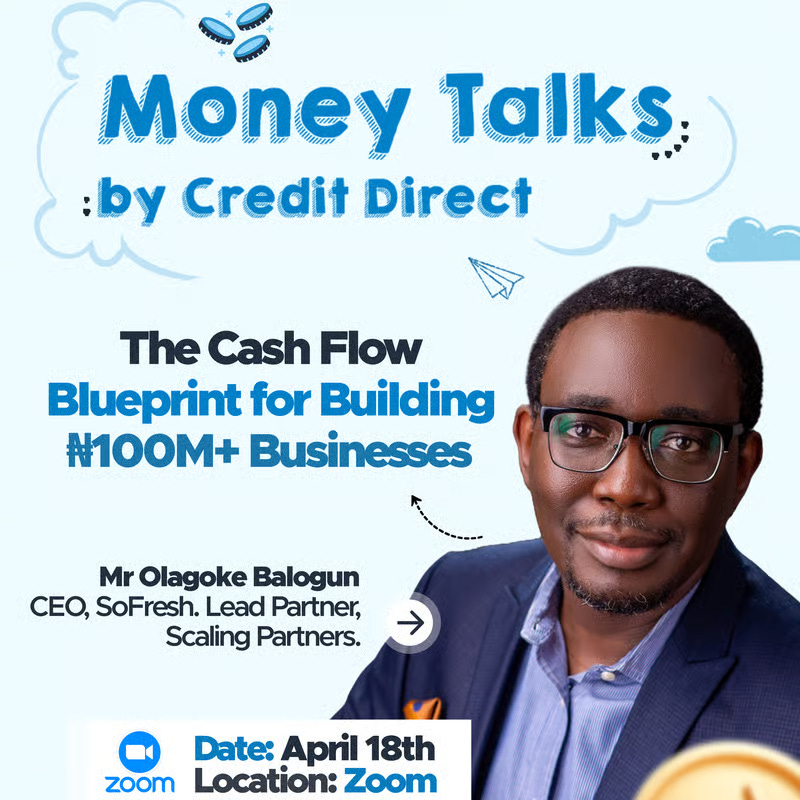
The question business owners need to start asking is “How do I keep more of the money my business is making?”
Credit Direct has partnered with Mr Olagoke Balogun to answer this question.
Join us on the 18th of April for a virtual session on Money Talks: The Cash Flow Blueprint for Building 100M+ Businesses.
We Need to Talk About Marketing

Marketing professionals, like practitioners of every art form, find themselves in a dilemma. Their artistic expression exists to craft a narrative for an audience and sell a brand. But they also have to wield that same expertise to impress their fellow marketing colleagues, and potential future employers and clients.
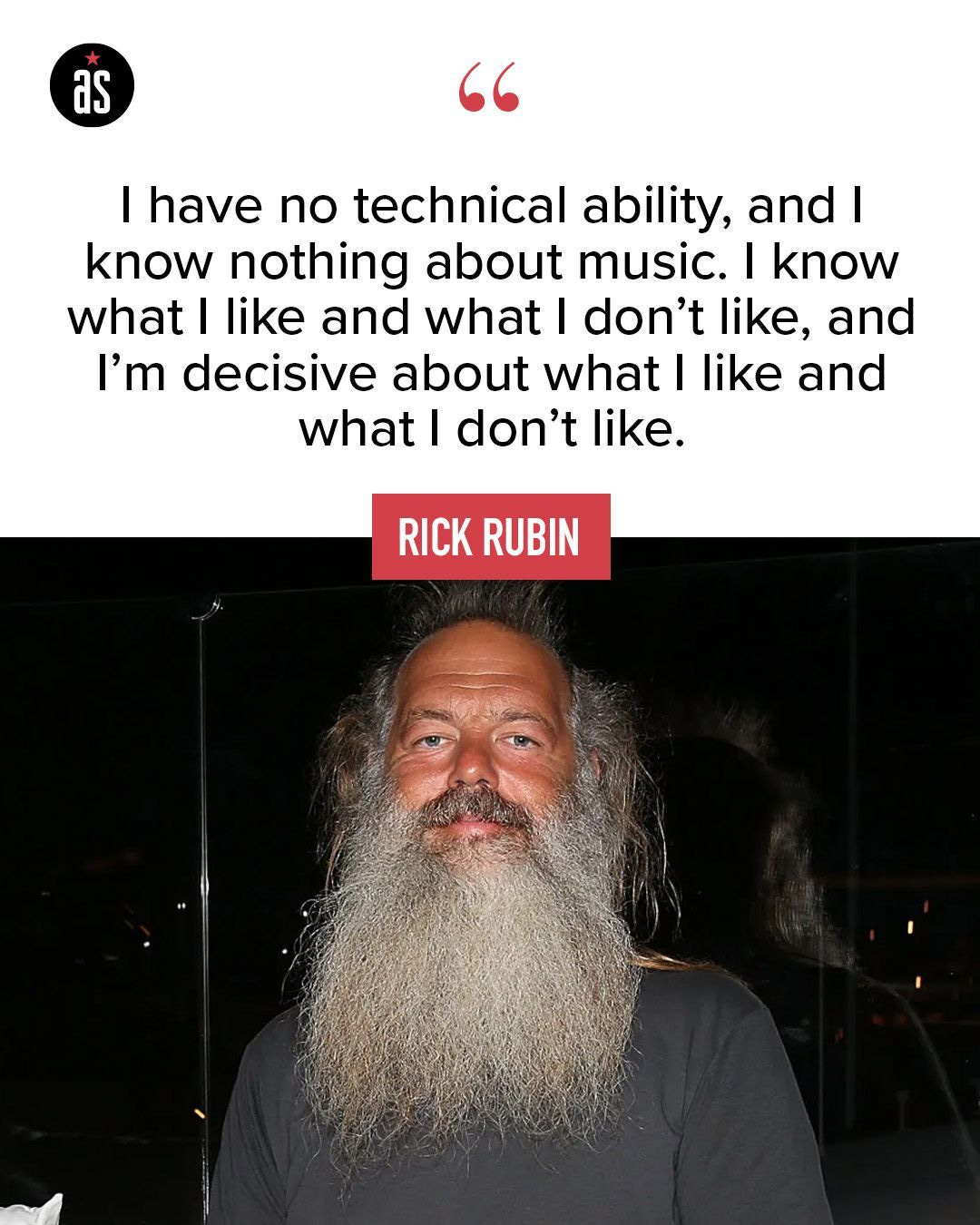
There’s the problem.
What marketers, customers, regulators, competition, and industry colleagues call good marketing copy could be completely different things. And with every art form, what passes as good is “subjective” and contextual.
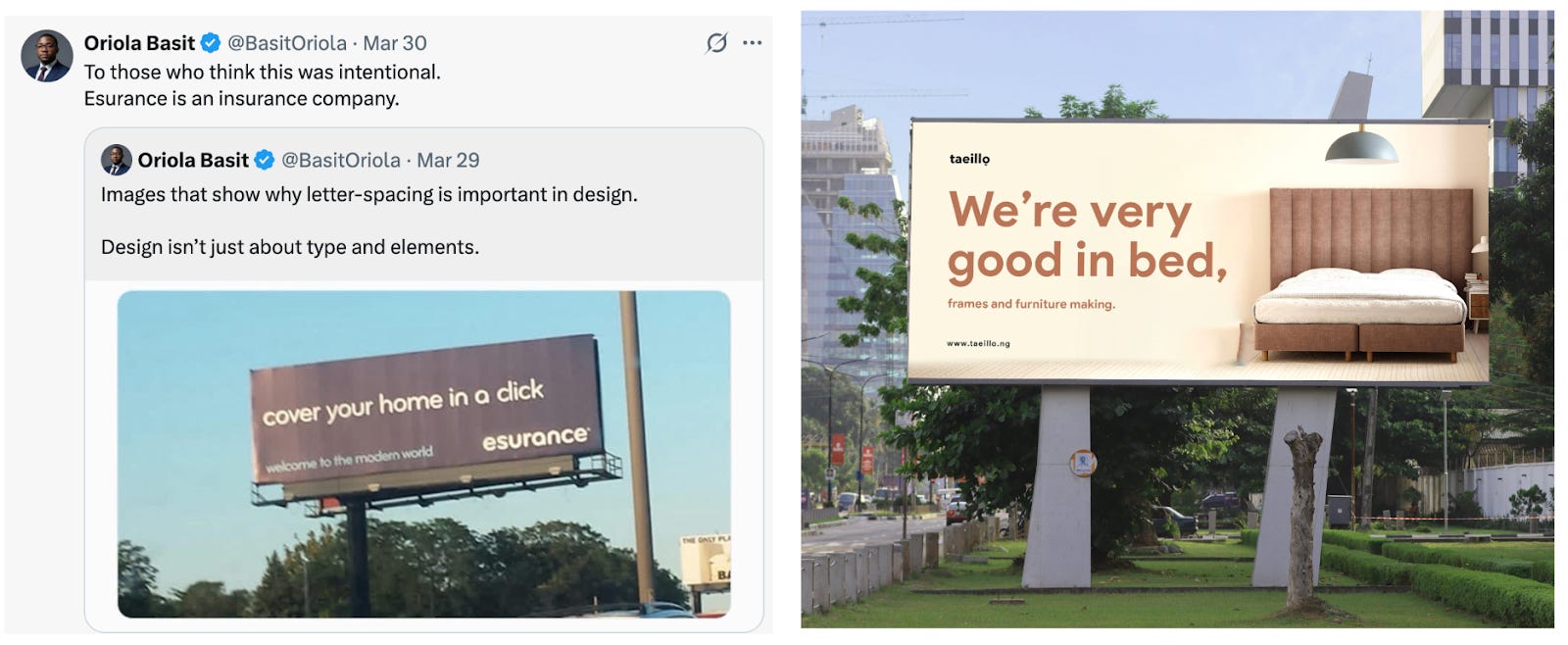
Left: An Insurance Company trying to be trendy, Right: A furniture company
I am writing this while having a KitKat, and I am sure it’s largely prompted by KitKat’s announcement that 12 tons of KitKat had been stolen. That’s marketing. It made me buy chocolate I wasn’t thinking about.
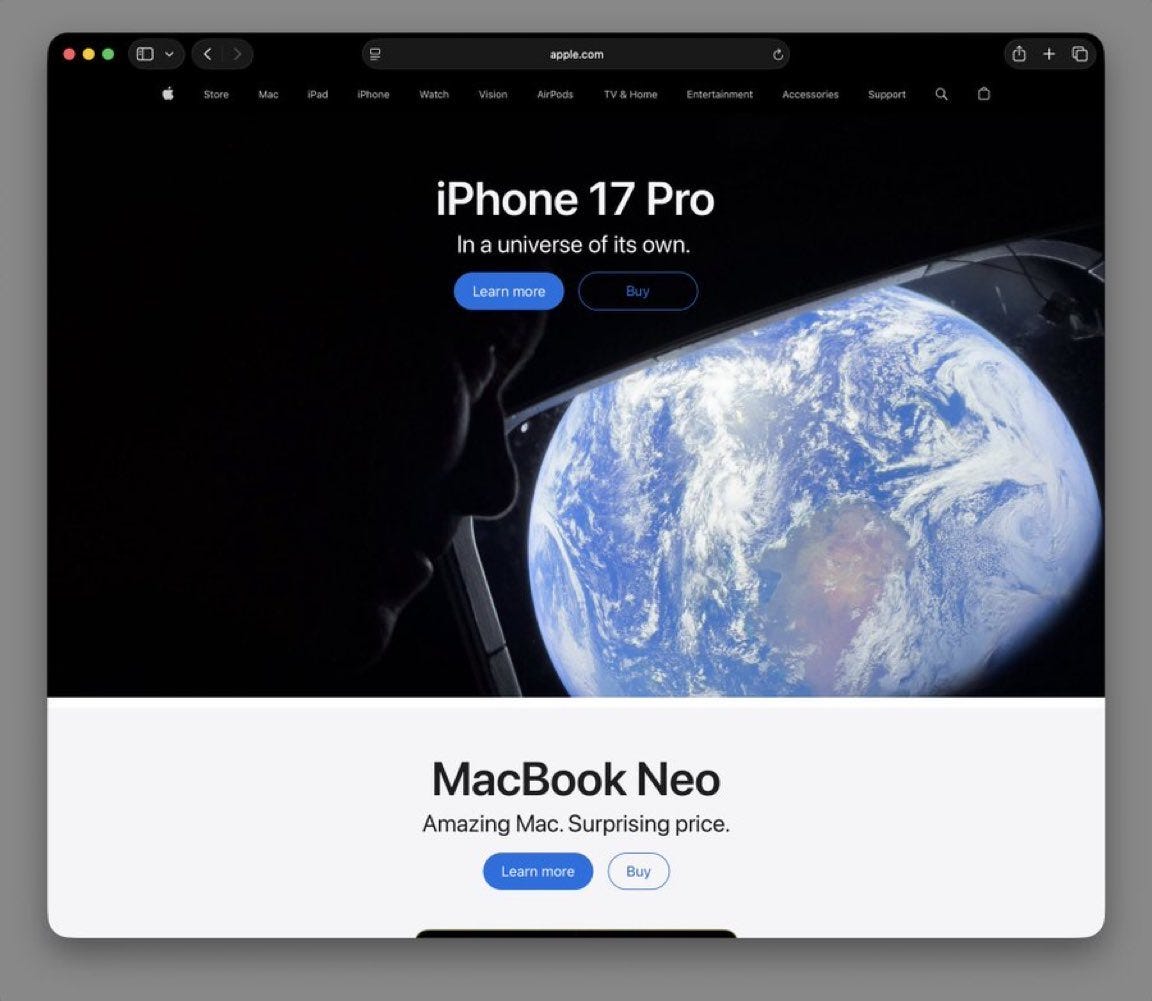
Over the last few weeks, I have observed what I can only term good marketing, unsportsmanlike marketing, and straight-up lies dressed as copy. And every time I forward these to my marketing friends, they only celebrate the smart copy — without context.
When a company buys up ad space at the location of a competitor’s event in a bid to convert eyeballs they did not acquire, it is reminiscent of famed campaigns such as Tesco vs ASDA vs Sainsbury’s, Mac vs PC, Samsung vs iPhone, Mercedes vs BMW, FedEx vs UPS, and Nike’s famous stealing of the World Cup and Olympics campaigns.
These are crafty; they show maturity, and any form of counter-response is valid. Marketing folks should be applauded for their inventiveness here.
But it seems to me that participants of the growing Nigerian ecosystem do not understand that industries are different and operate with different rules.
Industries like B2B SaaS, e-commerce, crypto, consumer hardware, and apparel companies have historically had marketers stretch the truth and be celebrated for it.
There is a reason Bill Gates, Elon Musk, Sam Altman, and Steve Jobs were celebrated for selling products that didn’t exist yet (even if they did eventually deliver), but Elizabeth Holmes at Theranos, SBF at FTX, and CZ at Binance went to prison for what looked like lesser offences on the face of it.
The difference isn’t the size of the lie, but the industry. Norms, rules, and regulations differ. Tech audiences will tolerate aspirational selling. Financial services audiences, customers, regulators, and the courts do not.
When money is involved, the person being lied to is a disappointed early adopter who trusted you with their savings and livelihood. Therefore, the potential for harm is fundamentally different.
Financial services, just like healthcare, have second-order effects beyond us, the players.
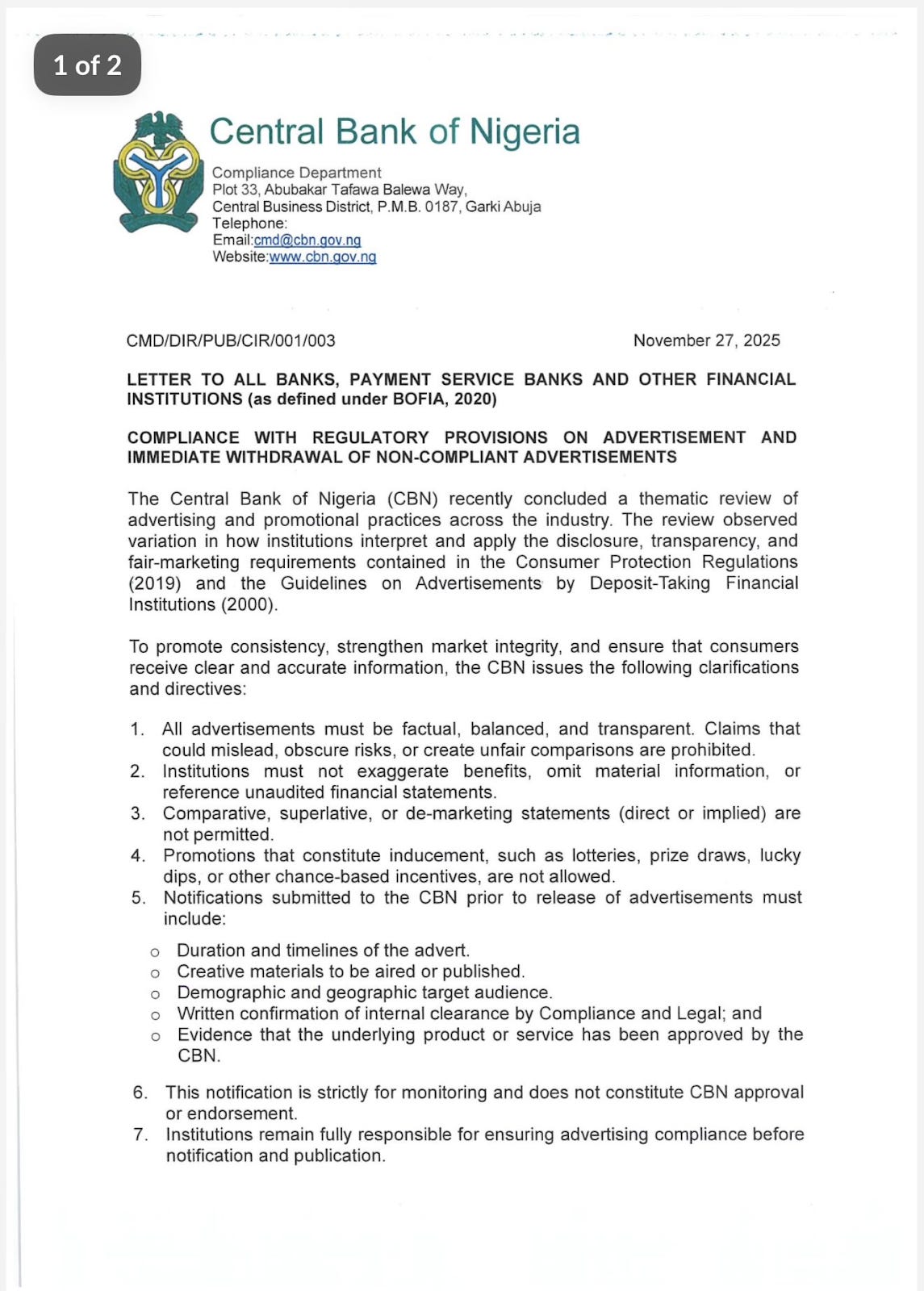
In November 2025, the Central Bank issued a circular directing all financial institutions to immediately withdraw non-compliant advertisements. All ads must now be factual, balanced, and transparent.
Exaggerating product benefits — banned. Omitting material information — banned. Comparative or superlative claims — banned. Starting January 2026, the CBN said it would review and impose sanctions for breaches.

So companies should not be notorious for sleights of hand with their marketing, no matter how glossy or impressive it would look to fellow marketing colleagues.
They are doing impressive things already. There is room to sell the truth about what is being built without exaggerating. Especially as we are entering the second decade of life for some of the leading companies in Nigeria’s financial services ecosystem.
So yes, it has to be repeated. Being ambiguous about a microfinance bank licence by pulling a “banking licence” pump fake is not marketing. It’s a lie.
The local and international media that ran with this narrative, rather than challenge claims of “full-scale financial services,” to compete with Access Bank and Zenith Bank, should have done better.
It’s a microfinance bank licence. It’s a good move — they can now hold deposits, retain more in the settlement value chain, and build lending products off open banking data.
They processed $40 billion in a decade. They joined the CBN’s Virtual Assets AML pilot.- These were strong stories on their own. You don’t need to embellish any of that. Tell that story.
But calling a microfinance bank licence “a banking license” - intentionally omitting that qualifier, while operating in a regulated space that should inspire trust. How should I then trust you with my deposits?
I get that founders have to be delusionally optimistic. I get the Jedi mind tricks on your org and the public to inspire belief. But there has to be a line between founder optimism and customer deception.
And it’s not just the licence framing. Marketing statements across other large players in the industry, like “we are the biggest agent network in Nigeria.” Or “the most licensed institution in Africa.” Or “we process 87% of NIBSS volumes.” These are lies.
And the risk is that regulators, journalists, informed consumers, or even your competition could call you out, causing harm to your brand and the space you operate in.
The Nigerian fintech ecosystem has done remarkable things over the last decade. We don’t need to lie about what we are doing. Rather, we need to get better at telling the truth about it in a compelling, confident manner.
Because if the question becomes “should I trust you with my deposits?” — your marketing copy better be the same as your regulatory filings.
I get it, everyone is trying to pander to investors these days. But does it have to come at the expense of writing marketing checks your organisation cannot cash, nor the regulatory and reputational risk that comes with it?
We don’t need sleight of hand. The truth is already impressive. Tell that one.
Every time you like the newsletter, it increases the chance that more people will find it! See you Sunday.
