


If you missed last week’s newsletters, catch up here and here. If this newsletter was forwarded to you, subscribe while it’s still free!
TOGETHER WITH CREDIT DIRECT

Your money sitting idle in a regular account is a quiet inefficiency most business owners overlook.
Credit Direct Business is designed to fix that, offering up to 15% per annum on deposits, while giving merchants a structured home for their Buy Now, Pay Later earnings. It’s not just a wallet. It’s leverage.
In Defence Of Nigerian VCs

In January, Terra Industries, a Nigerian defence startup and drone maker, closed an $11.75 million round led by 8VC, with Lux Capital, Valor Equity Partners, SV Angel, and Nova Global also participating. On the face of it, no Nigerian VC was on the cap table, and Nigeria’s next frontier technology was being funded by American defence-tech money.
Predictably, this reignited the favourite pastime of Nigerian tech Twitter: dunking on local VCs. Why didn’t they back this? Where were they? Do they even have vision?
I have written at length — here and here — about the limitations of the VC model in Nigeria, the narrow thesis most funds operate on, the lack of exits, and the valuation games that have burned capital. I stand by all of that.
But the current discourse lacks context. It confuses fair criticism with cheap shots, and it compares Nigerian VCs to their American counterparts without asking the most basic question: are they even playing the same game?
Spoiler: They are not.
A Category That Doesn’t Exist
Terra’s $34 million raise from American defence-tech investors is impressive. It is also a product of an ecosystem that has no Nigerian equivalent.
In the US, companies like Anduril and Palantir operate within a defence-tech market where investors with the right security clearance can deploy billions into companies selling to the Pentagon, NATO allies, and critical infrastructure operators with multi-year government contracts. American defence-tech startups raised $31 billion in 2024 alone. There is an entire government procurement pipeline, anchored by the Department of Defence’s innovation budget, that creates the demand signals VCs can underwrite.
Nigeria has none of this. No structured procurement pipeline funnelling contracts to startups. No defence-tech ecosystem where a VC can back a drone company knowing the military will be a reliable customer. The Nigerian military itself publicly admits it cannot produce its own equipment due to inadequate R&D investment.
So when critics ask why Nigerian VCs didn’t back Terra, they’re asking why funds operating in Lagos didn’t behave like funds operating in a $31 billion category that doesn’t exist in their market. Terra’s original $800K round included African investors: Alpha Gaps, Tofino Capital, Kaleo Ventures, Velocity Digital, and DFS Lab. The $34 million that followed came from a type of capital that Nigerian venture simply does not have access to.
The Capital They Actually Have
Unlike most of the developed world, the typical Nigerian LP is not a pension fund, a university endowment, or a sovereign wealth fund writing nine-figure cheques from a diversified portfolio. The typical Nigerian LP is someone between 45 and 60, with kids settled abroad, who has done well enough in their career to have some disposable capital. Instead of buying another plot of land in Ikoyi or Lekki, they put between $10K and $200K — money that is effectively retirement savings, school fees, or wedding funds — into a venture fund.
They are making a concentrated, high-risk bet on the Nigerian tech ecosystem with money they may actually need.
The domestic capital pool is shallow. The same high-net-worth individuals and family offices that venture funds are courting are also being chased by financial advisors, asset managers, private bankers, real estate developers, and everyone else competing for a thin slice of deployable Nigerian capital. Venture, with its 10-year lockups, no distributions, and binary outcomes, is the hardest sell in the room.
Where institutional money flows in, it largely comes from Development Finance Institutions. DFI capital provides scale that local LPs cannot, but it is not free money. It comes with mandates: financial inclusion, job creation, SME support, gender-lens investing, climate considerations, and measurable development outcomes.
Nigerian VCs who depend on DFI capital cannot freely chase every category. They cannot pile into crypto infrastructure like a US fund. They cannot back a defence startup even if they wanted to. They cannot deploy into categories that don’t fit the impact thesis their LPs signed up for.
Even the best-capitalised funds tell this story. When Ventures Platform raised $64 million for its second fund, its LP base included IFC, British International Investment, Proparco, Standard Bank, AfricaGrow, and European family offices. Most Nigerian funds are working with much thinner bases, where the money behind the fund has a face, a family, and a retirement plan attached to it.
TOGETHER WITH BUSHA

If you are a business exploring digital assets for cross-border payments or treasury management, you should check out Busha Business. Busha business also allows you to buy, sell, receive, and send stablecoins and digital assets.
What They Built With It
Here is what Nigerian VCs actually did with these constraints.
Before Tiger Global wrote a $250 million cheque for Flutterwave’s Series D, someone had to believe that building payment infrastructure in Nigeria was a venture-backable idea. Local VCs and early-stage funds wrote the first cheques into Flutterwave and Paystack without a $10 billion fund behind them. They had conviction built on understanding the market. Paystack was acquired by Stripe. Flutterwave built infrastructure powering e-commerce across 33+ African countries. The payment rails they funded in the 2010s are now the backbone of Nigeria’s digital economy.
Before Andela raised $381 million from Al Gore, Mark Zuckerberg, and SoftBank, some local investors believed Nigerian software developers were world-class and that someone could build a business proving it.
Before Moniepoint raised over $200 million from IFC, Google, and Visa, local investors like Oui Capital, Quantum Capital, and Verod Capital backed a company that now processes $250 billion annually in payments, employs over 4,000 people, and supports millions of merchants, bringing financial services to parts of Nigeria that banks actively ignored.
These sub-$10 million vehicles collectively seeded tens of thousands of direct jobs and the foundations of a digital economy that would have seemed implausible a decade ago.
The Risks Nobody Else Takes
Even when conviction pays off, the return math is structurally capped. Oui Capital’s early bet on Moniepoint — one of the best seed-stage outcomes in African VC history — returned roughly 53x after dilution. That is exceptional by any standard, local or global.
But as Samora Kariuki of Frontier Fintech points out, Africa’s single best fintech outcome, a company processing over $250 billion annually with $600 million+ in revenue, produces a diluted seed return that reflects smaller exit valuations, longer paths to exit, and entry prices that haven’t always accounted for either reality.
Nigerian VCs know this math. They deploy anyway.
They have also backed moonshots that didn’t work. 54Gene raised $45 million to build an African genomics company, backed by local names like Future Africa, Ingressive Capital, and Endeavour Catalyst. Before it shut down, its valuation was slashed from $170 million to $50 million. But the conviction to back African genomics research in a market where less than 3% of global genetic material used in pharmaceutical research comes from Africa, was real.
And they have stomached risks that no Silicon Valley investor has to think about. Founders shutting down businesses after allegedly lavishing investor funds abroad; portfolio companies ending up in EFCC headlines because fraudulent third parties processed money through their platforms; companies failing not because of bad unit economics, but because of wonky policies like okada bans, Naira devaluations, CBN policy reversals, and an unpredictable regulatory landscape.
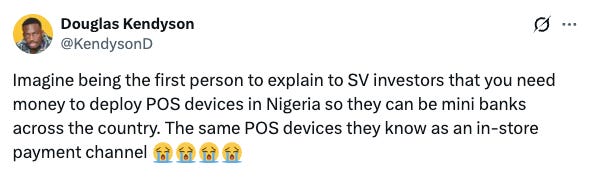
The mobility and logistics bets alone tell this story. Chowdeck, Gokada, MAX, Kobo360, MVX, Treepz, Shuttlers, Cars45, Autochek…Nigerian VCs funded wave after wave. They watched predecessors die and backed the next one. They saw Lagos ban okadas and kept deploying into adjacent plays. When the same thing happens in Silicon Valley, we call it iteration. When it happens in Nigeria, we call it bad judgment.

I am not arguing that Nigerian VCs are beyond criticism. They are not.
There are real governance gaps in the ecosystem. Reporting to LPs is inconsistent across funds. Some deal terms are more extractive than they should be. There is genuine herd behaviour, although I would argue that doubling down on fintech, the one sector where Nigeria has proven global competitiveness, is conviction more than it is herd mentality.
Narrative clustering in VC is what Warren Buffett calls institutional imperative: when LPs allocate, GPs raise, and deal flow is sourced, everyone needs to be telling roughly the same story. That is how venture capital works everywhere. The difference is that Nigerian VCs had fewer viable narratives to choose from, and the one they chose actually produced real companies.
What is more urgent is the need for realistic exit planning. Building for local M&A, preaching sustainability, developing secondary markets — these matter more than fantasising about IPOs or foreign acquisitions that may never come. The ecosystem needs more transparency, more discipline, and more honest conversations between GPs and LPs about what venture returns in Nigeria actually look like.
But these are criticisms of execution, not of conviction. And they are a different conversation from the one that erupts every time an American fund backs a Nigerian company that local VCs didn’t.
The Real Gap
The Terra episode did reveal something important, but it wasn’t that Nigerian VCs lack vision. It revealed the categories that remain inaccessible to different pools of capital.
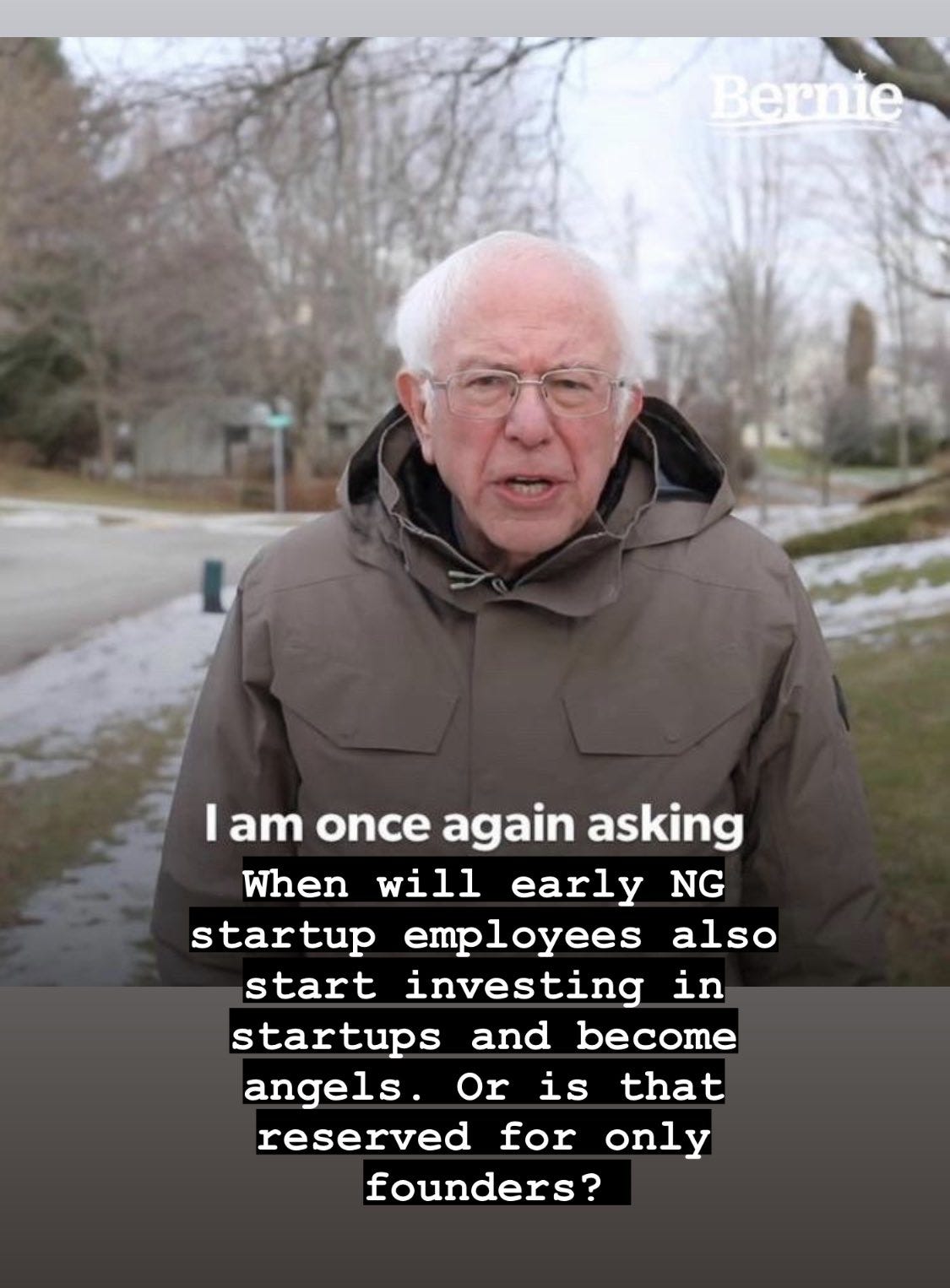
One of the local investors in Terra was Resilience 17, a fund owned by Flutterwave CEO GB Agboola. That is a founder who built a $3 billion company, generated personal wealth, and is now recycling it into the next generation of Nigerian companies. In Silicon Valley, the wealth created by early employees at Stripe, Facebook, and Google seeded thousands of angel investors and fund managers. Nigeria doesn’t yet have enough of this founder-to-funder pipeline.
Terra Industries is a genuinely exciting company for Nigeria in 2026, the same way Flutterwave and Paystack were in 2016. The fact that American defence-tech VCs funded them is great for Terra and great for Nigeria. The fact that founders are now recycling wealth into the next generation is even better.
So the next time you want to dunk on Nigerian VCs — don’t worry, I will probably be the one doing it.
But before you do, ask yourself: would you have let your 50-year-old mum or dad invest ₦100 million in Flutterwave or Paystack back in 2016, when Interswitch already existed? Or in TeamApt, when Bluechip, Telnet, and Chams already existed?
Somebody’s parent did. And that bet built the ecosystem you’re tweeting from.
See you on Sunday!

Thanks so much for sharing this perspective. Can be hard to see when you're deep in the trenches of fundraising (both as GPs and founders). Ultimately, we do need to bridge that later stage 'local' LP funding gap which will help us get a lot more realistic valuations that generate more paths to good exits and creates more founder-to-funder folks like Ayo at Velocity.
Best thing I've read this week.