


Last week, I wrote about MTN’s newest try at video streaming and shortly after publishing, a conversation with Adedeji Olowe sent me down a rabbit hole and led to today’s newsletter. Let me know what you think in the comments!
TOGETHER WITH CREDIT DIRECT
If it’s growth for you and your loved ones, choose Yield.
There’s a perfect plan for everyone and every situation.

Nollywood’s abundance problem
In March 2025, a smooth-talking, free-spending businessman hires a dance troupe to get a woman’s attention and, for the rest of the movie’s runtime, spends the budget of a small Nigerian state on her until they live happily ever after.
The film was Love in Every Word, Omoni Oboli’s romantic drama about the enduring Nollywood belief that there’s no romance without finance. Oboli bypassed the cinema (the destination of choice for Nollywood’s royalty) and the streamers, taking the film straight to YouTube.
Within twenty-four hours, it had crossed a million views. It ended the year with more than thirty million views and a top-five place in Google’s Year in Search, while “Achalugo” became the most-searched word in Nigeria.
Tens of millions will watch a Nigerian film the week it drops, so we know there’s no demand problem. What they will not do is pay a subscription to watch it. So, who pays for these films?
At the end of the Love in Every Word sequel, the credits list UBA, Coca-Cola, Vaseline, Close-Up, GIG Logistics, and MTN. Those were Oboli’s customers. The thirty million viewers were the inventory she sold to her customers.
The popularity of Nollywood films on YouTube is prompting questions on the future of paid video streaming in Africa. In a country where people love films, why can’t paid streamers find a critical mass to pay subscription fees?
The accepted answer is that Nigerians are too poor. It is the one Jason Njoku reached for after a decade of IrokoTV and a hundred million dollars, and it is partly true. He has long doubted whether Nigeria has 250,000 people who can consistently afford a five-dollar-a-month product.
But poverty cannot explain why these same viewers are buying data and watching two-hour-long shows by the millions. What the public is rejecting are subscriptions, not Nollywood.
Consider that the audience is willing to pay for live football. If Arsenal play Liverpool at 5:30, there is no substitute. The match happens once, and you either watch it or miss it.
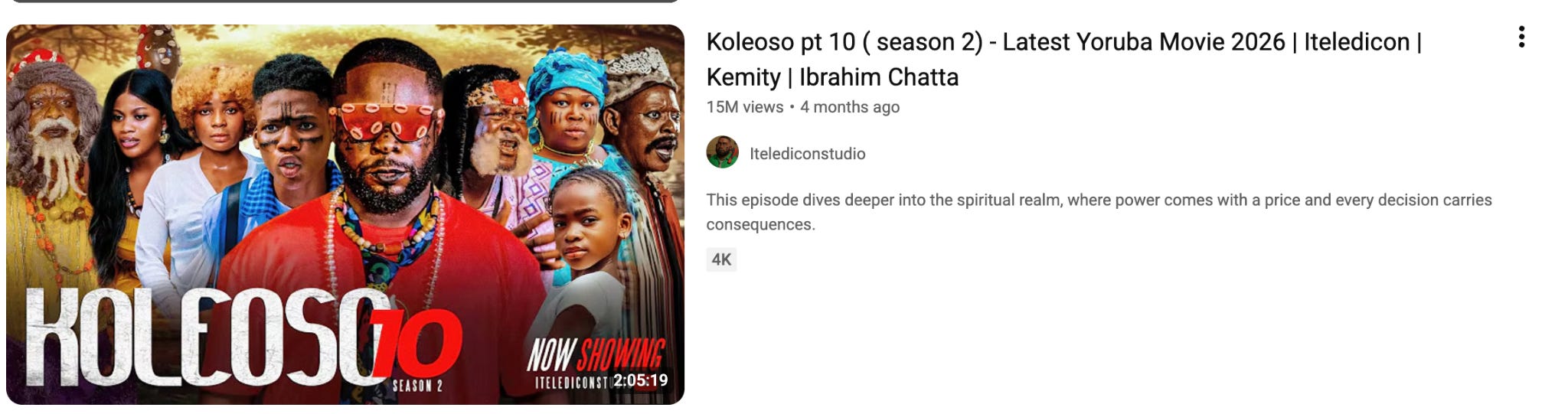
Nigerian movies aren’t like that. While Hollywood will spend millions of dollars on crafting specific titles and building franchises, the predominant Nollywood method is volume. Nigeria produces well over 1,000 films annually, with skitmakers and YouTube film producers adding to this abundance. Only a handful of filmmakers have the time and resources to build recognisable title franchises.
A subscription business assumes that a library creates power, but a library’s power comes when the audience believes the library contains something scarce. If what you have is a large collection of highly substitutable stories, your catalogue can become nice to have, but not worth throwing scarce disposable income at every month.
This is also why piracy is not merely a legal problem in Nollywood. Piracy shows that the audience wants the content, but not badly enough to accept the platform’s preferred terms. It tells you that the demand is elastic. The viewer is not saying, “I do not want this.” He is saying, “I do not want it like that.”
Does this abundance problem predate YouTube?
One interesting roundabout answer is that IrokoTV began on YouTube. Before the subscription app, Jason Njoku and Bastian Gotter launched “Nollywood Love” on YouTube. Njoku would later fly to Lagos, buy online rights from producers, and strike a deal with YouTube, to put Nollywood films online for free. These full films, which were fully licensed, were free to watch in 2011. This shows the YouTube model is not new to Nollywood.
Iroko’s YouTube network generated hundreds of millions of views, proving that the audience was there. It was time to turn all that watching into enough money to build the kind of company investors had funded.
It built an app and charged subscriptions. The pitch would have been that this was a home for Nigerian films, organised for an audience that had previously been scattered across DVD sellers, pirate sites, YouTube channels and memory cards.
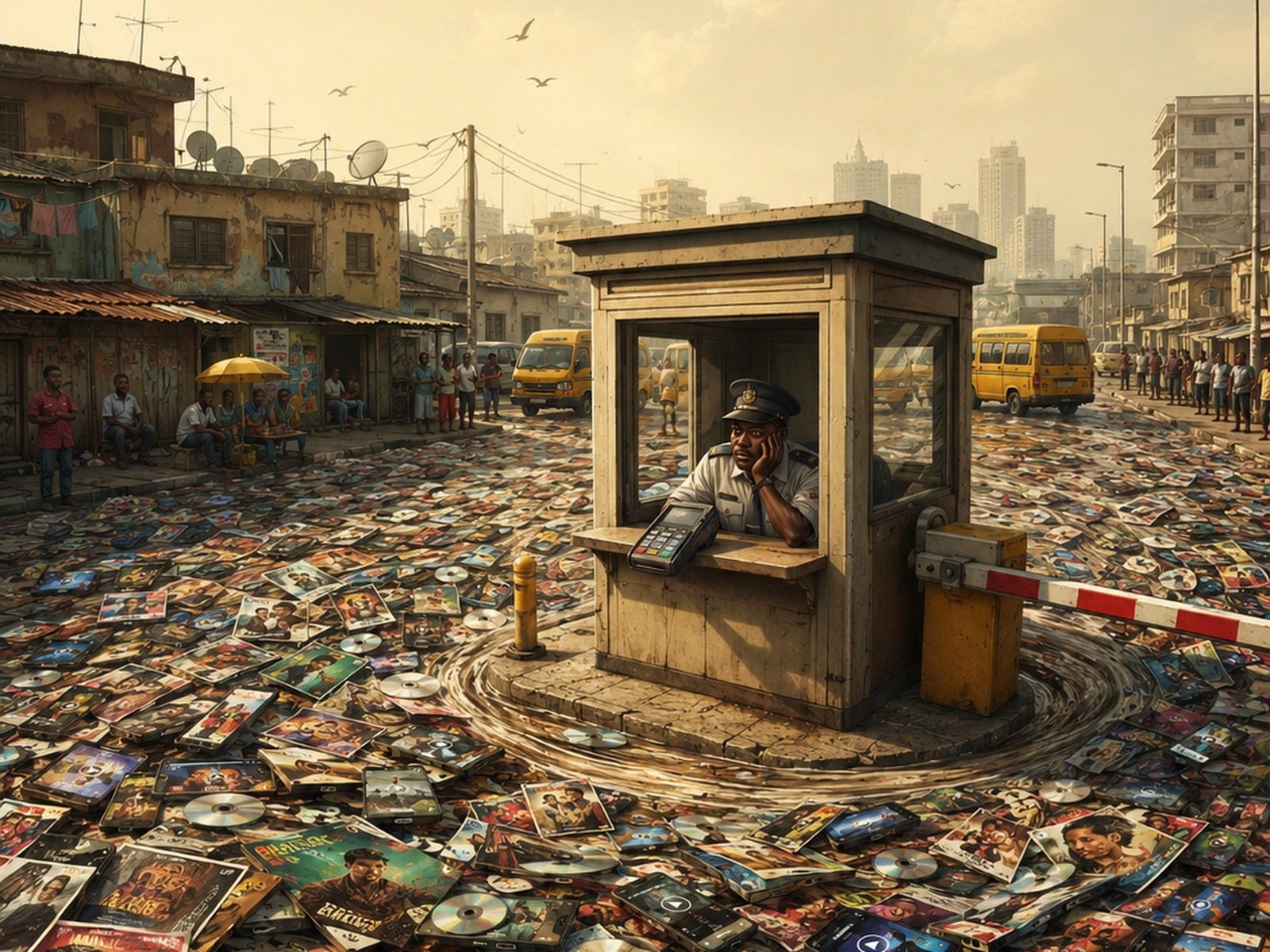
However, Nollywood’s natural state has always been overflow. DVDs, VCDs, Alaba marketers, Africa Magic reruns, roadside sellers, pirated discs, hard-drive transfers, Bluetooth, memory cards, illegal uploads and that one neighbour whose laptop is somehow always full of films.
The domestic Nigerian viewer had to choose between IrokoTV and a messy, informal distribution system that had already taught him that Nollywood was replaceable and cheap.
The diaspora audience was different. A Nigerian in London in 2011 had a scarcity problem, and if she wanted Nollywood, she needed someone travelling from Nigeria with discs, a pirate website, or a service that organised the chaos. Iroko solved that problem well.
A Nigerian in Lagos did not lack Nollywood. He lacked convenience, quality, payment simplicity and sometimes legality. Those are real problems, but they are not the same as scarcity. You can charge more easily for scarcity than for tidiness.
Nollywood was already producing at industrial speed when Iroko arrived. The stories were already formulaic, and substitution was already high.
In 2011, free video could work for a special aggregator with a licensed back-catalogue, a YouTube deal and a global audience. It could not yet work for everyone because the ad market was too thin and brand integration had not matured. Mobile video had not become an everyday Nigerian habit, so a producer could not reliably say: I will give this two-hour film away, collect tens of millions of views, and make the money back from brands.
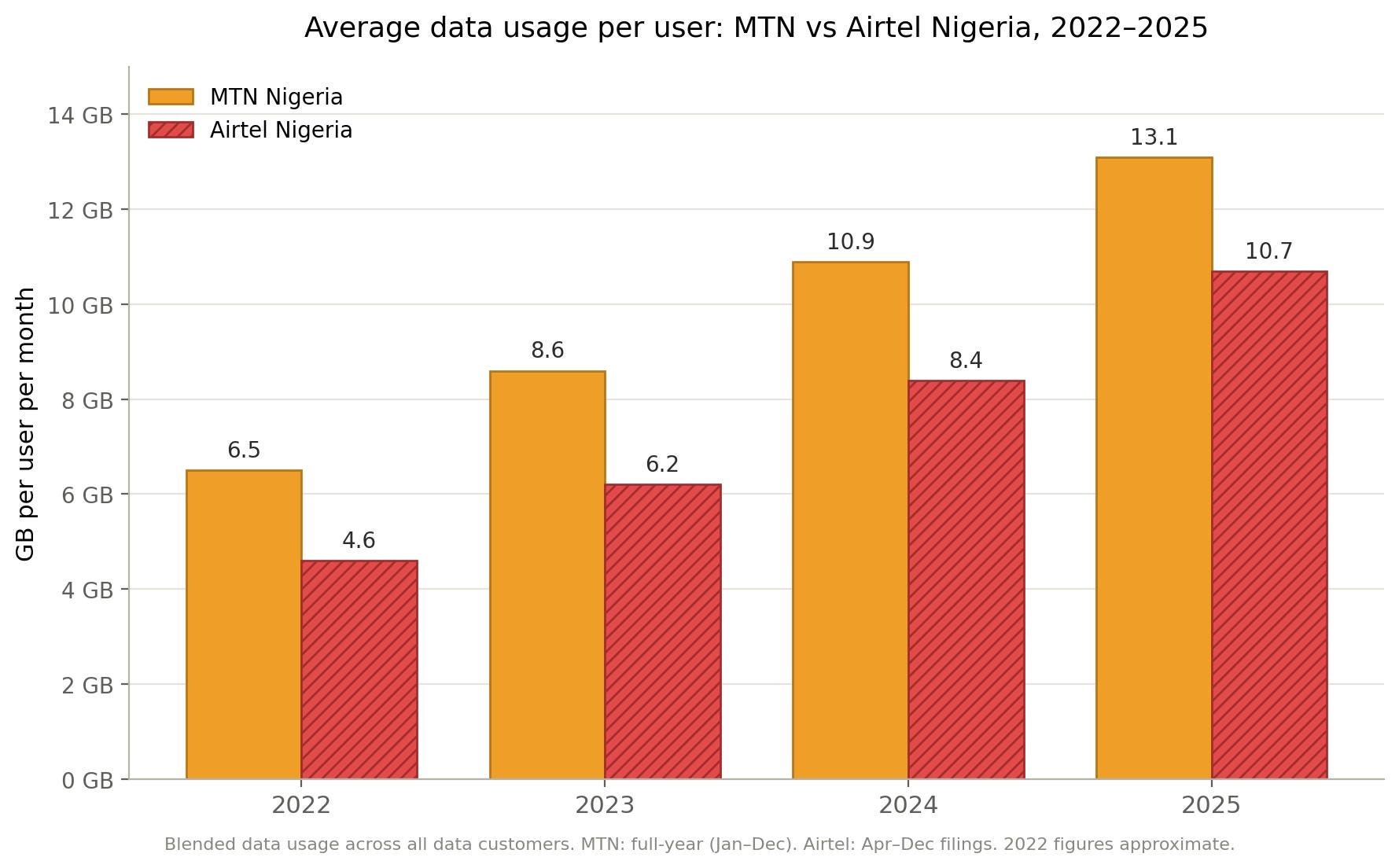
By 2025, data got cheaper, and smartphones became more accessible. The audience grew comfortable watching long Nigerian videos on phones, and brands learned that creator-led video was not a novelty. Then, skitmakers also joined the party.
Mark Angel led the way, opening the gates to a broader wave of creators like Broda Shaggi, Taaooma, Mr Macaroni, Sabinus, Kiekie, Sydney Talker, among others. The model was taking shape by giving the audience the video for free and selling the audience to advertisers.
The skitmakers showed that production could be funded without a subscription. They showed that brands would pay to sit inside culture and that an audience that refused to subscribe could still be valuable.
Omoni Oboli and other filmmakers are basically running the same model for feature-length films. Give the audience the film for free and let social media create virality with memes and short clips. The last leg is allowing brands buy proximity to the attention.
Nigeria’s music industry confronted and arguably solved a similar problem years ago. Used to downloading music from bootleg websites, Nigerians will not pay for recorded music any more than they will pay for film.
Music streaming services also struggle to find paying subscribers, so the freemium model of apps like Audiomack, Boomplay, and YouTube, which is supported by ads, has become the solution.
Artists make their money from shows, endorsements and image rights, but streaming income for musicians with mostly Nigerian listeners is notoriously paltry.
There have been some useful but brief periods of profitability. In 2008, MTN launched caller tunes for fifty naira per song, billed from a customer’s airtime, and it became the largest distributor of Nigerian music in the country.
The recording was everywhere and was worth nothing, so the money came from selling the audience a novelty through a telco. When Callertunes lost its allure, music found more ways out of the trap than film has, because it kept things that a copy cannot reproduce.
A Nollywood plot is replaceable; rich-man-poor-girl arrives in twenty versions before dinner. The star is scarce by identity, the concert is scarce the way the Arsenal match is, and the fan who streams from London pays in pounds.
Music sells three scarce things. Film, so far, sells one: a brand’s proximity to attention. That is why a touring musician out-earns a filmmaker with thirty million views while both give the recording away. Nollywood has solved distribution but it has not yet found its stage.
See you on Sunday!
This is a great article.
At the core, it all boils down to poverty. Even with the music stars, it is still relatively chicken change revenue from Nigerian concert goers and paid streaming subscribers in Nigeria. Tour abroad and get brand endorsement deals or remain broke.
Everything about creating and selling non-tangible non-essential products in Nigeria is battling with a majority poor populace. Until that changes, NGMI (well, unless you - whether filmmaker or musician - sell to the west primarily)
I wrote about this, and the junkyard that is my beloved Nollywood here
https://ifeoma-chukwuogo.medium.com/did-you-know-the-journal-blog/nollywood-junkyard-66b9a178003f
I would like to add that there is a pattern of Nollywood deliberately suppressing any rising stars, because stars have bargaining power, and leverage. Case in point, the Nollywood 2005 ‘G8’ ban.
Without stars, they effectively self-neuter one of their most important scarcity funnels.