


If you missed Wednesday’s unscheduled Notadeepdive, catch up here.
TOGETHER WITH CREDIT DIRECT

When scale is the goal, Credit Direct Business is your partner.
Get funding, grow business funds and make bulk payments on one platform.
Lending is easy
On Notadeepdive, I frequently say that lending is easy. Once you find a source of funding (preferably customer deposits), a few hundred people will be milling around your app, trying to get a loan before the end of the day. While the Nigerian saying is that garri doesn’t need advertising, I think the more accurate version is that personal loans don’t need ads.
Unsecured personal loans, a.k.a. loans without collateral, are popular for fairly obvious reasons. You could be one week from payday and desperately need money. Or you could be trying to complete the money for an unexpected purchase, like replacing the phone someone stole from you at the bus stop.
According to CRC Credit Bureau’s 2025 report, the average Nigerian consumer loan is about ₦136,000 ($89). The average individual American loan account carried a balance of $8,437.
Anyway, lending is easy, but you only stay in business when you can get the money back.
American lenders can consider a borrower’s income, existing debts, credit score, years of information about mortgages, credit cards, car loans, and missed payments. Even then, a loan is an educated guess about what the borrower will do next, and a wrong guess is expensive. In America, the borrower’s incentive to repay is tied to their credit score.
In Nigeria, a Bank Verification Number can confirm a borrower’s identity, and bank statements can show cash flow or salary. But neither reveals the borrower’s existing debts or their willingness to repay an unsecured loan.
And while Nigeria has three credit bureaus, their records are not always identical, so lenders often need to check at least two to get a fuller picture. Many digital lenders also do not consistently report their loans, so “smart” borrowers can owe several lenders while each one sees only part of the problem.
OPay’s $121 million school fees
OPay’s headline numbers have made the rounds in the past week, and I’ve been dying to see its consolidated financial statements. The numbers floating around are not as impactful without seeing the full picture. Thankfully, that bit of mischief has now been managed.
OPay sharply increased loan disbursements between 2024 and 2025, with $938.3 million in new loans in 2025. Unless you have some magic formula that no one else in lending has, that kind of growth will come with loan defaults.
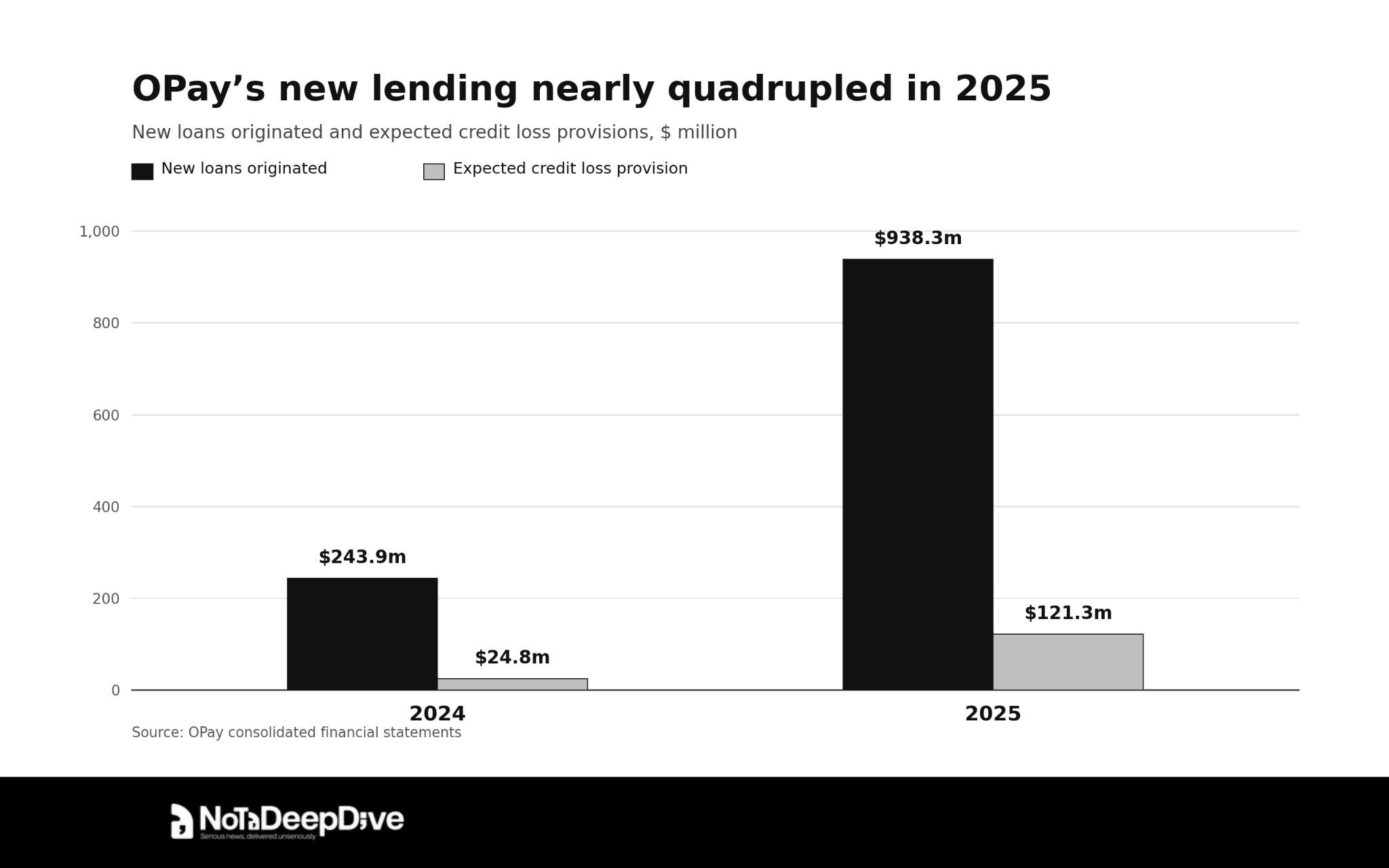
While OPay’s revenue more than doubled in 2025, its provision for expected credit losses nearly quintupled. For every dollar of revenue, OPay booked roughly 23 cents in expected credit losses, up from 12 cents the previous year.
Even with millions of active customers and visibility over their spending patterns, OPay is simply offering customers small loans and watching what happens. They then adjust the next offer based on borrower behaviour.
It’s hard to blame them because transaction data says little to nothing about willingness to repay. It also doesn’t tell you if a borrower is repaying just so they can look reliable until the limit increases to an amount that is substantial enough for them to risk “running away with.”
OPay still made $72.5 million in profit in 2025 (look away now, Jumia), which gives it room, for now, to absorb the defaults that come with growing its lending business this quickly.
In a Notadeepdive edition from last October, I described FairMoney’s success in similar terms. It burnt cash learning who would repay, then lowered its cost of funds until the maths worked.
In 2024, FairMoney generated ₦121.9 billion in revenue and made ₦7.9 billion in profit. It also recorded ₦59.4 billion in impairments on loans and other assets.
FairMoney charged enough interest to absorb those impairments, learnt from millions of loan applications, and eventually funded more of its lending with customer deposits instead of expensive investor capital and debt.
There is no version of mass-market unsecured lending where everyone pays because underwriting is a series of guesses. The lender records which ones were wrong and prices the next batch so that the good loans pay for the bad ones.
OPay’s $121.3 million provision is part of the cost of learning which borrowers will repay. It originated almost $1 billion in new loans, made room for a large number of bad ones, and still made $72.5 million.
That is a lot of school fees, but OPay can afford them.
See you on Sunday!
Insightful read that has made me curious about the economics of loan financing. Thanks for this!
Lovely piece. Jumia 🤣🤣🤣
Side note: I noticed that you reported Fairmoney's numbers in NGN and OPAY's in USD.