


If you missed last week’s Notadeepdive, catch up here and here. Subscribe for free if this email was forwarded to you:
TOGETHER WITH CREDIT DIRECT

The app that has it all.
Enjoy unlimited free transfers and grow your funds at 10% p.a. on the Credit Direct App.
Fourfold
It was written in the stars that when Nigeria finally got around to taxing crypto, it wouldn’t be able to resist a touch of greed.
Nigeria has never particularly liked crypto. In 2021, the Central Bank ordered banks to stop facilitating crypto transactions and close accounts linked to them.
The restrictions were partly relaxed in December 2023, and while Banks could now open accounts for licensed crypto businesses, they still could not hold or trade crypto.
Two months later, as the naira sank to new lows after a free float, the government detained two Binance executives who had travelled to Nigeria for meetings, and brought tax-evasion and money-laundering cases against the company. Binance, the claim said, had contributed to currency problems by providing a market where the naira could be traded while dollars were scarce.
But the relationship has since warmed. On July 31, Nigeria’s love story with crypto extended to guidelines for taxing virtual assets.
The new guidelines are so grabby, it would make Zaccheus, the biblical taxman (and the namesake of Nigeria’s current tax chief), blush.
Per the guidelines, if you sell Bitcoin for naira on a Nigerian exchange, that transaction can produce four tax claims.
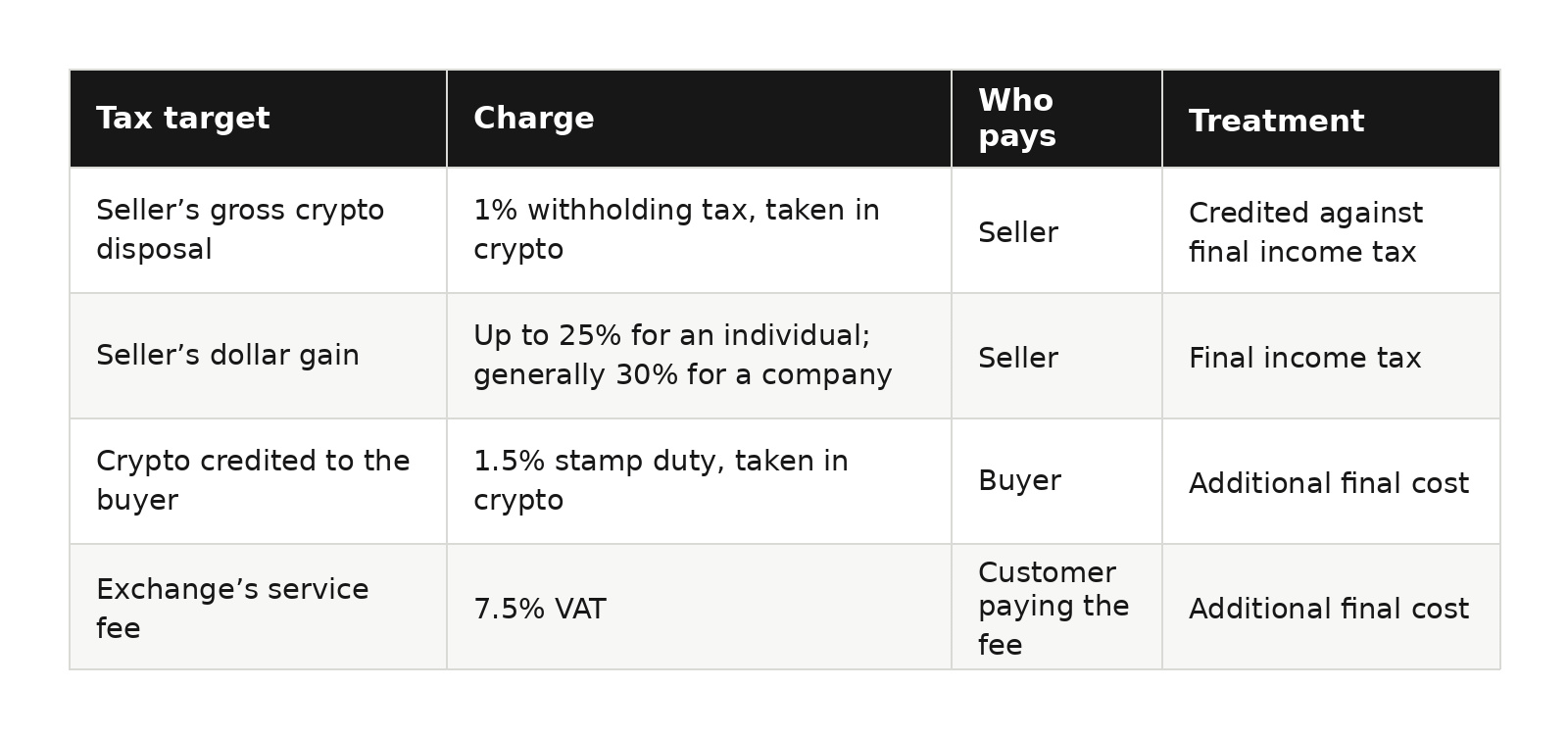
The guidelines go further. In one example, someone buys two Ether for $3,000 and later swaps them for 0.1 Bitcoin when the Ether are worth $4,000.
The NRS treats the Ether as sold for $4,000, producing a $1,000 gain, even though the person owned crypto before the trade and crypto afterwards. That gain is converted to naira at the official exchange rate and taxed. The Bitcoin is treated as having cost $4,000, which becomes the starting point for calculating the next gain.

The exchange must also withhold 1% of the two Ether being disposed of, or 0.02 ETH, and send it to an NRS-controlled wallet. At the prices in the example, the government receives $40 worth immediately and will still collect VAT from the exchange’s fee. The only mercy is that the 1.5% stamp duty does not apply because no fiat currency (naira) is in the trade.
With the withholding tax, two Ether for 0.1 Bitcoin is really 2.02 Ether for 0.1 Bitcoin: two Ether for the swap and 0.02 ETH for the NRS. The guidelines do not say whether that 0.02 ETH comes on top of the trade or out of the two Ether being exchanged.
The NRS has effectively made crypto exchanges tax collectors, requiring them to deduct taxes from users’ trades and send the money to the government.
It’s unclear whether that’s the intention, but the guidelines incentivise users to avoid exchanges altogether. A peer-to-peer trade can happen outside the NRS’s view, and anyone deliberately sidestepping an exchange is unlikely to declare that trade in their tax filing.
Nigeria’s 2021 banking restrictions already pushed crypto trading towards P2P markets. The new rules may push even more activity there.
Everyone and their daddy now uses stablecoins for cross-border payments. An importer converts naira into USDT and pays a supplier in China. Businesses do not necessarily care about crypto, but they care that stablecoins provide something resembling dollar access and speed.
Under the guidelines, a Nigerian business that converts naira into stablecoins to make a cross-border payment will pay 1.5% stamp duty on the conversion. The intermediary must deduct the 1.5% stamp duty from the stablecoins before sending the balance overseas.
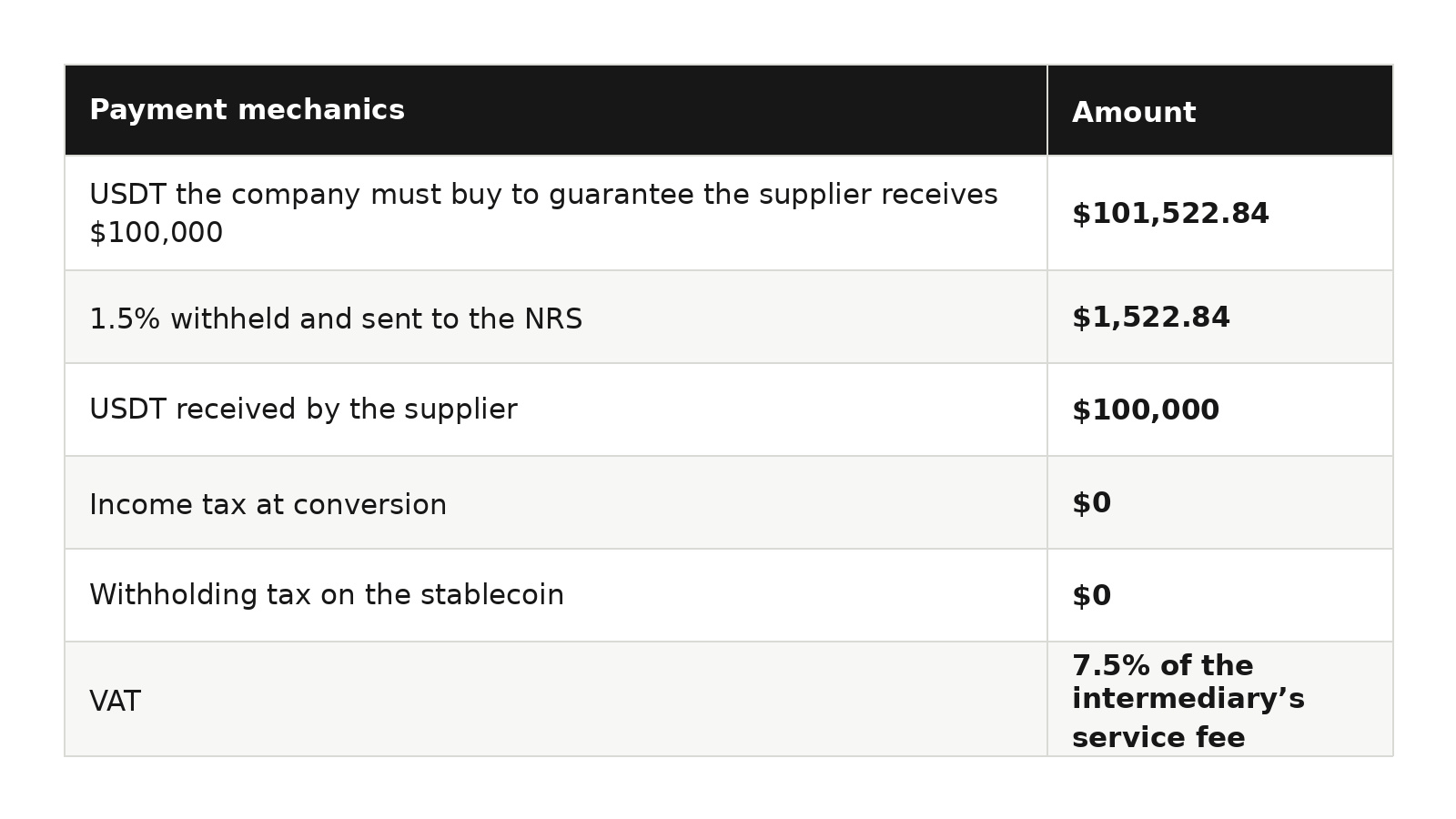
A company expecting to make $5,000 of gross profit from a $100,000 shipment would surrender roughly $1,523 while paying the supplier. That is more than 30% of its expected gross profit before shipping, customs, storage, salaries, and the small matter of selling the goods. It can absorb the cost, persuade the supplier to accept less, or pass it to Nigerian customers.
A company moving $100,000 every month would pay roughly $18,274 a year in stamp duty alone, before exchange spreads, platform fees, and VAT on those fees.
The biblical Zacchaeus promised to repay fourfold anyone he had cheated after meeting Jesus. These guidelines have yet to find theirs.
See you on Sunday!